On this page
Eight original JEE Main-style questions, easy to hard, each with a worked solution and a trap line: the most tempting wrong option. Q5 is a numerical-value question.
How should you use this periodicity practice set?
Unit 9 of the NTA Syllabus for JEE (Main) - 2027 covers the periodic table, the s, p, d and f blocks, and trends in radii, ionisation enthalpy, electron gain enthalpy, valence and reactivity.
Data come from Unit 3 of NCERT Class 11 Chemistry (reprint 2026-27) and NIST ionisation energies, converted to kJ/mol.
Give yourself 20 minutes, on paper, no periodic table.
Before answering, write the electron count and nuclear charge of every species.
New to the chapter? Start with how to prepare periodic trends for JEE Main.
Easy: can you place an element and size an ion?
Q1 (easy). Phosphorus has Z = 15. Which atomic number belongs to an element in the same group as phosphorus?
(A) 23
(B) 33
(C) 31
(D) 25
Answer: (B). P is [Ne]3s²3p³, group 15. Period 3 holds 8 elements, but period 4 holds 18 (the 3d series fills inside it), so the next group-15 element is 15 + 18 = 33. Trap: (A), from adding 8 as you would from nitrogen to phosphorus; Z = 23 is vanadium, group 5.
Q2 (easy). The element with Z = 34 belongs to:
(A) Period 4, group 16, p-block
(B) Period 4, group 6, d-block
(C) Period 3, group 16, p-block
(D) Period 4, group 14, p-block
Answer: (A). The configuration is [Ar]3d¹⁰4s²4p⁴. The highest shell is n = 4, the last electron enters 4p, and a p-block group number is 10 plus the valence electrons: 10 + 6 = 16. Trap: (B), from counting six valence electrons and stopping there.
Q3 (easy). Which order of size is correct?
(A) Na > F⁻ > Na⁺ > F
(B) F⁻ > Na > F > Na⁺
(C) Na > Na⁺ > F⁻ > F
(D) F⁻ > Na⁺ > Na > F
Answer: (A). NCERT Unit 3 gives Na 186, F⁻ 136, Na⁺ 95 and F 64 pm. Na⁺ loses sodium's whole third shell; F⁻ gains repulsion in fluorine's n = 2 shell. Both ions have 10 electrons, and 11 protons make Na⁺ the smaller. Trap: (C), from assuming a sodium species beats any fluorine species.
Medium: can you read the numbers behind the trends?
Q4 (medium). A period-3 element X has successive ionisation enthalpies of 787, 1577, 3232, 4356 and 16091 kJ/mol. The formula of its normal chloride is:
(A) XCl
(B) XCl₂
(C) XCl₃
(D) XCl₄
Answer: (D). The step ratios are 2.0, 2.0, 1.3 and 3.7. Only the fifth value jumps sharply, so four electrons are valence electrons: group 14, chloride XCl₄. (The data are silicon's, from NIST.) Trap: (B), from reading the doubling from the second to the third value as the jump into the core.
Q5 (medium, numerical). Using ΔiH₁ = 738 and ΔiH₂ = 1451 kJ/mol for magnesium (NIST, rounded) and a molar mass of 24 g/mol, how much energy, in kJ to the nearest integer, converts 2.4 g of gaseous Mg atoms into gaseous Mg²⁺ ions?
Answer: 219. 2.4 g is 0.10 mol. Two electrons per atom: 0.10 × (738 + 1451) = 218.9 kJ, which rounds to 219. Trap: 74 or 145, from using only one of the two enthalpies.
Q6 (medium). The correct increasing order of first ionisation enthalpy is:
(A) Mg < Al < Si < P < S
(B) Al < Mg < Si < S < P
(C) Al < Mg < Si < P < S
(D) Mg < Al < Si < S < P
Answer: (B). NIST values in kJ/mol: Al 578, Mg 738, Si 787, S 1000, P 1012. Al loses a 3p electron shielded by 3s², and S a paired 3p electron, so each dips below its left neighbour. Trap: (A), the smooth left-to-right rise that ignores both dips.
Hard: can you handle several trends at once?
Q7 (hard). Consider these statements:
I. Neon has a positive electron gain enthalpy.
II. Mg²⁺ has a larger radius than Na⁺.
III. An element's Pauling electronegativity is the same in all its compounds.
IV. CO is an amphoteric oxide.
V. Sodium has a higher second ionisation enthalpy than magnesium.
The correct statements are:
(A) I and V only
(B) I, II and V only
(C) I, IV and V only
(D) III and V only
Answer: (A). I is true: NCERT Table 3.7 gives Ne +116 kJ/mol: the electron must enter a new shell. II is false: with 10 electrons each, Mg²⁺ has the higher nuclear charge and is smaller. III is false: NCERT says electronegativity varies with the bonded partner. IV is false: NCERT lists CO as neutral. V is true: Na⁺ already has the neon core, while Mg⁺ still has a 3s electron (NIST: Na 4562, Mg 1451). Trap: (C), from treating every oxide in the middle of a period as amphoteric.
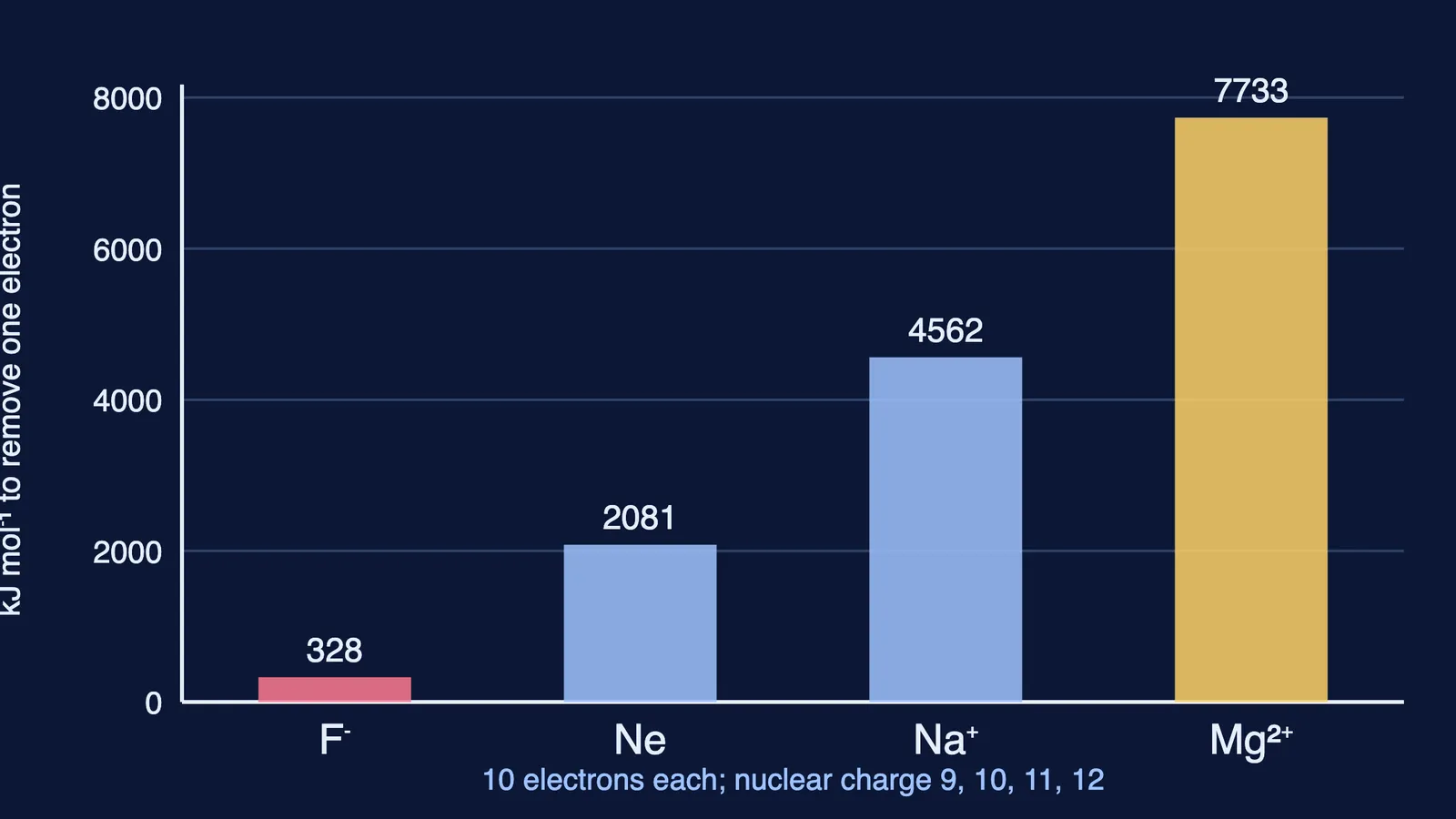
Q8 (hard). Rank F⁻, Ne, Na⁺ and Mg²⁺ by the energy needed to remove one more electron from each, lowest first:
(A) Ne < F⁻ < Na⁺ < Mg²⁺
(B) F⁻ < Ne < Na⁺ < Mg²⁺
(C) Mg²⁺ < Na⁺ < Ne < F⁻
(D) F⁻ < Na⁺ < Mg²⁺ < Ne
Answer: (B). All four have 10 electrons, so nuclear charge decides. For F⁻ it reverses fluorine's electron gain: 328 kJ/mol. NIST gives about 2081 for Ne, 4562 for Na⁺ (sodium's second ionisation) and 7733 for Mg²⁺ (magnesium's third). Trap: (D), from believing a noble gas is always hardest to ionise.
What should you do after checking your answers?
Sort every miss into one bin: position (Q1, Q2), radii and isoelectronic species (Q3, Q8), reading data (Q4, Q5, Q6) or exceptions (Q6, Q7). Practise the fullest bin this week. Revise exceptions in Classification of Elements for Class 11; electronegativity returns in chemical bonding for JEE Main.
If you keep picking the right trend but the wrong order, the Fermi Problem Library has worked problems with a step-by-step solver that explains the reasoning rather than printing an answer.
Redo your misses in two days, without the solutions.