On this page
Here are eight original NEET-style questions on haloalkanes and haloarenes, easy to hard. Each has four options with one correct, a worked solution and a trap line naming the most tempting wrong option.
How should you use this NEET practice set?
The NMC syllabus for NEET (UG)-2026 lists this chapter as Unit 16, Organic Compounds Containing Halogens, including the C–X bond, substitution mechanisms and the environmental effects of chloroform, iodoform, freons and DDT. Every fact tested here comes from Unit 6 of the NCERT Class 12 Chemistry Part II textbook (Reprint 2026-27).
Set a timer for 10 minutes and attempt all eight.
Next to each answer, write the one word that decided it: a class, a reagent, a rate law or a reason.
Then read every trap line, even where you were right.
New to the chapter? Read our guide on how to prepare organic compounds containing halogens for NEET first.
Easy: can you classify halides and recall the key facts?
Q1 (easy). 3-Chlorocyclohex-1-ene (chlorine on the ring carbon next to the C=C) is best classified as:
(A) a vinylic halide
(B) an allylic halide
(C) an aryl halide
(D) a benzylic halide
Answer: (B). Chlorine sits on an sp³ carbon next to the C=C, NCERT's definition of an allylic halide. A vinylic halide has the halogen on an sp² carbon of the double bond itself. Trap: (A), chosen because the molecule has a C=C somewhere.
Q2 (easy). A half-empty clear-glass bottle of chloroform has stood on a sunny shelf for months. What has most likely formed inside it?
(A) phosgene (carbonyl chloride), an extremely poisonous gas, from slow oxidation by air in light
(B) iodoform, formed when light rearranges chloroform
(C) methanol, formed when chloroform absorbs moisture
(D) a freon, formed when chloroform reacts with air
Answer: (A). NCERT notes that air slowly oxidises chloroform to carbonyl chloride (phosgene) in light, which is why it is kept in closed, dark-coloured bottles filled to the top. Trap: (B): iodoform contains iodine, and nothing in the bottle supplies any.
Q3 (easy). You want to turn propan-1-ol into 1-chloropropane so that every by-product leaves as a gas. Which reagent does this?
(A) PCl₅
(B) PCl₃
(C) concentrated HCl with anhydrous ZnCl₂
(D) SOCl₂
Answer: (D). R–OH + SOCl₂ gives R–Cl + SO₂ + HCl; both by-products are gases that escape, which is why NCERT prefers thionyl chloride. PCl₅ leaves liquid POCl₃, PCl₃ leaves H₃PO₃, and the HCl route leaves water. Trap: (A): it does release HCl gas, but POCl₃ stays behind as a liquid.
Medium: can you predict rates and products?
Q4 (medium). Which of these isomers of C₄H₉Cl has the lowest boiling point?
(A) 1-chlorobutane
(B) 2-chlorobutane
(C) 1-chloro-2-methylpropane
(D) 2-chloro-2-methylpropane
Answer: (D). All four have the same molar mass, so shape decides. NCERT states that boiling points of isomeric haloalkanes fall as branching increases; the tertiary isomer is the most branched. Trap: (A), the straight chain, which actually boils highest of the four.
Q5 (medium). CH₃Cl reacts with OH⁻ by the SN2 mechanism. If [CH₃Cl] is halved and [OH⁻] is tripled at the same temperature, the rate becomes:
(A) 0.5 times
(B) 1.5 times
(C) 3 times
(D) 6 times
Answer: (B). NCERT describes this reaction as second order: the rate depends on the concentrations of both reactants, so rate = k[CH₃Cl][OH⁻]. The new rate is ½ × 3 = 1.5 times the old one. Trap: (A), which treats it as SN1, where only the halide concentration counts.
Q6 (medium). Chlorobenzene and chloromethane are treated together with sodium in dry ether. The alkylarene formed is:
(A) biphenyl
(B) ethane
(C) toluene
(D) ethylbenzene
Answer: (C). An alkyl halide and an aryl halide with sodium in dry ether give an alkylarene (the Wurtz–Fittig reaction), here C₆H₅–CH₃, toluene. Trap: (A), the Fittig product of two aryl groups, which is not an alkylarene.
Hard: can you combine two ideas in one question?
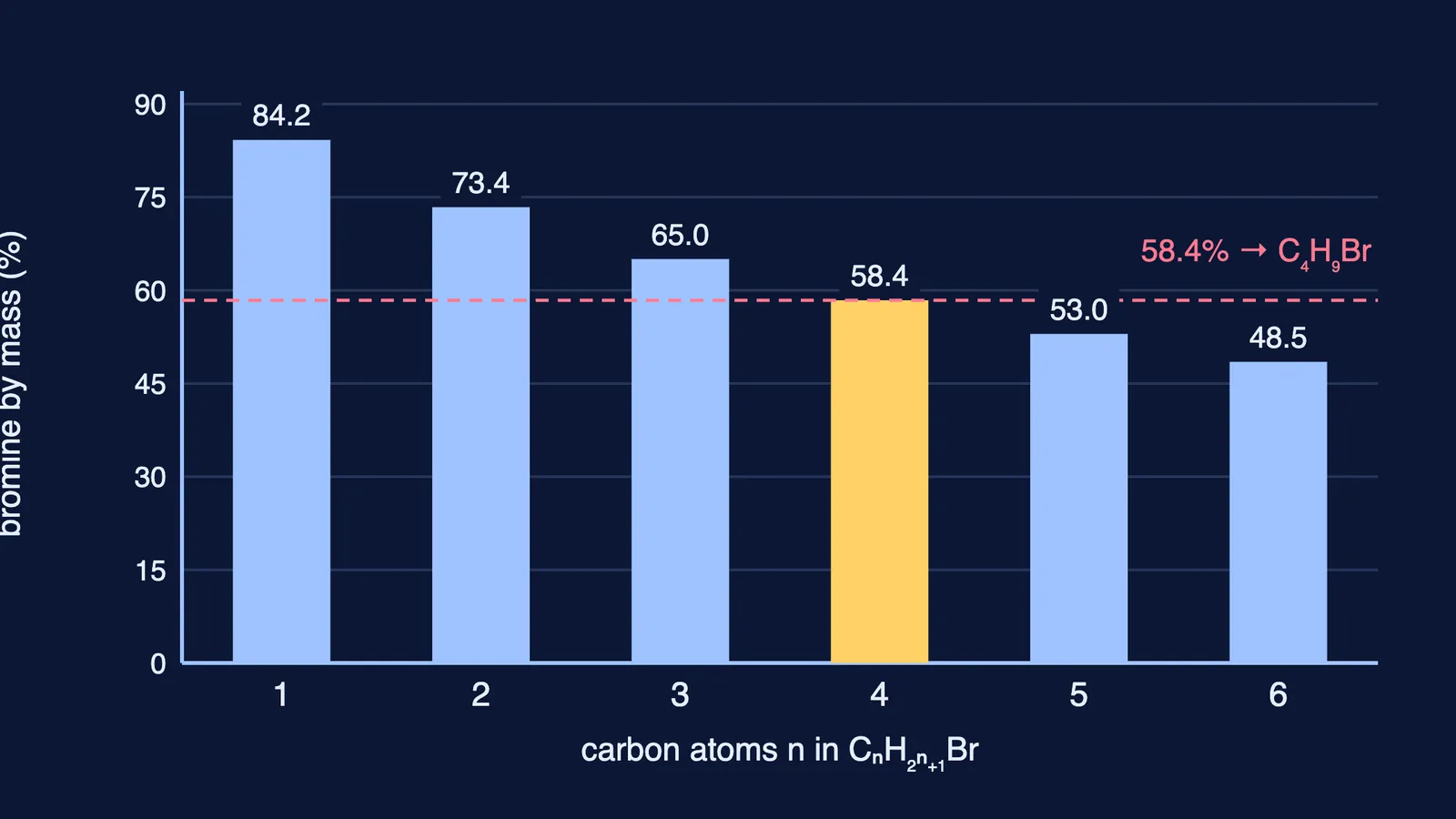
Q7 (hard). An alkyl bromide X contains 58.4% bromine by mass (C = 12, H = 1, Br = 80) and is optically active. X is:
(A) 2-bromopentane
(B) 1-bromobutane
(C) 2-bromobutane
(D) 2-bromo-2-methylpropane
Answer: (C). For CₙH₂ₙ₊₁Br, M = 14n + 81. Setting 80/M = 0.584 gives M ≈ 137, so n = 4 and X is C₄H₉Br. Of the C₄H₉Br options, only 2-bromobutane has a carbon carrying four different groups (H, Br, CH₃, C₂H₅), so only it is chiral. Trap: (B) or (D) have the right formula but no chiral carbon; (A) is chiral but its bromine content is only 53.0%.
Q8 (hard). NCERT gives several reasons why chlorobenzene resists nucleophilic substitution. Which statement is NOT one of them?
(A) Resonance gives the C–Cl bond partial double-bond character.
(B) The C–Cl carbon is sp² hybridised and holds the bonding pair more tightly.
(C) The C–Cl bond in chlorobenzene (177 pm) is longer than in a haloalkane (169 pm), so it breaks easily.
(D) A phenyl cation would not be resonance-stabilised, so SN1 is ruled out.
Answer: (C). The numbers are swapped. NCERT gives 177 pm for C–Cl in a haloalkane and 169 pm in a haloarene; the shorter bond is harder to break, which is why chlorobenzene reacts so slowly. Trap: (B), which sounds doubtful, but the more electronegative sp² carbon is one of NCERT's stated reasons.
What should you revise if you missed some?
Q1: classify halides by the carbon holding the halogen: sp³ (alkyl, allylic, benzylic) or sp² (vinylic, aryl).
Q2 and Q3: the uses and hazards of chloroform, iodoform and freons, and the reagents that turn alcohols into halides.
Q4 and Q5: boiling-point trends, and the rate laws for SN1 and SN2.
Q6 to Q8: reactions with metals, chirality, and why haloarenes behave differently from haloalkanes.
For more on why the nucleophile matters in SN2, read why iodide is a strong nucleophile in water. Many of these halides are made from alkenes and arenes, so the hydrocarbons NEET practice questions make a good next set.
For more problems like these, the Fermi Problem Library has worked problems with a step-by-step solver that explains the reasoning rather than printing an answer.