On this page
These eight original NEET-style questions climb from easy to hard. Each has one correct option, a worked solution and a trap line naming the most tempting wrong option.
How should you use this practice set?
Purification and Characterisation of Organic Compounds is Unit 13 of Chemistry in the NMC NEET (UG)-2026 syllabus. Every fact and formula below follows sections 8.8 to 8.10 of NCERT Class 11 Chemistry Unit 8 (reprint 2026-27). In NEET-UG 2026, a correct answer earned +4 and a wrong one cost 1 mark, according to the NTA information bulletin.
Set a timer for 8 minutes and work on paper.
For every estimation sum, write which atom you are tracking and its share of the weighed product before you touch the numbers.
Circle any answer you guessed.
New to the unit? Read our guide on how to prepare purification and characterisation of organic compounds for NEET first.
Easy: do you know the methods and tests?
Q1 (easy). A crude organic solid contains an impurity whose solubility is close to its own in every solvent tried. How is it best purified by crystallisation?
(A) One crystallisation from a hot solvent
(B) Repeated crystallisation
(C) Boiling the solution with activated charcoal
(D) Washing the crude solid with cold solvent
Answer: (B). NCERT says repeated crystallisation is needed when impurities have comparable solubilities. Trap: (C). Activated charcoal removes impurities that colour the solution, not ones with similar solubility.
Q2 (easy). Which pairing for the sodium fusion extract is correct?
(A) Acetic acid and lead acetate, black precipitate: sulphur
(B) Ammonium molybdate after boiling with nitric acid, violet colour: phosphorus
(C) Iron(II) sulphate then concentrated sulphuric acid, blood-red colour: nitrogen only
(D) Silver nitrate, yellowish precipitate sparingly soluble in ammonium hydroxide: chlorine
Answer: (A). Sulphide gives black lead sulphide. Phosphorus gives a yellow colour or precipitate, nitrogen alone gives Prussian blue, and a yellowish precipitate sparingly soluble in ammonia means bromine. Trap: (C). Blood red comes from thiocyanate, so it means nitrogen and sulphur together.
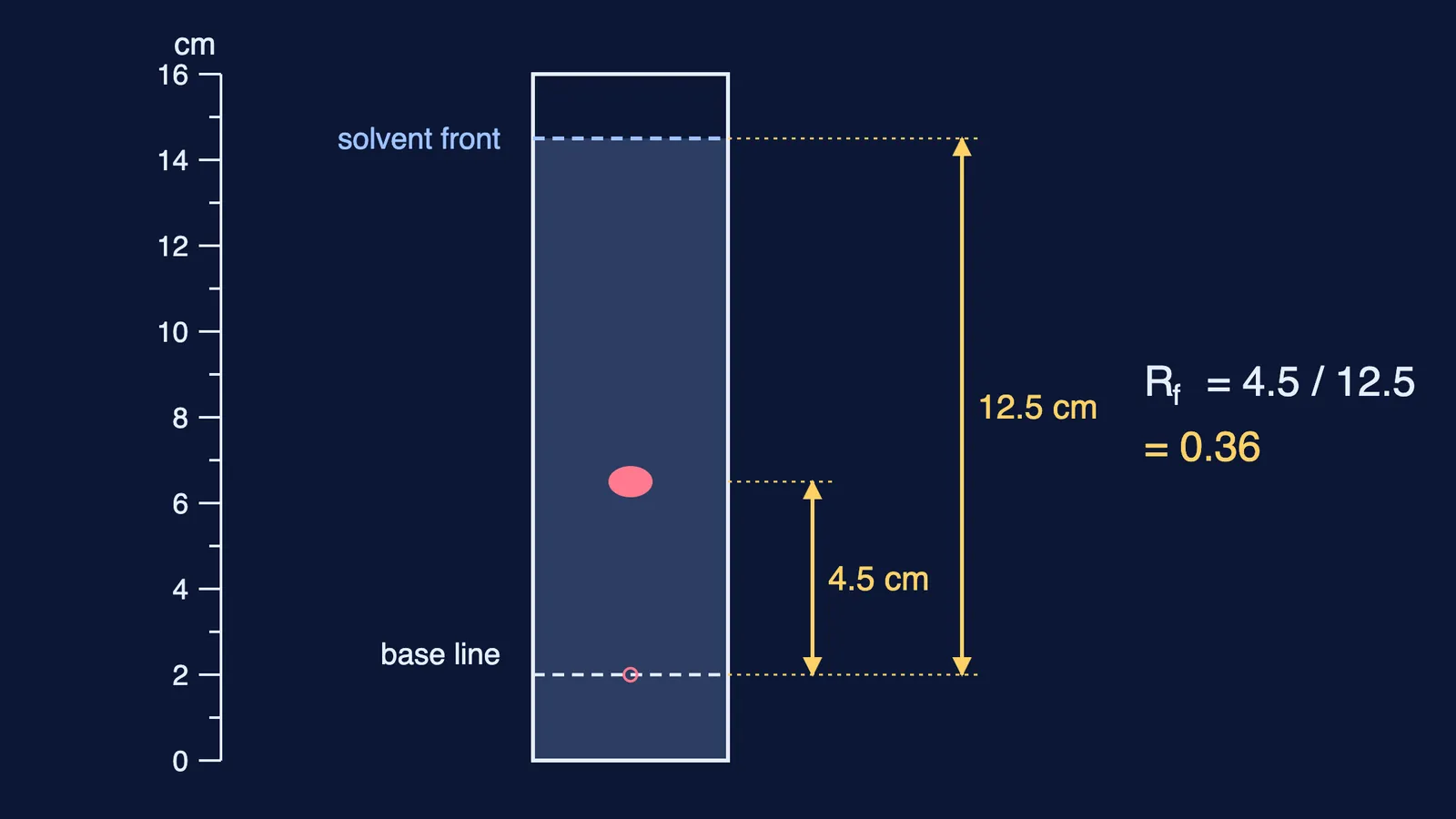
Q3 (easy). A TLC plate is spotted 2.0 cm above its lower edge. After development, the solvent front is 12.5 cm above the base line and the spot's centre is 4.5 cm above it. The Rf value is:
(A) 0.45
(B) 0.36
(C) 0.64
(D) 2.78
Answer: (B). Rf = distance moved by the substance ÷ distance moved by the solvent, both measured from the base line: 4.5 ÷ 12.5 = 0.36. Trap: (A). Measuring from the plate's edge gives 6.5 ÷ 14.5 ≈ 0.45.
Medium: can you explain why a method works?
Q4 (medium). A liquid X is steam volatile and immiscible with water. Under an outside pressure p, the steam distillation mixture of X and water boils when:
(A) the vapour pressure of X equals p
(B) the vapour pressure of water equals p
(C) the vapour pressures of X and water add up to p
(D) the vapour pressures of X and water are equal
Answer: (C). The mixture boils when p₁ + p₂ = p. So the mixture boils close to but below 373 K at atmospheric pressure; NCERT separates aniline from water this way. Trap: (B). That is water boiling on its own, at 373 K.
Q5 (medium). In a Carius estimation, 0.180 g of an organic compound gives 0.287 g of AgCl. The percentage of chlorine is (Ag = 108, Cl = 35.5):
(A) 30.1%
(B) 39.4%
(C) 52.4%
(D) 78.9%
Answer: (B). AgCl = 143.5 g mol⁻¹. Percentage of Cl = (35.5 × 0.287 × 100) ÷ (143.5 × 0.180) = 39.4%. Trap: (D). Using 71 for chlorine counts Cl₂, but one AgCl holds one chlorine atom.
Q6 (medium). Kjeldahl's method gives a correct nitrogen percentage for:
(A) Nitrobenzene
(B) Azobenzene
(C) Pyridine
(D) Acetanilide
Answer: (D). NCERT states the method does not apply to nitrogen in nitro or azo groups or in a ring, because that nitrogen does not change to ammonium sulphate. Acetanilide's amide nitrogen does. Trap: (C). Pyridine is a base like ammonia, but its ring nitrogen is not converted.
Hard: can you run a full calculation?
Q7 (hard). In a Dumas estimation, 0.280 g of a compound gives 42.0 mL of nitrogen collected over aqueous KOH at 300 K and 758 mm Hg. Aqueous tension at 300 K is 27 mm Hg. The percentage of nitrogen is closest to:
(A) 8.2%
(B) 16.4%
(C) 17.0%
(D) 18.8%
Answer: (B). Dry pressure = 758 − 27 = 731 mm. Volume at STP = (731 × 42.0 × 273) ÷ (760 × 300) = 36.76 mL. Percentage of N = (28 × 36.76 × 100) ÷ (22400 × 0.280) = 16.4%. Trap: (C). Skipping the aqueous tension uses moist-gas pressure and inflates the answer.
Q8 (hard). On complete combustion, 0.222 g of a compound of C, H and O gives 0.396 g of CO₂ and 0.162 g of H₂O. Its molar mass is 148 g mol⁻¹. The molecular formula is:
(A) C₃H₆O₂
(B) C₆H₁₂O₄
(C) C₆H₁₂O₆
(D) C₄H₈O₂
Answer: (B). C = (12 × 0.396 × 100) ÷ (44 × 0.222) = 48.65%. H = (2 × 0.162 × 100) ÷ (18 × 0.222) = 8.11%. O = 43.24% by difference. Mole ratio C : H : O = 4.05 : 8.11 : 2.70 = 3 : 6 : 2, so the empirical formula is C₃H₆O₂ (74). Since 148 ÷ 74 = 2, the molecular formula is C₆H₁₂O₄. Trap: (A). It is the empirical formula; the molar mass asks for one more step.
What should you do with your score?
7-8 right: time yourself on mixed sums from all four estimation methods.
4-6 right: redo every miss and write the trap in your own words.
0-3 right: reread NCERT 8.8 to 8.10, then retry in a week.
If the numbers in Q7 and Q8 keep slipping, the Fermi Problem Library has worked problems with a step-by-step solver that explains the reasoning rather than printing an answer.
To see how the three chromatography set-ups differ, read TLC vs column vs paper chromatography. For the story behind Q7, see the Dumas method of nitrogen estimation.