On this page
Jean-Baptiste Dumas (1800 to 1884) built two tools for finding out what compounds are made of: a way to catch the nitrogen in an organic compound as a gas and measure its volume, and a way to weigh a vapour to work out how heavy its molecules are. The first is still taught in NCERT's Class 11 chemistry textbook.
Who was Jean-Baptiste Dumas?
Dumas was born in Alès in southern France on 14 July 1800, moved to Paris in 1822, joined the French Academy of Sciences in 1832 and later served as France's minister of agriculture and commerce (Wikipedia biography of Dumas).
In 1823 he and Pierre Pelletier analysed nine alkaloids by combustion; a bookseller's description of the paper says they were the first to find the numbers of carbon, hydrogen, oxygen and nitrogen atoms in them (Lynge & Søn catalogue entry).
How does the Dumas method estimate nitrogen?
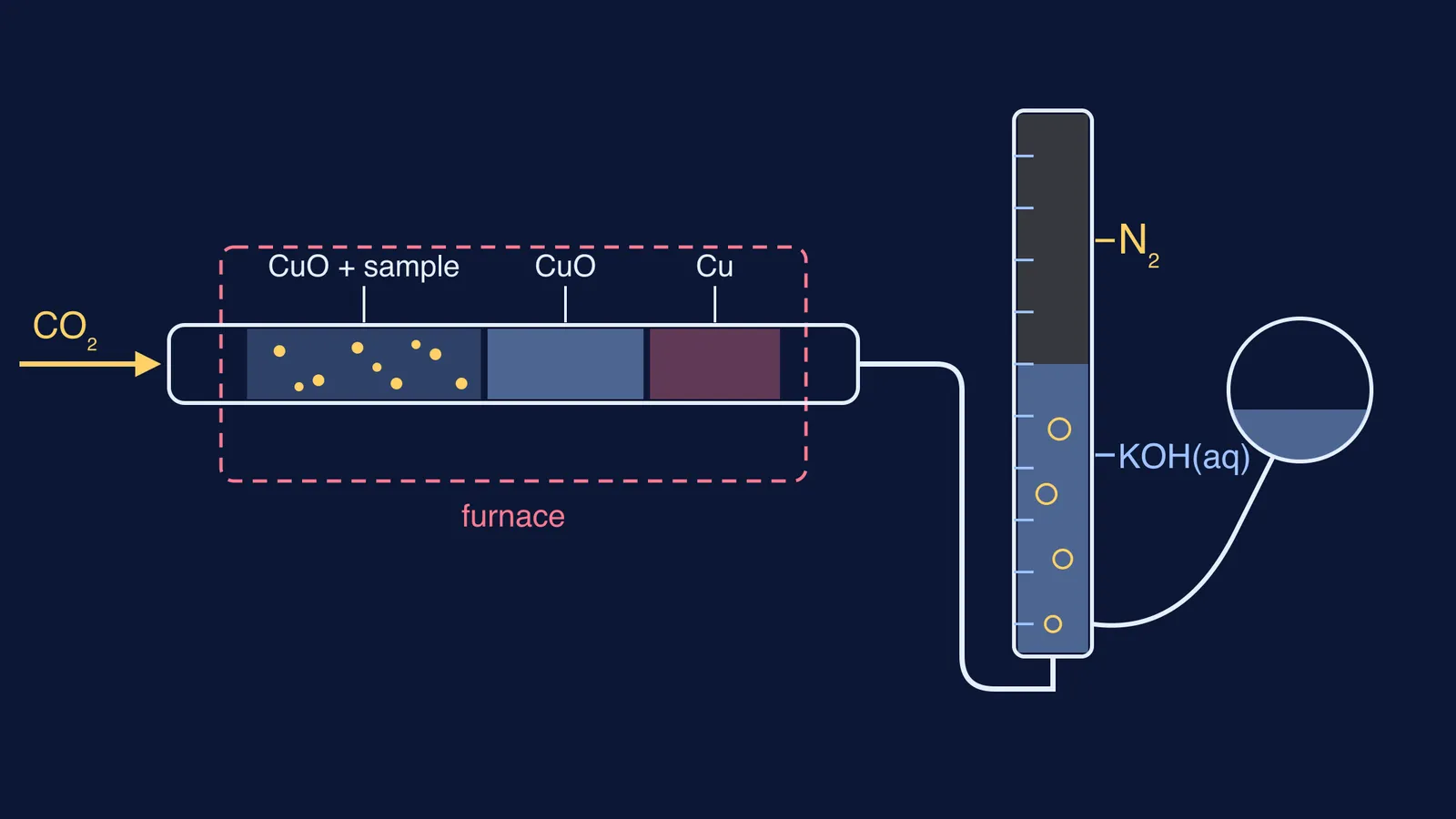
Gerhardt, a maker of nitrogen analysers, says Dumas published the combustion method that carries his name in 1831 (Gerhardt's Dumas method page); Wikipedia's biography dates it to 1833. His key changes were to flush the combustion tube with carbon dioxide and to put potassium hydroxide in the collecting trough, so the carbon dioxide dissolved and nitrogen was the only gas left to measure (Wikipedia biography of Dumas). Flushing with carbon dioxide removed the air's own nitrogen from the tube, so it was no longer counted as the sample's.
The NCERT Class 11 textbook describes the same steps in Unit 8, section 8.10.2 (NCERT, Organic Chemistry: Some Basic Principles and Techniques):
Heat a weighed sample with copper(II) oxide in an atmosphere of carbon dioxide. Carbon becomes CO2, hydrogen becomes water, and nitrogen comes off as free N2.
Pass the gases over heated copper gauze, which reduces any oxides of nitrogen back to nitrogen.
Collect the gases over potassium hydroxide solution in a graduated tube. The KOH absorbs the carbon dioxide and the nitrogen gathers at the top.
Read the volume, correct it to STP, and convert it to a mass, since 22400 mL of N2 at STP weighs 28 g.
That gives the formula in the same NCERT section: %N = 28 × V × 100 / (22400 × m), where V is the volume of nitrogen at STP in mL and m is the mass of the sample in grams.
How do you solve a Dumas method numerical?
Most of the work here is bookkeeping, not chemistry. Use the same four lines every time, all from the NCERT section above:
Correct the pressure: p1 = atmospheric pressure minus aqueous tension, because the gas is collected over a solution.
Convert to STP: V = p1 × V1 × 273 / (760 × T1), with T1 in kelvin.
Convert to mass: mass of N2 = 28 × V / 22400 g.
Divide by the sample mass and multiply by 100.
NCERT's Problem 8.21 runs exactly this: 0.3 g of a compound gives 50 mL of nitrogen at 300 K and 715 mm, the aqueous tension is 15 mm, so p1 is 700 mm, the volume at STP is 41.9 mL and the answer is 17.46% (NCERT textbook).
Here is our worked check. Urea, CO(NH2)2, has a molar mass of 60 g/mol and two nitrogen atoms, so it is 28/60 = 46.67% nitrogen. Suppose 0.15 g of urea gives 66.8 mL of nitrogen at 300 K and 715 mm, with aqueous tension 15 mm.
p1 = 715 − 15 = 700 mm
V at STP = 700 × 66.8 × 273 / (760 × 300) = 56.0 mL
Mass of N2 = 28 × 56.0 / 22400 = 0.070 g
%N = 0.070 × 100 / 0.15 = 46.7%
It matches, so the routine works. Now try the two common slips on the same data: skip the aqueous tension and you get 47.7%; use 14 in place of 28 and you get 23.3%. Neither looks absurd on its own, which is why a known compound is a useful test.
If you keep losing marks on the same step, the Fermi Problem Library has a step-by-step solver that explains the reasoning rather than printing an answer, so you can see where your working went off.
What were Dumas's vapour densities for?
In 1826 Dumas published a method for measuring vapour densities directly (Le Moyne College notes citing Dumas, Annales de Chimie et de Physique 33, 337 to 391). He put a substance into a weighed glass bulb, heated it until it turned to vapour, recorded the pressure, then let the bulb cool and weighed the vapour; the gas law then gave the amount of substance, and so the weight of its molecules (Wikipedia biography of Dumas). He later redetermined the atomic weights of about thirty elements, according to the same page.
Not every result fitted. His sulfur experiments suggested molecules of about six atoms, with scatter as the temperature changed (Le Moyne College notes).
Both methods rest on the gas laws, so if pV = nRT still feels shaky, revise it in the Fermi Concept Library before your next set of Dumas numericals.