On this page
We wrote these eight NEET-style questions for this post, graded easy to hard. Each has a worked solution and a trap: the wrong option a rushed student is most likely to mark.
Which Chemical Thermodynamics topics do these NEET questions cover?
The NEET (UG) syllabus notified by the National Medical Commission lists Chemical Thermodynamics as Unit 4 of Physical Chemistry: intensive and extensive properties, the first law, heat capacity, Hess's law, the named enthalpies, spontaneity, and ΔG° with the equilibrium constant. Every question stays inside that list and Unit 5 of NCERT Class 11 Chemistry Part I (Reprint 2026-27).
We use NCERT's ΔU = q + w (w is work done on the system) and R = 8.314 J K⁻¹ mol⁻¹. New to the chapter? Start with our guide on how to prepare Chemical Thermodynamics for NEET.
How should you use this practice set?
In NEET-UG 2026, the NTA information bulletin set 45 Chemistry questions in a 180-minute paper, with +4 for a correct answer and −1 for a wrong one.
Give yourself 9 minutes for all eight.
Write the sign you expect for q, w, ΔH or ΔG before any arithmetic.
Circle guesses; read every trap.
Easy: definitions, reference states and heat capacity
Q1 (easy). Which set contains only intensive properties?
(A) Temperature, pressure, molar heat capacity (B) Volume, mass, temperature (C) Enthalpy, density, pressure (D) Heat capacity, density, temperature
Answer: (A). NCERT lists temperature and pressure as intensive, and a molar property does not depend on the amount of matter. Trap: (D) looks right, but heat capacity is extensive; only molar heat capacity is intensive.
Q2 (easy). Which of these has a standard enthalpy of formation of zero at 298 K?
(A) C(diamond) (B) O₃(g) (C) S(rhombic) (D) S(monoclinic)
Answer: (C). ΔfH° is zero only for an element in its reference state, its most stable form at 25 °C and 1 bar; for sulphur NCERT names rhombic sulphur. Trap: (A) is pure carbon, but carbon's reference state is graphite, not diamond.
Q3 (easy). How much heat is needed to warm 45.0 g of liquid water from 22 °C to 62 °C? (Molar heat capacity of water = 75.3 J K⁻¹ mol⁻¹; M = 18.0 g mol⁻¹)
(A) 3.01 kJ (B) 7.53 kJ (C) 63.1 kJ (D) 135.5 kJ
Answer: (B). n = 45.0/18.0 = 2.50 mol, and a change of 40 °C is a change of 40 K. q = nC_mΔT = 2.50 × 75.3 × 40 = 7530 J = 7.53 kJ. Trap: (D) multiplies the molar heat capacity by grams instead of moles.
Medium: reversible work, Hess's law and enthalpy of solution
Q4 (medium). 2.0 mol of an ideal gas expands reversibly and isothermally at 350 K from 0.40 L to 40.0 L. Which set is correct?
(A) q = 0, w = −26.8 kJ, ΔU = −26.8 kJ (B) q = +26.8 kJ, w = −26.8 kJ, ΔU = 0 (C) q = +11.6 kJ, w = −11.6 kJ, ΔU = 0 (D) q = −26.8 kJ, w = +26.8 kJ, ΔU = 0
Answer: (B). For an ideal gas at constant temperature ΔU = 0. NCERT gives w = −2.303nRT log(V_f/V_i) = −2.303 × 2.0 × 8.314 × 350 × log 100 = −26.8 kJ, so q = −w = +26.8 kJ. Trap: (C) drops the 2.303, so it uses log₁₀ where ln is needed.
Q5 (medium). Using ΔfH° values (kJ mol⁻¹) H₂S(g) −20.6, SO₂(g) −296.8 and H₂O(l) −285.8, find ΔrH° for 2H₂S(g) + SO₂(g) → 3S(s) + 2H₂O(l).
(A) +31.6 kJ (B) −254.2 kJ (C) −233.6 kJ (D) +233.6 kJ
Answer: (C). Sulphur is an element in its reference state, so its ΔfH° is zero. ΔrH° = 2(−285.8) − [2(−20.6) + (−296.8)] = −571.6 + 338.0 = −233.6 kJ. Trap: (B) doubles the water but forgets the 2 in front of H₂S.
Q6 (medium). A salt MX has ΔlatticeH = +690 kJ mol⁻¹ and its ions have a combined ΔhydH = −674 kJ mol⁻¹. Which is correct?
(A) ΔsolH = +16 kJ mol⁻¹; the solution warms up (B) ΔsolH = +16 kJ mol⁻¹; the solution cools down (C) ΔsolH = −16 kJ mol⁻¹; the solution warms up (D) ΔsolH = −1364 kJ mol⁻¹; the solution warms up
Answer: (B). NCERT gives ΔsolH = ΔlatticeH + ΔhydH = 690 − 674 = +16 kJ mol⁻¹. Dissolving is endothermic, so the solution cools. Trap: (A) has the right number but reads "positive" as "releases heat".
Hard: the universe's entropy and ΔG° from K
Q7 (hard). At 300 K a reaction has ΔrH = −45.0 kJ mol⁻¹ and ΔrS(system) = −120 J K⁻¹ mol⁻¹. Which is correct?
(A) ΔStotal = −120 J K⁻¹ mol⁻¹; not spontaneous (B) ΔStotal = +30 J K⁻¹ mol⁻¹; spontaneous (C) ΔStotal = −270 J K⁻¹ mol⁻¹; not spontaneous (D) ΔStotal = +150 J K⁻¹ mol⁻¹; spontaneous
Answer: (B). The surroundings absorb the heat the reaction gives out, so ΔSsurr = −ΔrH/T = +45 000/300 = +150 J K⁻¹ mol⁻¹. ΔStotal = 150 − 120 = +30 J K⁻¹ mol⁻¹, which is positive. Trap: (A) looks only at the system's entropy and stops.
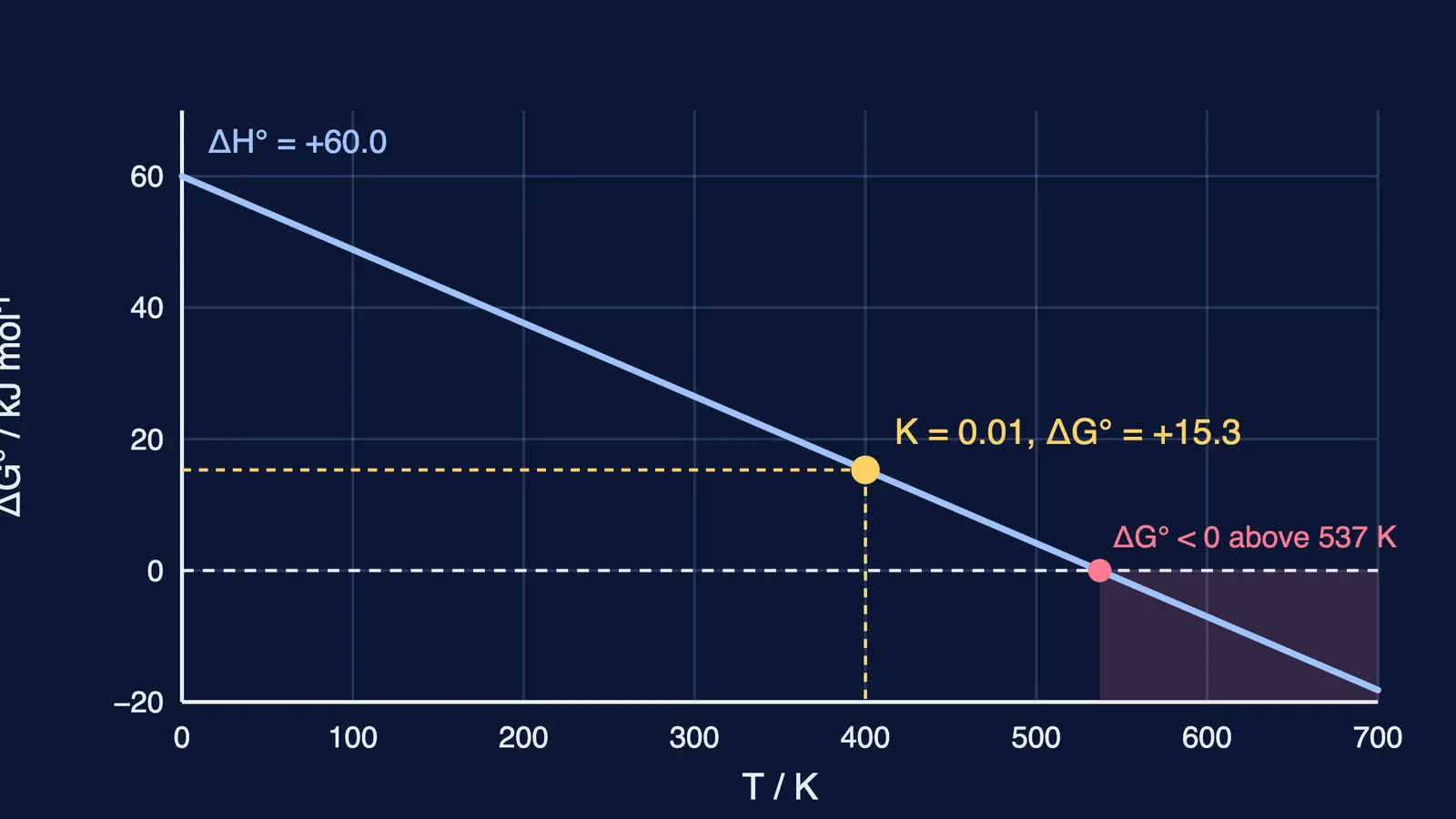
Q8 (hard). At 400 K a reaction has K = 1.0 × 10⁻² and ΔrH° = +60.0 kJ mol⁻¹. Its ΔrS° is closest to
(A) 112 J K⁻¹ mol⁻¹ (B) 133 J K⁻¹ mol⁻¹ (C) 150 J K⁻¹ mol⁻¹ (D) 188 J K⁻¹ mol⁻¹
Answer: (A). ΔrG° = −2.303RT log K = −2.303 × 8.314 × 400 × (−2) = +15.3 kJ mol⁻¹. Then ΔrS° = (ΔrH° − ΔrG°)/T = (60.0 − 15.3) × 1000/400 = 112 J K⁻¹ mol⁻¹. Trap: (C) sets ΔG° = 0 "because the reaction is at equilibrium". At equilibrium ΔG is zero; ΔG° is not.
What should you do after checking your answers?
Sort your misses: a definition slip (Q1, Q2), a unit or factor slip (Q3, Q4, Q8) or a sign slip (Q5, Q6, Q7). Redo the group you missed most, then retry the set in three days.
If Q8 felt shaky, try our Equilibrium NEET practice questions. For the board-exam view, see Thermodynamics Class 11 chemistry: signs, Hess's law, Gibbs energy.
For more questions with every step shown, the Fermi Problem Library has worked problems with a step-by-step solver that explains the reasoning rather than printing an answer.