On this page
These eight NEET-style questions cover chemical and ionic equilibrium, graded easy to hard. Each one has a worked solution and a trap: the wrong option a hurried student is most likely to mark. We wrote all eight for this set, so you will not have met them in a book or a past paper.
Equilibrium is Unit 6 of Chemistry in the NEET (UG) syllabus on NTA's site, which lists Kp and Kc, ΔG and ΔG°, Le Chatelier's principle, Brønsted-Lowry acids and bases, pH, hydrolysis of salts, solubility products and buffer solutions. Every question here sits inside that list and inside Unit 6 of NCERT Class 11 Chemistry Part I (Reprint 2026-27). If you are still learning the chapter, start with our guide on how to prepare Equilibrium for NEET.
How should you use this practice set?
NEET 2027 has not been notified yet. As in NEET-UG 2026, the NTA information bulletin gives 45 Chemistry questions in a 180-minute paper, with +4 for a correct answer and −1 for a wrong one.
Give yourself 10 minutes for all eight.
Mark an option and write one line of reasoning before you read any solution.
Note which answers were guesses, since a wrong answer costs a mark in the real paper.
For every miss, copy the trap into your notebook in your own words.
Easy: do you know the definitions?
Q1 (easy). The conjugate base of HPO₄²⁻ is
(A) H₂PO₄⁻ (B) PO₄³⁻ (C) H₃PO₄ (D) OH⁻
Answer: (B). In NCERT's terms, a conjugate base has one proton less than its acid, so removing H⁺ from HPO₄²⁻ leaves PO₄³⁻. Trap: (A) is the conjugate acid, with one proton added instead of removed.
Q2 (easy). Solid NH₄HS is in equilibrium with NH₃(g) and H₂S(g) in a closed flask at constant temperature: NH₄HS(s) ⇌ NH₃(g) + H₂S(g). A little more solid NH₄HS is added. What happens?
(A) The equilibrium shifts forward (B) The equilibrium shifts backward (C) Kp increases (D) Nothing changes
Answer: (D). The concentration of a pure solid is constant and independent of the amount present, so it stays out of the K expression. Adding solid changes neither Q nor K. Trap: (A) treats the solid like a dissolved reactant.
Q3 (easy). A reaction has K = 10 at 300 K. Taking R = 8.314 J mol⁻¹ K⁻¹, its ΔG° is about
(A) −5.74 kJ mol⁻¹ (B) +5.74 kJ mol⁻¹ (C) −2.49 kJ mol⁻¹ (D) −57.4 kJ mol⁻¹
Answer: (A). ΔG° = −RT ln K = −2.303 RT log K = −2.303 × 8.314 × 300 × 1 = −5744 J mol⁻¹. Trap: (C) drops the 2.303 and uses log K as if it were ln K. Our explainer on calculating K from ΔG° runs the same formula the other way.
Medium: can you set up the expression correctly?
Q4 (medium). In the NH₄HS flask from Q2, the total pressure at equilibrium is 0.60 bar, with no other gas present. Kp is
(A) 0.36 bar² (B) 0.30 bar² (C) 0.09 bar² (D) 0.18 bar²
Answer: (C). The solid gives NH₃ and H₂S in a 1:1 ratio, so each has a partial pressure of 0.30 bar. Kp = p(NH₃) × p(H₂S) = 0.30 × 0.30 = 0.09 bar². Trap: (A) squares the total pressure instead of each partial pressure.
Q5 (medium). For A(g) + B(g) ⇌ 2C(g), Kc = 16 at a fixed temperature. A flask holds [A] = 0.20 M, [B] = 0.10 M and [C] = 0.50 M. Which is correct?
(A) Qc = 12.5; the reaction moves forward (B) Qc = 25; the reaction moves backward (C) Qc = 12.5; the reaction moves backward (D) The mixture is at equilibrium
Answer: (A). Qc = [C]²/([A][B]) = 0.25/0.020 = 12.5. Since Qc < Kc, more C must form, so the reaction moves forward. Trap: (B) forgets to square [C], gets 25 and flips the direction.
Q6 (medium). 20 mL of 0.10 M HCl is mixed with 30 mL of 0.10 M NaOH at 298 K. The pH of the mixture is
(A) 1.70 (B) 12.00 (C) 12.30 (D) 12.52
Answer: (C). HCl gives 2.0 mmol H⁺ and NaOH gives 3.0 mmol OH⁻, so 1.0 mmol OH⁻ is left over in 50 mL. [OH⁻] = 0.020 M, pOH = 1.70 and pH = 14 − 1.70 = 12.30. Trap: (D) divides by the 30 mL of base alone and forgets the acid's volume. (A) is the pOH.
Hard: can you pick the right formula for the salt or buffer?
Q7 (hard). A salt is formed from a weak acid with pKa = 3.8 and a weak base with pKb = 5.0. The pH of its 0.10 M aqueous solution at 298 K is about
(A) 7.6 (B) 7.0 (C) 6.4 (D) 5.8
Answer: (C). For a salt of a weak acid and a weak base, NCERT gives pH = 7 + ½(pKa − pKb) = 7 + ½(3.8 − 5.0) = 6.4. The acid is the stronger partner, so the solution is slightly acidic, and the concentration does not enter. Trap: (A) writes pKb − pKa and lands on the wrong side of 7. (D) drops the ½.
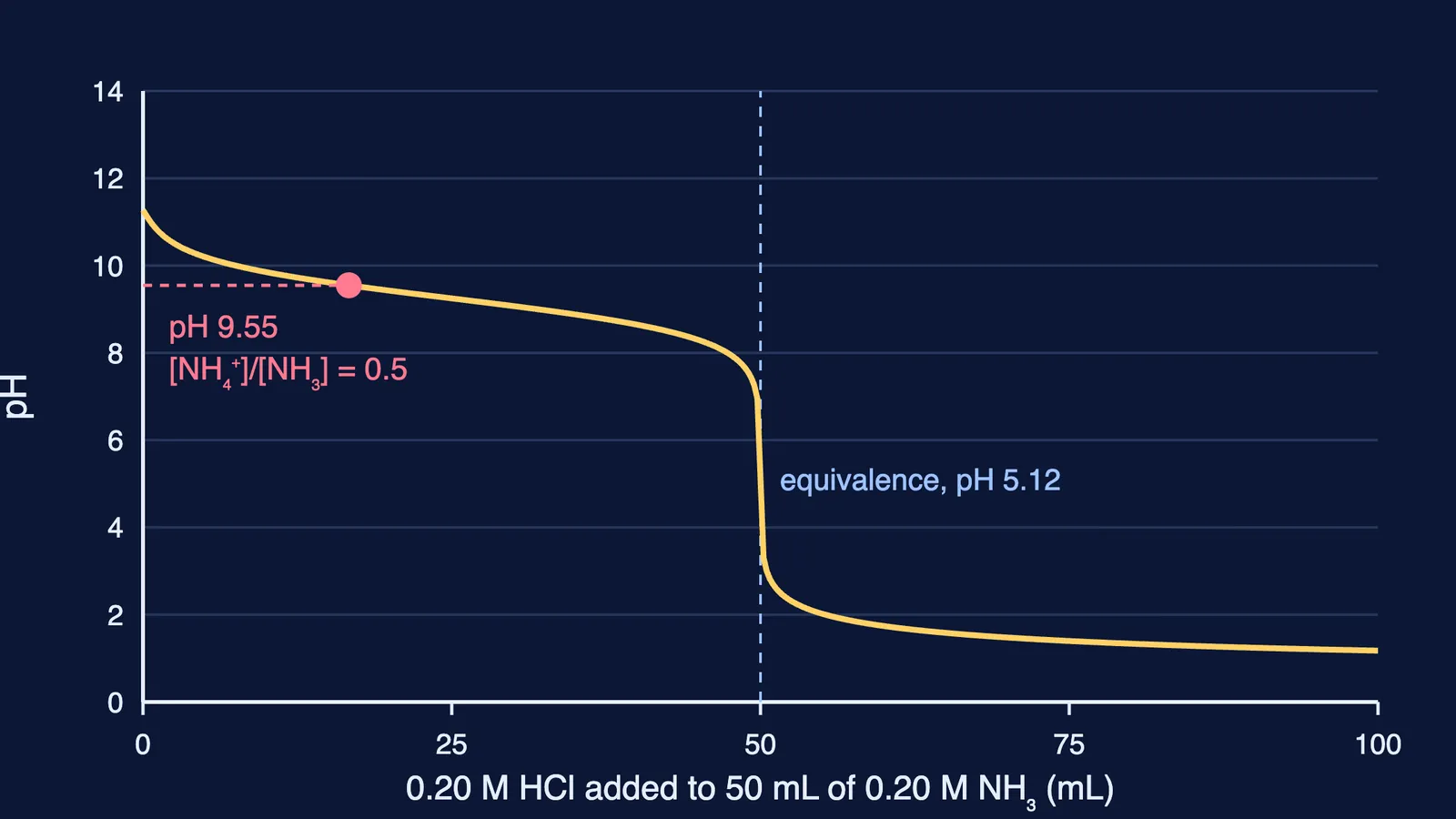
Q8 (hard). A buffer contains 0.20 M NH₃ and 0.10 M NH₄Cl at 298 K. Take pKb of ammonia as 4.75. Its pH is
(A) 4.45 (B) 8.95 (C) 9.25 (D) 9.55
Answer: (D). For a base and its conjugate acid, pOH = pKb + log([BH⁺]/[B]) = 4.75 + log(0.10/0.20) = 4.75 − 0.30 = 4.45, so pH = 14 − 4.45 = 9.55. Trap: (B) flips the ratio to [base]/[salt]. (A) stops at pOH and reports it as the pH.
What should you do after this set?
Count traps, not marks. If Q2 or Q4 went wrong, go back to how pure solids are left out of K. If you missed Q5, our piece on whether K changes with concentration or pressure separates Q from K. If Q6 to Q8 tripped you up, write one formula sheet: strong acid with strong base, salt hydrolysis, acidic buffer, basic buffer.
When it is the method rather than a fact that goes wrong, the Fermi Problem Library has worked problems with a step-by-step solver that explains the reasoning rather than printing an answer.