On this page
Equilibrium feeds three kinds of NEET question: a Kp or Kc conversion, a Le Chatelier "which way does it shift" statement, and a pH, buffer or solubility calculation. Each takes about a minute once you know the method. Here is the official coverage, the NCERT map, three worked examples, the traps and a 10-day plan.
What does the NEET-UG syllabus include in Equilibrium?
In the NEET (UG) syllabus PDF linked from NTA's NEET page, Equilibrium is Unit 6 of Chemistry. The file is headed NEET (UG) 2025; the NEET (UG) 2026 information bulletin says NMC notified the syllabus and that it did not change from the previous year. The unit has three parts:
Physical processes: dynamic equilibrium, solid-liquid, liquid-gas and solid-gas equilibria, Henry's law.
Chemical processes: the law of chemical equilibrium, Kp and Kc, ΔG and ΔG°, factors affecting equilibrium, Le Chatelier's principle.
Ionic equilibrium: acid-base concepts, ionisation constants, ionisation of water, pH, common ion effect, salt hydrolysis, solubility products, buffers.
Your textbook is Unit 6, Equilibrium, in NCERT Class 11 Chemistry Part I (Reprint 2026-27), sections 6.1 to 6.13. Every syllabus topic is still in it, including Henry's law and buffer solutions, so nothing has been cut.
How are Equilibrium questions asked in NEET?
NEET 2027 has not been notified yet. As in NEET-UG 2026, the information bulletin sets 180 compulsory multiple-choice questions in 180 minutes, 45 of them in Chemistry, with +4 for a correct answer and −1 for a wrong one. That is about a minute a question, with no numerical-value section. Three habits pay off:
Recall, not derivation: Kp = Kc(RT)^Δn, pH = pKa + log([salt]/[acid]), Ksp = s² or 4s³.
Elimination: decide bigger or smaller, acidic or basic, before calculating.
NCERT statements: statement-type items can turn on NCERT lines about catalysts, inert gases or temperature.
How do you solve Equilibrium MCQs quickly?
Example 1: Kp from Kc. For a gas reaction A(g) + 3B(g) ⇌ 2C(g) at 500 K, take Kc = 0.50 L² mol⁻². Δn = 2 − 4 = −2. With NCERT's R = 0.0831 bar L mol⁻¹ K⁻¹, RT = 41.55, so Kp = 0.50 ÷ 41.55² ≈ 2.9 × 10⁻⁴ bar⁻². Shortcut: Δn is negative and RT exceeds 1, so Kp must be smaller than Kc; any option above 0.50 is out.
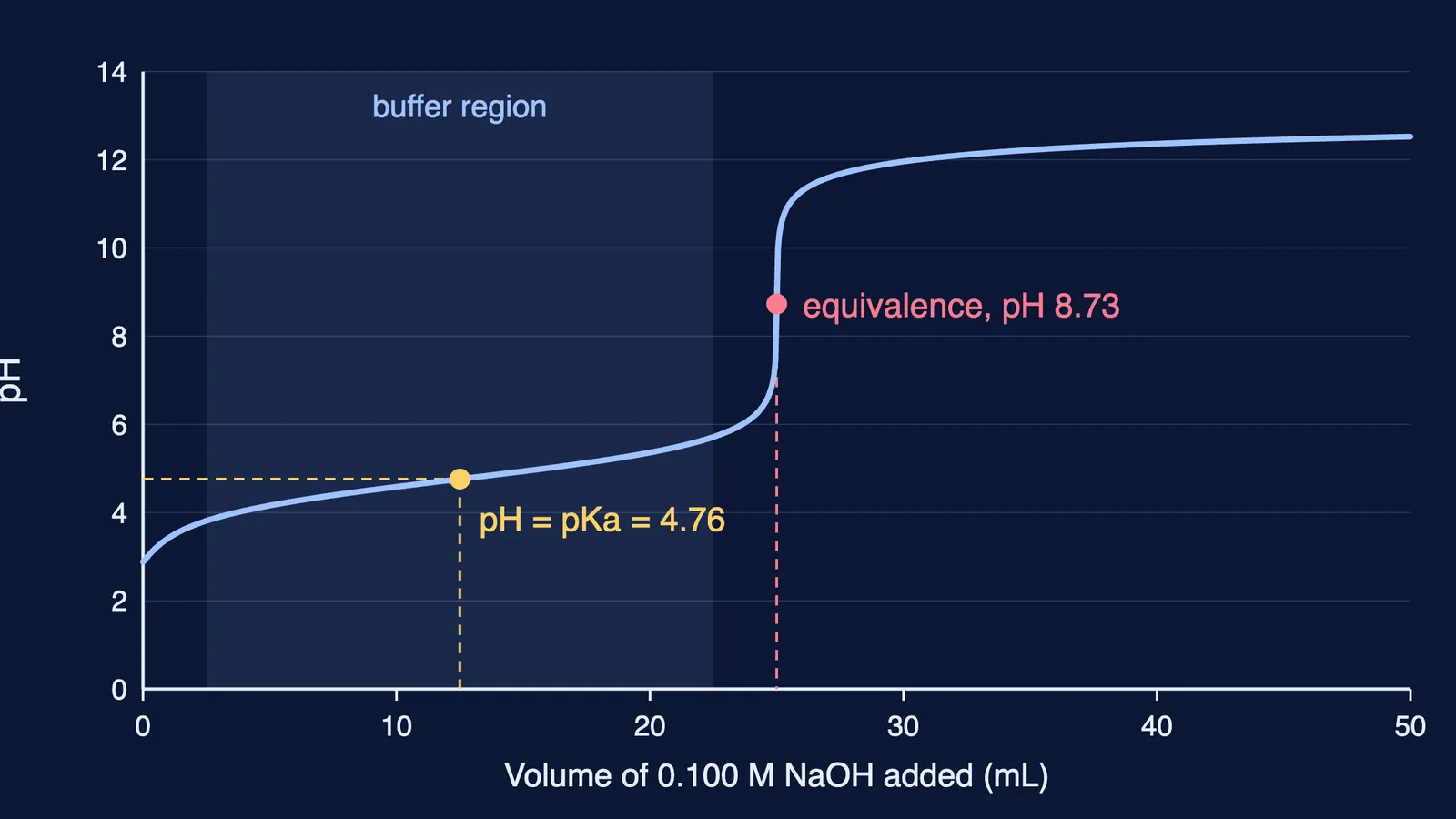
Example 2: a buffer. One litre holds 0.20 mol of a weak acid HA (pKa 4.76, acetic acid's value in NCERT) and 0.10 mol of NaA. pH = 4.76 + log(0.10/0.20) = 4.76 − 0.30 = 4.46. Add 0.020 mol NaOH: HA falls to 0.18 mol and A⁻ rises to 0.12 mol, so pH = 4.76 + log(2/3) = 4.58. The pH moves only 0.12. The diagram at the top shows the same idea for acetic acid titrated with NaOH: a flat buffer stretch with pH = pKa at half-neutralisation, then a basic equivalence point because the salt hydrolyses.
Example 3: common ion effect. A salt MX has Ksp = 1.0 × 10⁻¹⁰. In pure water, s = √Ksp = 1.0 × 10⁻⁵ mol L⁻¹. In 0.010 M NaX, s ≈ Ksp ÷ 0.010 = 1.0 × 10⁻⁸ mol L⁻¹, a thousandth of its solubility in water. Don't write s² once a common ion is present.
For longer ICE-table problems, see our Equilibrium guide for JEE Main; for board-style answers, Equilibrium for Class 11 CBSE.
What are the common traps in Equilibrium?
Solids and pure liquids stay out of K for heterogeneous equilibria (NCERT 6.5).
A catalyst does not change the equilibrium composition (6.8.5).
Inert gas at constant volume leaves the equilibrium undisturbed, because partial pressures do not change (6.8.3).
Only temperature changes K; concentration and pressure shift the position.
Reversing an equation inverts K; doubling it squares K. See manipulating the equilibrium constant.
Stuck on a step? The Fermi Problem Library has worked problems with a step-by-step solver that explains the reasoning rather than printing an answer.
What is a 10-day practice plan for Equilibrium?
Days 1-2: NCERT 6.1 to 6.8; write every K expression in the solved examples yourself.
Days 3-4: 30 timed MCQs on Kp, Kc, Q and Le Chatelier.
Days 5-6: NCERT 6.9 to 6.13; one formula sheet for pH, buffers, hydrolysis and Ksp.
Days 7-8: 30 timed MCQs on ionic equilibrium; redo wrong ones next morning.
Days 9-10: assertion-reason practice from NCERT lines, then a mixed 20-question set in 20 minutes.
Practice questions (our own)
For 2A(g) ⇌ B(g) at 600 K, Kc = 50 L mol⁻¹. Kp is about: (a) 1.0 bar⁻¹ (b) 50 bar⁻¹ (c) 2490 bar⁻¹ (d) 0.020 bar⁻¹.
0.020 M NaOH is diluted ten times. Its pH is about: (a) 11.3 (b) 12.3 (c) 2.7 (d) 10.3.
M(OH)₂ has solubility 2.0 × 10⁻⁴ mol L⁻¹. Its Ksp is: (a) 8.0 × 10⁻¹² (b) 3.2 × 10⁻¹¹ (c) 4.0 × 10⁻⁸ (d) 1.6 × 10⁻¹¹.
Answers: 1 (a), since Kp = Kc ÷ RT = 50 ÷ 49.9; 2 (a), since [OH⁻] = 0.0020 M and pOH = 2.7; 3 (b), since Ksp = 4s³.