On this page
This unit runs on a handful of formulas. Here is the syllabus mapped to NCERT, three solved problems, the traps and a plan.
What does the NEET syllabus include in Oscillations and Waves?
The NMC's updated syllabus for NEET (UG)-2026 lists Unit 10, Oscillations and Waves, as: periodic motion (time period, frequency, displacement as a function of time); periodic functions; simple harmonic motion and its equation; phase; oscillations of a spring, restoring force and force constant; kinetic and potential energy in SHM; the simple pendulum and the derivation of its period; wave motion; longitudinal and transverse waves; speed of a travelling wave; the displacement relation for a progressive wave; superposition and reflection of waves; standing waves in strings and organ pipes, fundamental mode and harmonics; and beats.
In the 2026-27 reprint this is two chapters of NCERT Class 11 Physics Part II: Chapter 13, Oscillations, sections 13.1 to 13.8, and Chapter 14, Waves, sections 14.1 to 14.7. Damped and forced oscillations get only a passing mention, and the Doppler effect is not in the Waves chapter. Neither is in the NMC list.
How is Oscillations and Waves asked in NEET?
In NEET-UG 2026, physics had 45 of the 180 questions, answered in 180 minutes, with +4 for a correct answer and −1 for a wrong one, according to the NTA information bulletin. Every question was a multiple-choice question with four options and a single correct answer, so you have about a minute each. NTA has not yet notified the NEET-UG 2027 pattern, so check the new bulletin when it appears.
That pace rewards three habits:
Instant formula recall: T = 2π√(m/k), T = 2π√(L/g), E = ½kA², v = √(T/μ), f_n = nv/2L.
Ratios instead of full calculations.
Unit checks to strike out options.
Worked examples: three NEET-style problems
1. Energy in a spring. A 0.5 kg block on a spring of k = 200 N/m oscillates with amplitude 5 cm. Find the period, the maximum speed and the speed at x = 3 cm.
ω = √(k/m) = 20 rad/s, so T = 2π/20 ≈ 0.31 s and v_max = ωA = 1.0 m/s. E = ½kA² = 0.25 J. At 3 cm, potential energy is 0.09 J, kinetic is 0.16 J and v = ω√(A² − x²) = 0.8 m/s. Kinetic and potential energy are equal at x = A/√2 ≈ 3.5 cm, not at A/2.
2. A longer pendulum. A simple pendulum's length is increased by 69%. What happens to its period?
T ∝ √L, so the period becomes √1.69 = 1.3 times: 30% longer. Mass is not in T = 2π√(L/g), so strike out options that depend on it.
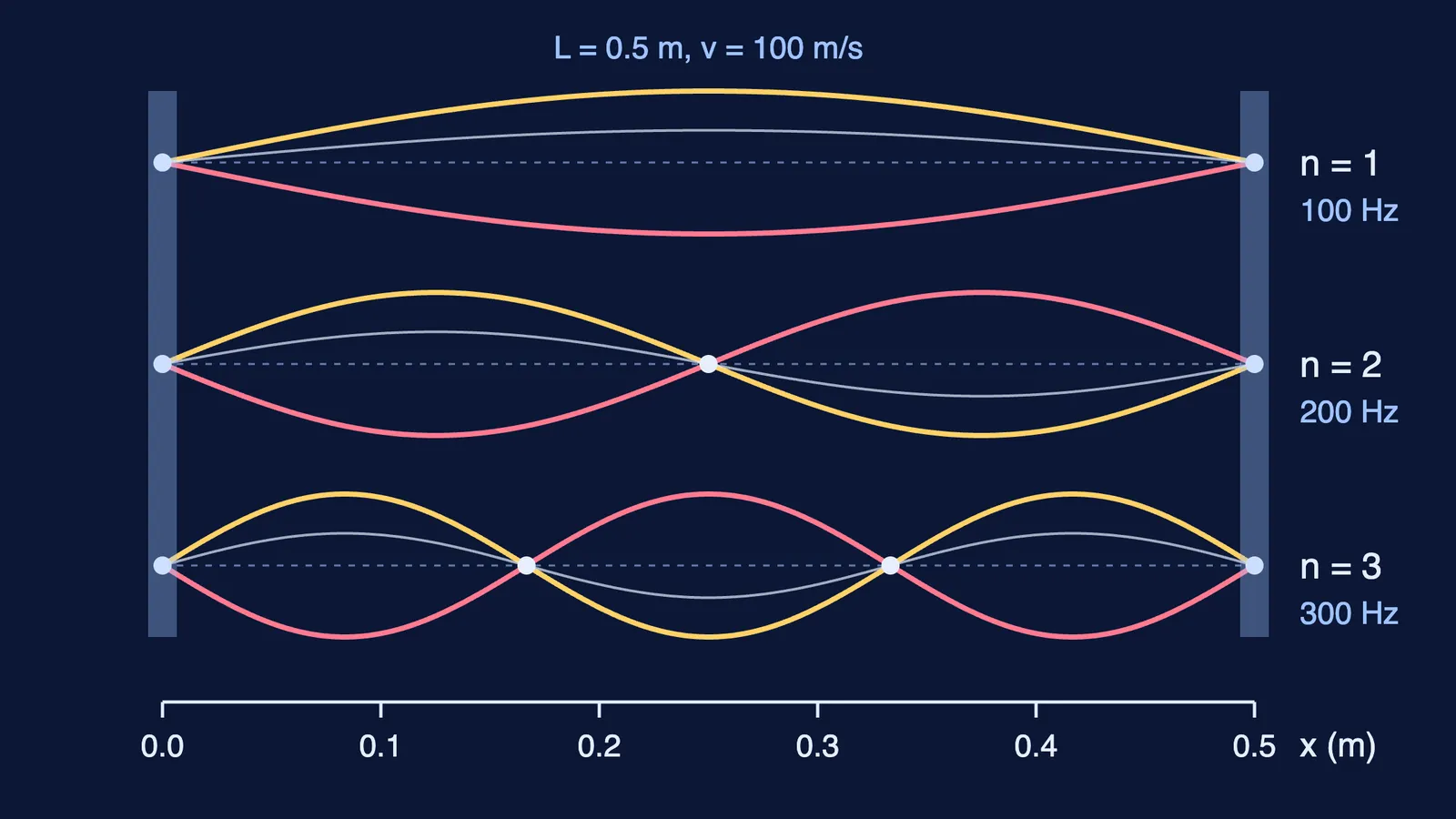
3. A string, its harmonics and beats. A 0.5 m string with linear mass density 5 g/m is fixed at both ends under 50 N tension. A tuning fork gives 4 beats per second with its fundamental. When the tension is raised slightly, the beats rise to 6 per second. Find the fork's frequency.
v = √(T/μ) = √(50/0.005) = 100 m/s, so f₁ = v/2L = 100 Hz, with harmonics at 200 Hz and 300 Hz. The fork is 96 Hz or 104 Hz. Higher tension raises the string's frequency, and beats rise only if it moves away from the fork: 96 Hz.
Stuck on a step? The Fermi Problem Library has worked problems with a step-by-step solver that explains the reasoning rather than printing an answer.
Which mistakes cost marks in Oscillations and Waves?
Confusing ω with f: ω = 2πf, and a factor of 2π hides in many wrong options.
Assuming energy splits equally at half the amplitude; at x = A/2, three quarters of the energy is kinetic.
Giving a closed pipe even harmonics: a pipe closed at one end has only odd harmonics, f = nv/4L with n = 1, 3, 5, as NCERT Chapter 14 shows.
Adding frequencies for beats; the beat frequency is their difference.
If a sketch on paper isn't enough, the Fermi Simulation Lab has interactive simulations for the ideas that are easier to see than to read.
How should you practise Oscillations and Waves for NEET?
A two-week plan, about an hour a day:
Days 1-3: Chapter 13; put every formula and its unit on one card.
Days 4-6: Chapter 14, sketching nodes for every string and pipe.
Days 7-10: 20 timed single-correct questions a day; label each miss as recall, ratio or reading.
Days 11-14: timed 15-question sets; redo misses a day later.
Try these:
x = 0.05 sin(10πt), in metres and seconds. Find the period and maximum speed.
A 0.35 m pipe is closed at one end; sound travels at 350 m/s. Find its two lowest frequencies, and the fundamental with both ends open.
A 2 kg block on a spring has period 0.5 s. Find the period with 8 kg.
Answers: 0.2 s and about 1.57 m/s; 250 Hz and 750 Hz, and 500 Hz open; 1.0 s.
Next, try assertion-reason questions on waves and oscillations, revise Waves for Class 11 Physics, or go deeper with Oscillations for JEE Main.