

On this page
Assertion-reason questions in NEET-UG and JEE Main physics test if you really understand the mechanics beneath the math. In waves and oscillations, students often memorise formulas for frequency and speed but struggle when asked *why* a property behaves a certain way.
Let's break down three classic assertion-reason pairs on energy in simple harmonic motion (SHM), the speed of sound, and standing waves.
Is energy conserved in simple harmonic motion?
Assertion: The total mechanical energy of a particle performing Simple Harmonic Motion (SHM) remains constant. Reason: In SHM, the force acting on the particle is a conservative force.
This is a standard (A) option: both statements are true, and the reason correctly explains the assertion.
For SHM, the restoring force is directly proportional to the displacement (F = -kx). Because this is a conservative force, the sum of kinetic and potential energy (E = ½ kA²) stays constant, as OpenStax University Physics explains. While the energy shifts between kinetic (which is maximum at the mean position) and potential (maximum at the extremes), the total remains fixed unless there is damping. When you study damped vs forced oscillations, you will see the total energy drops over time due to resistive forces.
Why does sound travel faster in solids than gases?
Assertion: Sound travels faster in solids than in gases. Reason: Solids have a much higher modulus of elasticity compared to the density of the medium.
This is another (A) option. It often traps students who remember that speed is inversely proportional to the square root of density (v ∝ 1/√ρ) and incorrectly guess that denser solids should slow sound down.
The speed of sound in any medium is the square root of its elasticity divided by its density (v = √(E/ρ)). The speed of sound in steel is 5,960 m/s, compared to 343 m/s in air, according to OpenStax University Physics. Even though steel is much denser than air, its modulus of elasticity is massively higher. The atoms are packed tightly with strong intermolecular forces, transmitting vibrations far more quickly than in a gas.
Do standing waves transfer energy?
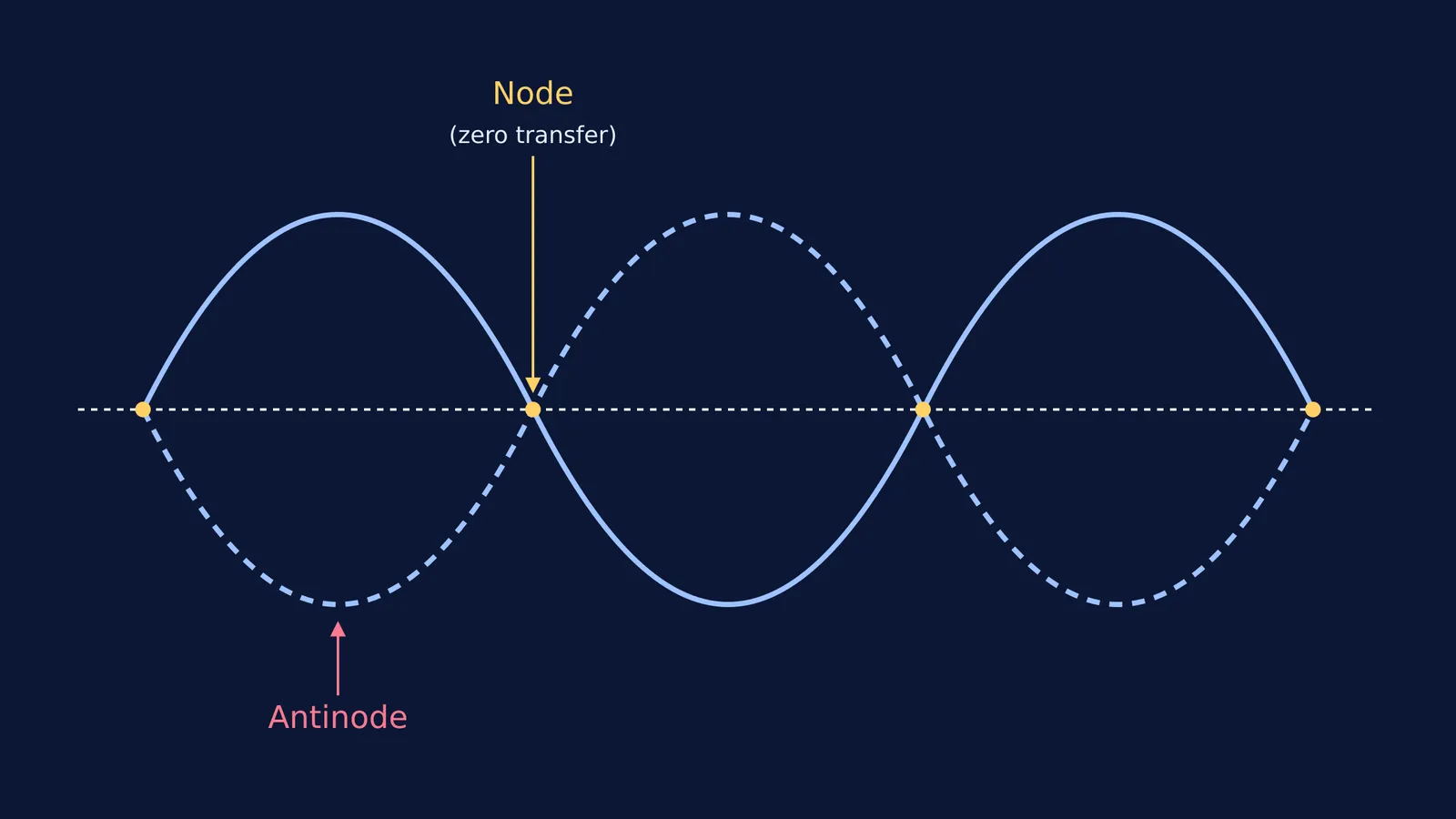
Assertion: In a standing wave, the average rate of transfer of energy at any cross-section is zero. Reason: The instantaneous rate of energy transfer at a node is always zero.
Both statements are true, and the reason correctly explains the assertion (A).
A standing wave forms when two identical waves travel in opposite directions and superimpose. As OpenStax University Physics explains, the energy is trapped between nodes. Because the displacement and velocity at a node are always zero, no energy can pass through those points. Therefore, there is no net energy transfer across the wave. You will see similar principles applied when analysing how a closed pipe partly filled with water changes frequency or strings fixed at both ends.
How to prepare for physics assertions?
When you practice these pairs, read the Reason first. If the Reason is factually false, you have instantly narrowed your options. If both are true, read them together with a "because" in the middle to check if the logic holds.
If you are confused by concepts like how wave speed on a string changes with tension and struggle to find the 'why' behind these rules, the Fermi Problem Library has worked problems with a step-by-step solver that explains the reasoning rather than printing an answer. The AI tutor notices where you are stuck and decides whether to explain, ask, or show, helping you build the conceptual depth needed for exams.


