On this page
Rotational Motion is where NEET physics stops treating bodies as points. Torque, moment of inertia and angular momentum are twins of force, mass and momentum, so learn each as the rotational version of an idea you already know.
What does the NEET syllabus include in Rotational Motion?
The NMC's updated syllabus for NEET (UG)-2026, dated 22 December 2025, lists Unit 5: Rotational Motion as: centre of mass of a two-particle system and of a rigid body; basic concepts of rotational motion; moment of a force, torque, angular momentum, conservation of angular momentum and its applications; moment of inertia, radius of gyration, values for simple geometrical objects, parallel and perpendicular axes theorems and their applications; equilibrium of rigid bodies, rigid body rotation and equations of rotational motion; and a comparison of linear and rotational motions. Watch nmc.org.in for a 2027 update.
The textbook is NCERT Class 11 Physics Part I, Chapter 6, Systems of Particles and Rotational Motion, marked Reprint 2026-27. Two gaps matter:
The chapter does not teach the parallel and perpendicular axes theorems, though NMC still lists them. Learn both separately.
NMC does not name rolling motion, and the chapter describes it only briefly in its introduction (Fig. 6.2). Know that a rolling body translates and rotates, then move on.
For board-exam framing, see our System of Particles and Rotational Motion Class 11 guide.
How are Rotational Motion questions asked in NEET?
In NEET-UG 2026, Physics had 45 of the 180 compulsory questions, each a multiple-choice question with four options and a single correct or best answer, in a 180-minute paper, according to the NTA Information Bulletin for NEET (UG)-2026. A correct answer earned +4 and a wrong one -1. That works out to about a minute per question, with no numerical-value section, unlike our Rotational Motion guide for JEE Main. NEET 2027 has not been notified yet, so treat this as the 2026 pattern.
So drill instant recall of Table 6.1, unit checks (kg m², N m) and elimination by limiting cases.
Three worked examples in NEET style
All use g = 10 m/s².
Example 1: where does the rod balance? A uniform 1 m rod of mass 2 kg carries a 1 kg weight hung at the 10 cm mark. Find the balance point and the support force.
The pivot sits under the centre of mass: x = (1 × 0.10 + 2 × 0.50)/3 = 1.1/3 ≈ 0.367 m, about the 36.7 cm mark.
Torques: 10 × 0.267 ≈ 20 × 0.133 ≈ 2.67 N m.
Support force = total weight = 30 N.
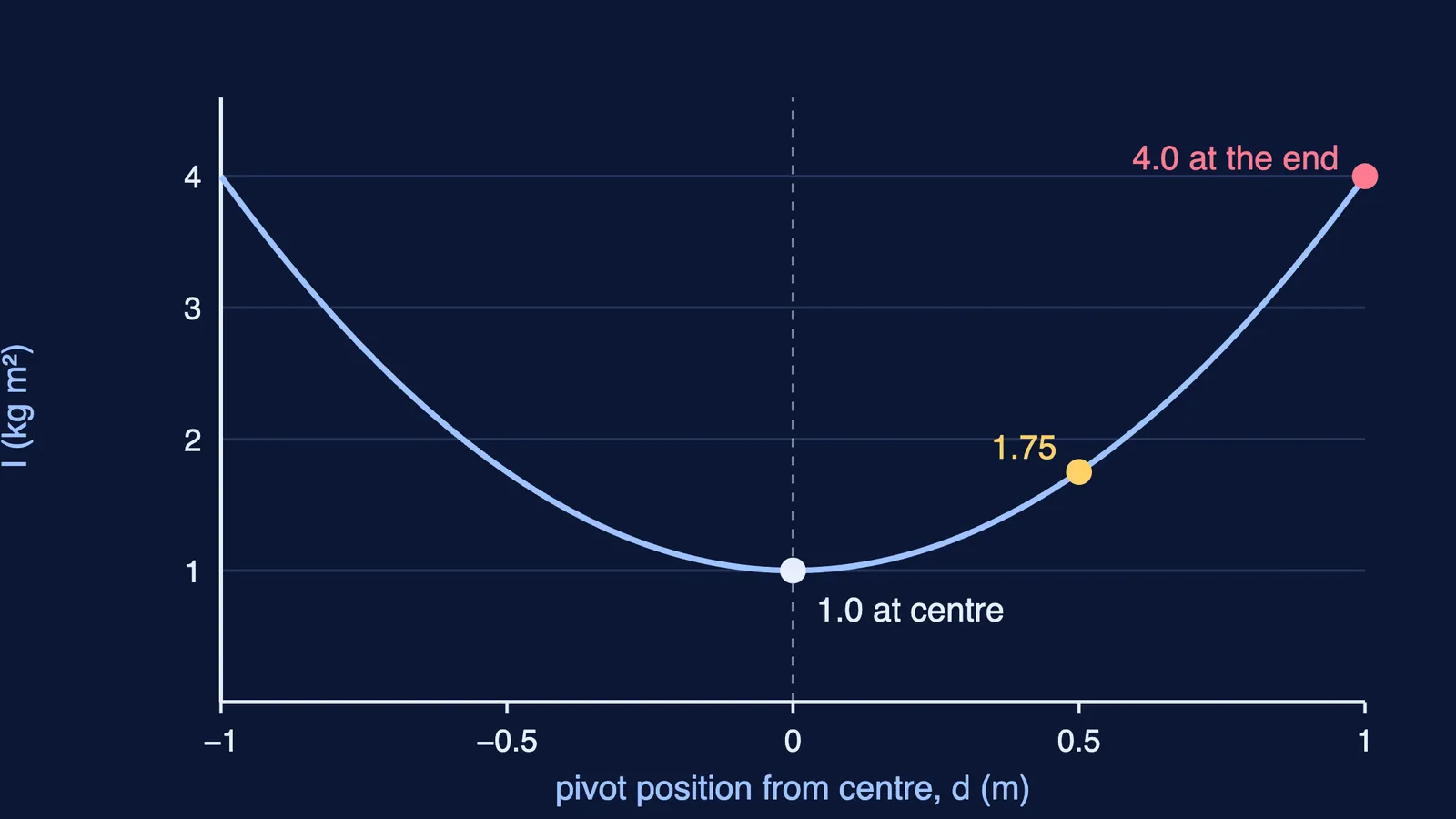
Example 2: a rod pivoted off-centre. A uniform 3 kg, 2 m rod is pivoted 0.5 m from one end and released from rest while horizontal. Find α at release.
About the centre, I = ML²/12 = 3 × 4/12 = 1 kg m².
The pivot is d = 0.5 m from the centre, so by the parallel axes theorem I = 1 + 3 × 0.5² = 1.75 kg m².
Torque of gravity = Mgd = 3 × 10 × 0.5 = 15 N m, so α = 15/1.75 ≈ 8.6 rad/s².
Example 3: a lump lands on a spinning disc. A 2 kg disc of radius 0.5 m spins freely at 30 rad/s. A 0.5 kg clay lump lands on its rim and sticks.
Disc: I = MR²/2 = 0.25 kg m². With the clay: 0.25 + 0.5 × 0.5² = 0.375 kg m².
No external torque about the axis, so L is conserved: ω = 0.25 × 30/0.375 = 20 rad/s.
Kinetic energy falls from 112.5 J to 75 J; an option that conserves energy is the trap.
Which traps cost marks in Rotational Motion?
Using an I from Table 6.1 about the wrong axis, such as MR²/2 for a disc about its diameter (it is MR²/4).
Applying the parallel axes theorem between two axes when neither passes through the centre of mass.
Assuming kinetic energy is conserved whenever angular momentum is.
Forgetting that torque uses only the perpendicular component.
Stuck on a step? The Fermi Problem Library has worked problems with a step-by-step solver that explains the reasoning rather than printing an answer.
How should you practise Rotational Motion for NEET?
Days 1-2: read Chapter 6 and write each rotational quantity beside its linear twin (Table 6.2).
Day 3: learn both axes theorems and derive Table 6.1 values from each other.
Days 4-6: timed sets of 15 MCQs in 15 minutes; log each error by type.
Day 7: redo logged errors, then try these.
Practice:
Find the moment of inertia of a 5 kg solid sphere of radius 0.2 m about an axis 0.3 m from its centre.
A wheel speeds up uniformly from 10 rad/s to 40 rad/s in 5 s. Through what angle does it turn?
A wheel with I = 0.4 kg m² spins at 50 rad/s. How long does a 2 N m braking torque take to stop it?
Answers: 1. 0.53 kg m². 2. 125 rad. 3. 10 s.