On this page
This chapter turns single-particle mechanics into the physics of wheels, doors and spinning skaters. Here is what the 2026-27 syllabus asks, with solved numericals and board-style questions.
How many marks is System of Particles and Rotational Motion in CBSE Class 11?
In the CBSE Physics curriculum for 2026-27, Chapter 6 sits in Unit V, and Units IV, V and VI (Work, Energy and Power; this chapter; Gravitation) share one block of 17 marks out of 70 in theory. CBSE prints no separate figure for this chapter alone.
The same document lists the scope: the centre of mass of two particles and of a uniform rod, torque, angular momentum and its conservation, equilibrium of rigid bodies, equations of rotational motion, the comparison of linear and rotational motion, moment of inertia and radius of gyration. Moments of inertia of simple shapes are needed as values, with no derivation.
Its question paper design gives about 38% of marks to remembering and understanding, 32% to applying and 30% to analysing, evaluating and creating.
What does the 2026-27 NCERT chapter cover?
The current NCERT Physics Part I, Chapter 6 (Reprint 2026-27) runs from section 6.1 to 6.12: centre of mass, linear momentum of a system, the vector product, angular velocity, torque and angular momentum, equilibrium of a rigid body (couples, principle of moments, centre of gravity), moment of inertia, and rotation about a fixed axis.
Older guides also teach the theorems of parallel and perpendicular axes and a section on rolling motion. Neither is a section in the current text, so leave them out of board revision. NCERT's Table 6.1 lists moments of inertia for eight regular bodies, such as MR² for a thin ring about its central perpendicular axis and 2MR²/5 for a solid sphere about a diameter.
The heart of the chapter is NCERT's Table 6.2, which pairs each linear quantity with a rotational twin:
mass M with moment of inertia I
force F = Ma with torque τ = Iα
kinetic energy Mv²/2 with Iω²/2
power Fv with τω
linear momentum Mv with angular momentum Iω
Learn them as pairs.
Solved numericals in board style
1. Centre of mass. A 2.0 kg mass is at x = 0 and a 3.0 kg mass at x = 1.0 m. Then x_cm = (2.0 × 0 + 3.0 × 1.0)/5.0 = 0.60 m, closer to the heavier mass.
2. Braking torque and work. A uniform disc (2.0 kg, radius 0.30 m) spins at 30 rad/s about its axis. A brake applies a steady opposing torque of 0.45 N m.
I = MR²/2 = 2.0 × (0.30)²/2 = 0.090 kg m²
α = τ/I = 0.45/0.090 = 5.0 rad/s², slowing the disc
Time to stop: t = ω₀/α = 30/5.0 = 6.0 s
Angle turned: θ = ω₀²/(2α) = 900/10 = 90 rad
Kinetic energy lost = Iω₀²/2 = 40.5 J, and work done by the brake = τθ = 0.45 × 90 = 40.5 J
Step 5 matching is the work-energy theorem for rotation, and a handy arithmetic check.
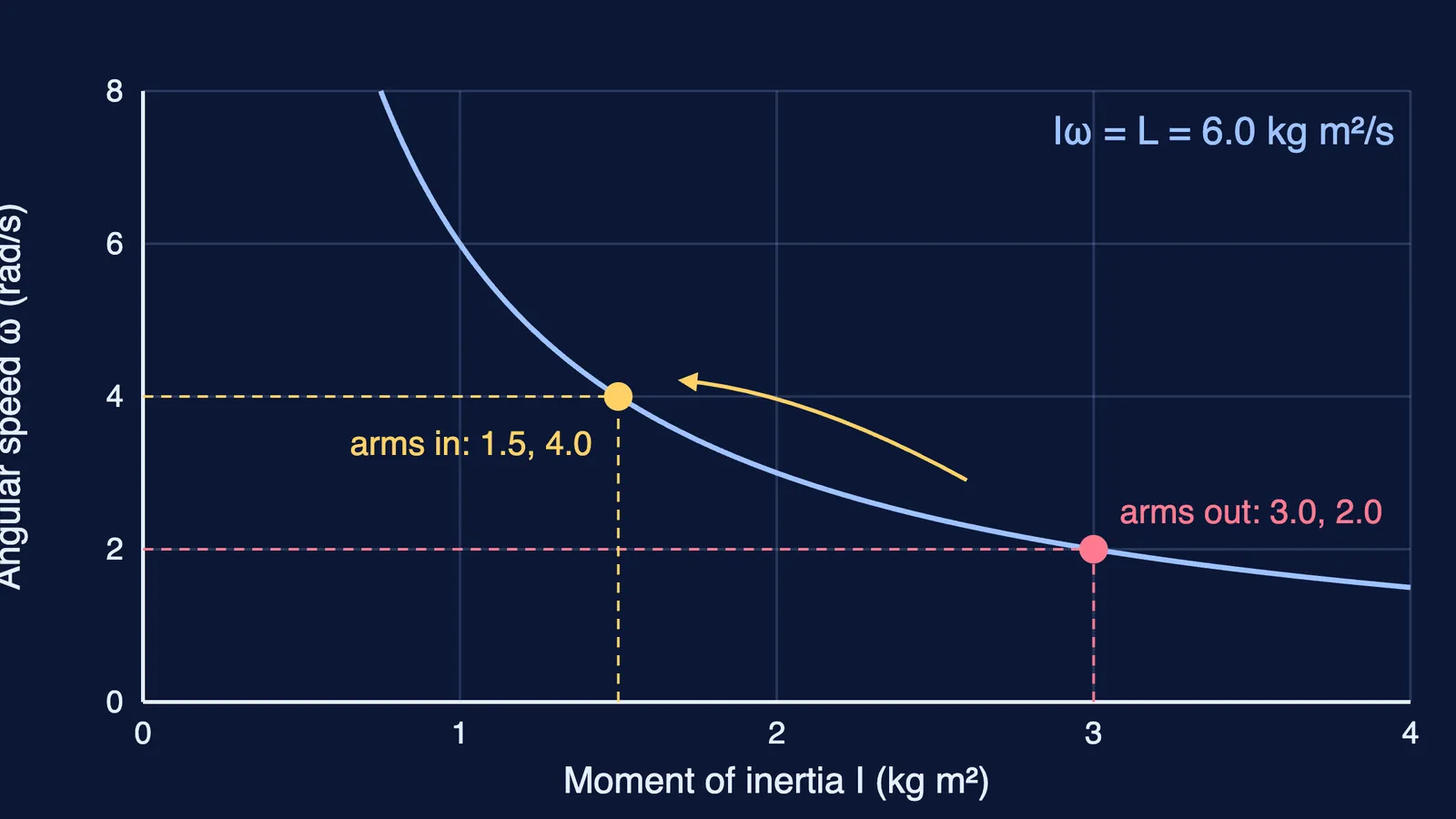
3. Conservation of angular momentum. An ice skater spins at 2.0 rad/s with arms out (I = 3.0 kg m²), then pulls them in (I = 1.5 kg m²). Ignoring friction, there is no external torque about the spin axis, so L = 3.0 × 2.0 = 6.0 kg m²/s and the new ω = 6.0/1.5 = 4.0 rad/s. Kinetic energy rises from 6.0 J to 12 J; the extra 6.0 J is work done by the skater's muscles. The graph above plots this case.
For harder problems on the same ideas, see our guide to preparing Rotational Motion for JEE Main.
Practice questions to try
(2 marks) Define radius of gyration. Find it for a solid sphere of radius 0.10 m about a diameter.
(2 marks) A metre rule balances at its 50 cm mark. A 200 g mass hangs at 20 cm. What mass at 70 cm keeps it balanced?
(3 marks) Show that a couple produces rotation but no translation. Give one everyday example.
(5 marks) State the law of conservation of angular momentum. A spinning space probe unfolds two long antennas. Using numbers of your own, explain what happens to its spin rate and to its rotational kinetic energy.
Answers: 1. k = R√(2/5) ≈ 0.063 m. 2. 300 g.
How should you revise this chapter?
Week 1: centre of mass and the vector product, doing every NCERT example by hand.
Week 2: torque, equilibrium and the principle of moments, tied to the metre-scale practical.
Week 3: moment of inertia values, Table 6.2 and conservation of angular momentum.
Our weekly study plan for Class 11 physics shows how to fit this into a full term.
When you are stuck on a step, Fermi's AI tutor works out what you already know and builds a plan for the session, so you sit down to a clear next step.