On this page
These eight questions cover limits, continuity and differentiability at JEE Advanced level, graded from easy to hard. Each has a worked solution and the trap a hurried student is most likely to fall for.
The JEE (Advanced) 2026 syllabus lists limits, continuity, L'Hospital's rule, continuity of composite functions and the intermediate value property under Differential Calculus, and says it is unchanged from 2025. JEE (Advanced) 2027 is on 23 May 2027, according to the official JEE (Advanced) website. If you have not finished the chapter, start with our guide on how to prepare limits, continuity and differentiability for JEE Advanced.
How should you use this practice set?
Each question is labelled; our explainer on JEE Advanced question types covers the formats.
Give yourself 24 minutes.
In a "one or more options correct" question, judge every option on its own.
The numerical-value answers in this set are non-negative numbers.
Note each trap you fall for in one line.
Easy: can you expand before you substitute?
Q1 (easy, single correct). lim(x→0) (e^(3x) − 1 − 3x) / (x sin 2x) equals
(A) 3/4 (B) 9/4 (C) 9/2 (D) 3/2
Answer: (B). e^(3x) = 1 + 3x + 9x²/2 + …, so the numerator behaves like 9x²/2. The denominator behaves like x · 2x = 2x². The limit is (9/2)/2 = 9/4. Trap: (C) replaces sin 2x by x instead of 2x.
Q2 (easy, numerical value). For k > 0, f(x) = (1 − cos kx)/x² for x ≠ 0 and f(0) = 8. If f is continuous at x = 0, find k.
Answer: 4. 1 − cos kx behaves like k²x²/2, so the limit is k²/2. Setting k²/2 = 8 gives k = 4. Trap: dropping the 1/2 gives k = 2√2.
Medium: where do corners and jumps hide?
Q3 (medium, one or more options correct). Let f(x) = (x + 1)|x − 1| + |x − 2| sin(πx/2). Then
(A) f is continuous on ℝ (B) f is differentiable at x = 1 (C) f is differentiable at x = 2 (D) f′(3) = 7
Answer: (A), (C). Sums and products of continuous functions are continuous, so (A) holds. At x = 1 the left derivative is −3 and the right derivative is 1, so (B) fails. At x = 2, sin(πx/2) = 0, so the corner of |x − 2| is cancelled; f′(2) = 4 from both sides. Near x = 3, f(x) = x² − 1 + (x − 2) sin(πx/2), so f′(3) = 6 + sin(3π/2) = 5. Trap: rejecting (C) because |x − 2| "always" makes a corner; (D) takes sin(3π/2) as +1.
Q4 (medium, single correct). lim(t→0) (ln(1 + t²) − sin²t) / t⁴ equals
(A) 1/6 (B) −1/6 (C) 0 (D) −1/3
Answer: (B). ln(1 + t²) = t² − t⁴/2 + … and sin t = t − t³/6 + …, so sin²t = t² − t⁴/3 + …. The difference is t⁴(−1/2 + 1/3) = −t⁴/6. Trap: (C) stops at the t² terms. (D) squares sin t as t² − t⁴/6, missing the factor 2 in the cross term.
Q5 (medium, numerical value). How many points in the open interval (0, 3) are points of discontinuity of f(x) = [x² − 2x], where [·] is the greatest integer function?
Answer: 3. On (0, 3), g(x) = x² − 2x runs from −1 (at x = 1) up towards 3. [g] jumps where g crosses an integer: g = 0 at x = 2, g = 1 at x = 1 + √2 and g = 2 at x = 1 + √3. At x = 1, g only touches −1 from above, so [g] stays −1 and is continuous. Trap: 4, counting x = 1.
Hard: what changes when the function is defined by a limit?
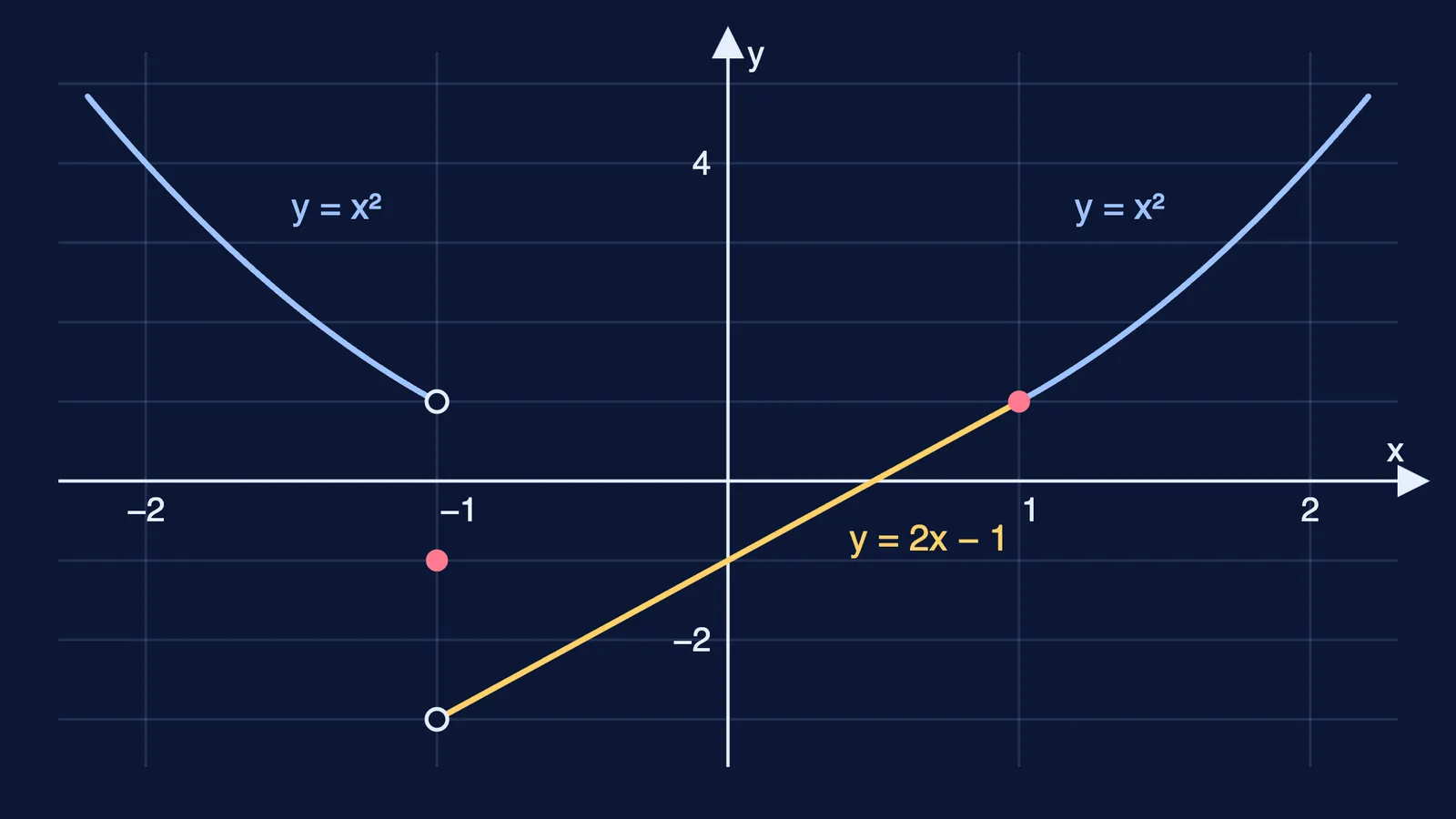
Q6 (hard, one or more options correct). Let f(x) = lim(n→∞) (x^(2n+2) + 2x − 1) / (x^(2n) + 1). Then
(A) f is continuous at x = 1 (B) f is differentiable at x = 1 (C) f is continuous at x = −1 (D) lim(x→−1⁺) f(x) = 1
Answer: (A), (B). For |x| < 1, x^(2n) → 0 and f(x) = 2x − 1. For |x| > 1, divide by x^(2n) to get f(x) = x². At x = ±1, f = (x² + 2x − 1)/2, so f(1) = 1 and f(−1) = −1. At x = 1 both pieces equal 1 with slope 2: (A) and (B) hold. At x = −1 the left limit is 1 and the right limit is −3: (C) and (D) fail. Trap: (D) uses x² just right of −1, where the line applies.
Q7 (hard, numerical value). For a positive integer p, let f(x) = |x|^p sin(1/x²) for x ≠ 0 and f(0) = 0. Find the smallest p for which f′ exists everywhere and is continuous at x = 0.
Answer: 4. f′(0) = lim(h→0) |h|^p sin(1/h²)/h, which is 0 for p ≥ 2 and does not exist for p = 1. For x > 0, f′(x) = p x^(p−1) sin(1/x²) − 2x^(p−3) cos(1/x²). At p = 3 the term −2cos(1/x²) oscillates between −2 and 2, so f′ has no limit at 0. At p = 4 both terms tend to 0. Trap: 3, carried over from the x^p sin(1/x) result.
Q8 (hard, single correct). lim(x→0) ((1 + sin x)/(1 + x cos x))^(1/x³) equals
(A) 1 (B) e^(1/3) (C) e^(−1/3) (D) e^(−1/6)
Answer: (B). A 1^∞ form, so take logs: ln(1 + sin x) − ln(1 + x cos x) = (sin x − x cos x) − (sin²x − x²cos²x)/2 + …. Since sin x − x cos x = x³/3 + …, the first bracket gives x³/3; the second is of order x⁴. The log of the limit is 1/3. Trap: (A) treats "base tends to 1" as "answer is 1"; (D) replaces x cos x by x.
What should you do after this set?
Series slips (Q1, Q4, Q8): expand until a term survives the cancellation. Piece or side slips (Q3, Q5, Q6): sketch the function first. For the basics behind these, see our guide to limits and continuity for JEE, with indeterminate forms.
For more practice, the Fermi Problem Library has worked problems with a step-by-step solver that explains the reasoning rather than printing an answer.