On this page
JEE (Advanced) 2027 will be held on 23 May 2027, a Sunday, with IIT Delhi as the organising institute, according to the official JEE (Advanced) website. To sit it, you must be among the top 2,50,000 candidates in the B.E./B.Tech paper of JEE (Main) 2027, as the eligibility page states. The 2027 syllabus has not been published yet, so this guide works from the official 2026 syllabus, which says it is unchanged from 2025.
What does the JEE Advanced syllabus say about limits, continuity and differentiability?
The JEE (Advanced) 2026 syllabus lists, under Mathematics, Differential Calculus:
Limit of a function at a real number, continuity of a function, limit and continuity of the sum, difference, product and quotient of two functions, L' Hospital rule of evaluation of limits of functions.
Continuity of composite functions, intermediate value property of continuous functions.
Derivative of a function, … chain rule, derivatives of polynomial, rational, trigonometric, inverse trigonometric, exponential and logarithmic functions.
Derivatives up to order two of implicit functions.
Unit 7 of the JEE (Main) 2027 syllabus covers limits, continuity, differentiability and derivatives of composite and implicit functions, but its text does not name L'Hospital's rule, the intermediate value property or continuity of composite functions. The Advanced list does, so give those three extra time. For basics, see our guides to limits and continuity for JEE and differentiability, corners and modulus functions.
How is this unit different at JEE Advanced level?
JEE (Advanced) 2026 had two compulsory papers of three hours each, according to the 2026 Information Brochure, which also said marking details would be given in the instructions at the time of the exam. Prepare for any format. Our explainer on JEE Advanced question types covers multiple-correct and numerical-answer thinking.
Depth is what changes. Three habits help:
Expand, then match orders. Write series to x³ and kill lower-order terms first.
Go one-sided on purpose. Wherever a modulus, floor or piecewise rule switches, find left and right derivatives separately.
Judge each option alone. In multiple-correct questions, x = 1 tells you nothing about x = 2.
What do Advanced-level problems on this unit look like?
These are original; each answer was checked with sympy.
Example 1 (limit with unknown constants). Find a and b so that lim (x → 0) of [a ln(1 + x) + b sin x − x²]/x³ is finite, and find the limit.
Expand: a(x − x²/2 + x³/3) + b(x − x³/6) − x². The x term must vanish, so a + b = 0. The x² term must vanish, so −a/2 − 1 = 0. That gives a = −2, b = 2, and the limit is the x³ coefficient: −2/3 − 2/6 = −1. L'Hospital's rule, applied three times, agrees but is slower.
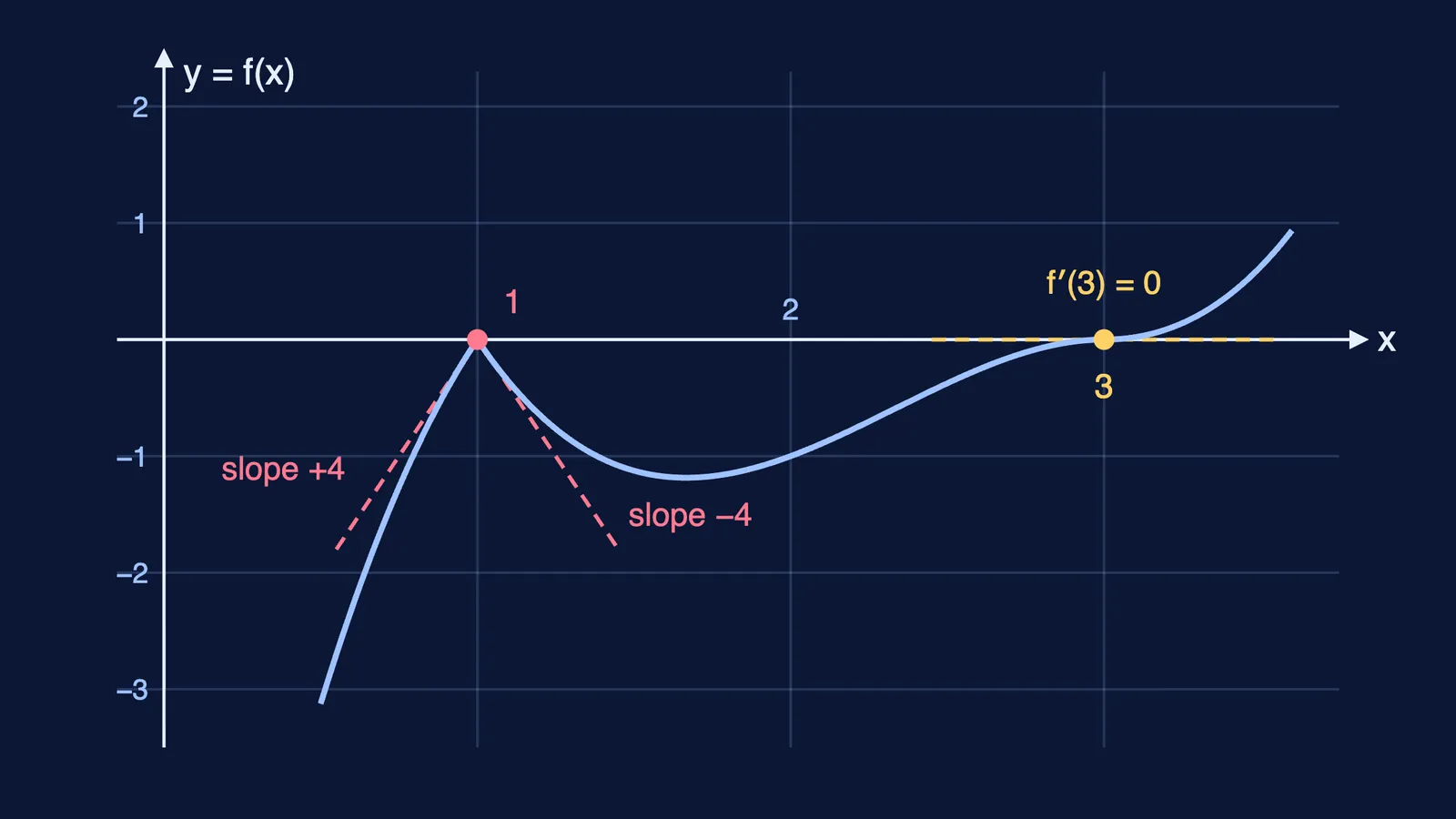
Example 2 (where is it differentiable?). Let f(x) = (x − 3)|x² − 4x + 3|. Is f differentiable at x = 1 and at x = 3?
Factor the modulus: f(x) = (x − 3)|x − 3||x − 1|. Near x = 3, (x − 3)|x − 3| is smooth with derivative 0 and |x − 1| is smooth, so f′(3) = 0 from both sides. Near x = 1, (x − 3)|x − 3| ≈ −4, so f ≈ −4|x − 1|: the left derivative is +4 and the right derivative is −4, a corner. Marking both zeros of the modulus as non-differentiable is the trap; only x = 1 is.
Example 3 (implicit, second order). The curve x² + xy + y³ = 3 passes through (1, 1). Find y′ and y″ there.
Differentiate: 2x + y + xy′ + 3y²y′ = 0, so y′ = −(2x + y)/(x + 3y²) = −3/4. Differentiate again: 2 + 2y′ + xy″ + 6y(y′)² + 3y²y″ = 0. At (1, 1): 2 − 3/2 + 27/8 + 4y″ = 0, so y″ = −31/32.
How should you plan your preparation for this unit?
Week 1: standard limits, series to x³, and the forms 0/0, ∞ − ∞ and 1^∞.
Week 2: L'Hospital's rule, and limits with unknown constants like Example 1.
Week 3: continuity of composite and piecewise functions; the intermediate value property to show an equation has a root.
Week 4: one-sided derivatives, inverse-trig chain rule, implicit second derivatives; mixed timed sets.
Keep an error log by mistake type. Is a step in a solution not making sense? The Fermi Problem Library has worked problems with a step-by-step solver that explains the reasoning rather than printing an answer.
Practice questions
Find lim (x → 0) of (e^(3x) − 1 − 3x)/(1 − cos 2x).
f(x) = [ln(1 + kx) − sin x]/x for x ≠ 0 and f(0) = 5. For which k is f continuous at 0?
Find the derivative of cos⁻¹(1 − 2x²) at x = −1/2.
Answers: 1. 9/4; 2. k = 6; 3. −4/√3 (for x < 0 the function equals −2 sin⁻¹ x, so the familiar +2/√(1 − x²) has the wrong sign).