On this page
Each JEE Main kinetic theory question hides one trap: Celsius instead of kelvin, a miscounted degree of freedom, or the wrong process. Here are 8 original questions, easy to hard, with worked solutions and the wrong option most students pick.
All of them sit inside Unit 9, Kinetic Theory of Gases, of the official Syllabus for JEE (Main) - 2027 published by NTA. The theory is NCERT Class 11 Physics Chapter 12, Kinetic Theory (Reprint 2026-27), with adiabatic work from Chapter 11, Thermodynamics. Take k_B = 1.38 × 10⁻²³ J K⁻¹ and R = 8.3 J mol⁻¹ K⁻¹.
How should you use this practice set?
Cover the answers; allow 15 minutes.
Q6 is a numerical-value question: write a number, not a letter.
Commit to an answer, then read the trap line even when right.
Redo the ones that caught you after three days.
New to the chapter? Read how to prepare Kinetic Theory of Gases for JEE Main.
Easy: can you turn PV = nRT into molecules and energy?
Q1 (easy). A vacuum chamber is pumped down to 1.38 × 10⁻³ Pa at 27 °C. About how many gas molecules are left in each cubic centimetre?
(A) 3.3 × 10¹¹ (B) 3.7 × 10¹² (C) 3.3 × 10¹⁷ (D) 3.3 × 10²³
Answer: (A). From P = nk_BT, n = 1.38 × 10⁻³ / (1.38 × 10⁻²³ × 300) = 3.3 × 10¹⁷ m⁻³. Per cm³: 3.3 × 10¹¹. Trap: (C) is the right number per cubic metre; (B) uses T = 27; (D) multiplies by 10⁶ instead of dividing.
Q2 (easy). A cylinder holds 4 g of helium and 14 g of nitrogen at a total pressure of 3.0 × 10⁵ Pa. What is the partial pressure of nitrogen?
(A) 2.0 × 10⁵ Pa (B) 1.5 × 10⁵ Pa (C) 1.0 × 10⁵ Pa (D) 2.33 × 10⁵ Pa
Answer: (C). Kinetic theory gives Dalton's law: pressure depends on the number of molecules, not their mass (NCERT 12.4). Helium is 1 mol, nitrogen 0.5 mol, so nitrogen gets 1/3 of the total. Trap: (D) splits by mass, (A) swaps the two gases.
Q3 (easy). What is the ratio of the internal energy of 1 mol of hydrogen (rigid diatomic) at 300 K to that of 1 mol of helium at 450 K?
(A) 2/3 (B) 10/9 (C) 5/3 (D) 14/9
Answer: (B). By equipartition U = (f/2)RT per mole, with f = 5 for a rigid diatomic and 3 for a monatomic gas (NCERT Sections 12.5-12.6). Ratio = (5/2 × 300)/(3/2 × 450) = 750/675 = 10/9. Trap: (A) counts only translational energy; (D) adds a vibrational mode the question rules out.
Medium: can you link molecules to pressure, speed and heat?
Q4 (medium). A cubical box of side 20 cm holds 3.0 × 10²³ molecules, each of mass 4.0 × 10⁻²⁶ kg, with an rms speed of 500 m/s. What pressure do they exert?
(A) 250 Pa (B) 2.5 × 10⁴ Pa (C) 3.75 × 10⁵ Pa (D) 1.25 × 10⁵ Pa
Answer: (D). NCERT's P = (1/3)nm⟨v²⟩ with n = N/V and V = (0.20)³ = 8.0 × 10⁻³ m³: P = (3.0 × 10²³ × 4.0 × 10⁻²⁶ × 2.5 × 10⁵)/(3 × 8.0 × 10⁻³) = 1.25 × 10⁵ Pa. Trap: (C) drops the 1/3; (B) divides by the face area instead of the volume; (A) forgets to square the speed.
Q5 (medium). Helium (M = 4 g/mol) is at 200 K. At what temperature does argon (M = 40 g/mol) have the same rms speed?
(A) 20 K (B) 632 K (C) 2000 K (D) 1727 K
Answer: (C). v_rms = √(3RT/M), so equal speeds need equal T/M: T = 200 × 40/4 = 2000 K. Trap: (B) takes a square root of the mass ratio; (A) inverts it; (D) is the Celsius value labelled kelvin.
Q6 (medium, numerical value). Heated at constant pressure, 2.0 mol of a gas of rigid non-linear triatomic molecules absorbs 3320 J. By how many joules does its internal energy rise?
Answer: 2490. With six degrees of freedom (three translational, three rotational), C_v = 3R and C_p = 4R (NCERT Eq. 12.36 with no vibrational modes). Q = nC_pΔT gives ΔT = 3320/(2 × 4 × 8.3) = 50 K, so ΔU = nC_vΔT = 2 × 3 × 8.3 × 50 = 2490 J. Trap: 2371 uses the diatomic ratio 5/7, 1992 the monatomic 3/5, and 830 is the work done, not ΔU.
Hard: collisions and adiabatic compression
Q7 (hard). An ideal gas in a sealed rigid container is heated from 300 K to 600 K. What happens to the mean free path l and the average time τ between collisions?
(A) l doubles, τ rises by √2 (B) l unchanged, τ falls to 1/√2 of its value (C) both unchanged (D) l doubles, τ unchanged
Answer: (B). NCERT gives l = 1/(√2nπd²), which depends only on n, and n is fixed in a sealed rigid box. τ is l divided by the mean speed, √(8RT/πM) (OpenStax University Physics Vol. 2, 2.4), so doubling T raises the speed by √2 and τ falls to 1/√2. Trap: (A) uses l ∝ T/P, true only at constant pressure.
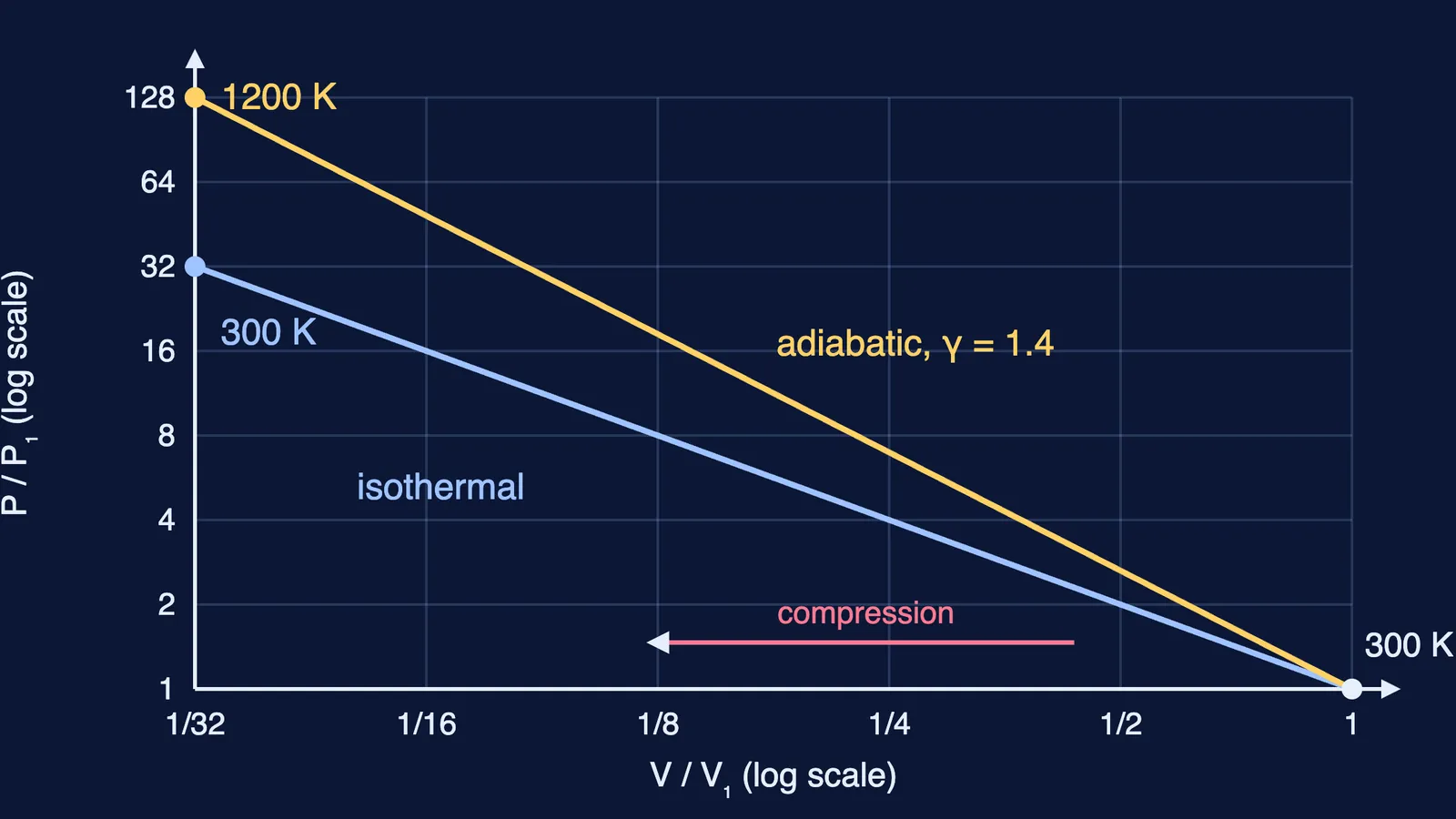
Q8 (hard). One mole of a rigid diatomic gas at 300 K is compressed adiabatically and reversibly to 1/32 of its volume. How much work is done on the gas?
(A) 18.7 kJ (B) 8.6 kJ (C) 26.1 kJ (D) 33.9 kJ
Answer: (A). With γ = 7/5, TV^(γ−1) is constant, so T₂ = 300 × 32^0.4 = 300 × 4 = 1200 K. NCERT's adiabatic result W = μR(T₁ − T₂)/(γ − 1) gives work on the gas = 8.3 × 900/0.4 = 18.7 kJ, equal to C_vΔT. Trap: (B) is the isothermal RT ln 32; (C) uses C_p; (D) uses the monatomic γ = 5/3.
What should you do after this set?
Sort every miss into one bin: units, kelvin, a lost factor (1/3, a square, a root) or the wrong process. Two misses in a bin show what to drill. If a method keeps breaking, the Fermi Problem Library has worked problems with a step-by-step solver that explains the reasoning rather than printing an answer.
For the three molecular speeds, read most probable, average and rms speed and their ratio. For adiabatic and isothermal work, see our Thermodynamics for JEE Main guide.