On this page
Eight original JEE Main-style questions on waves and sound, graded easy to hard. Each has a worked solution and a trap line naming the most tempting wrong option. Q5 is a numerical-value question. SHM is left for a separate oscillations set.
How should you use this waves and sound question set?
NTA's Syllabus for JEE (Main) - 2027 puts waves in Unit 10, Oscillations and Waves. Its waves topics run from wave speed and the progressive wave equation to superposition, reflection, standing waves in strings and organ pipes, and beats. Every question here stays inside that list and inside NCERT Class 11 Physics Chapter 14, Waves (Reprint 2026-27).
Take 20 minutes, on paper, without a calculator.
Write the relation before the numbers; sketch nodes for strings and pipes.
Read every trap line, even where you were right.
New to the chapter? Start with our guide on how to prepare waves and sound for JEE Main.
Easy: phase, temperature and wave speed on wires
Q1 (easy). A sound wave of frequency 250 Hz travels at 300 m/s. What is the phase difference between two points 0.40 m apart along its direction of travel?
(A) 60° (B) 90° (C) 120° (D) 240°
Answer: (C). λ = v/f = 300/250 = 1.2 m. Phase difference = 360° × Δx/λ = 360° × 0.40/1.2 = 120°.
Trap: (A) uses 180° × Δx/λ, treating one wavelength as a phase of π instead of 2π.
Q2 (easy). Sound travels at 340 m/s in air at 17 °C. Treating air as an ideal gas, at what temperature will it travel at 360 m/s?
(A) 19 °C (B) 34 °C (C) 52 °C (D) 325 °C
Answer: (C). From v = √(γP/ρ) and the ideal gas law, v ∝ √T with T in kelvin. T = 290 × (360/340)² ≈ 325 K, which is about 52 °C.
Trap: (A) applies the ratio to 17 °C; the proportion holds only in kelvin.
Q3 (easy). Wires A and B are made of the same metal. B has twice the diameter of A and is under twice the tension. What is the ratio of transverse wave speeds, v_A : v_B?
(A) 1 : √2 (B) 1 : 1 (C) √2 : 1 (D) 2 : 1
Answer: (C). v = √(T/μ), and μ ∝ d². For B, T doubles and μ quadruples, so v_B = v_A × √(2/4) = v_A/√2. The ratio is √2 : 1.
Trap: (B) takes μ ∝ d, so the two changes seem to cancel.
Medium: standing waves, pipes and beats
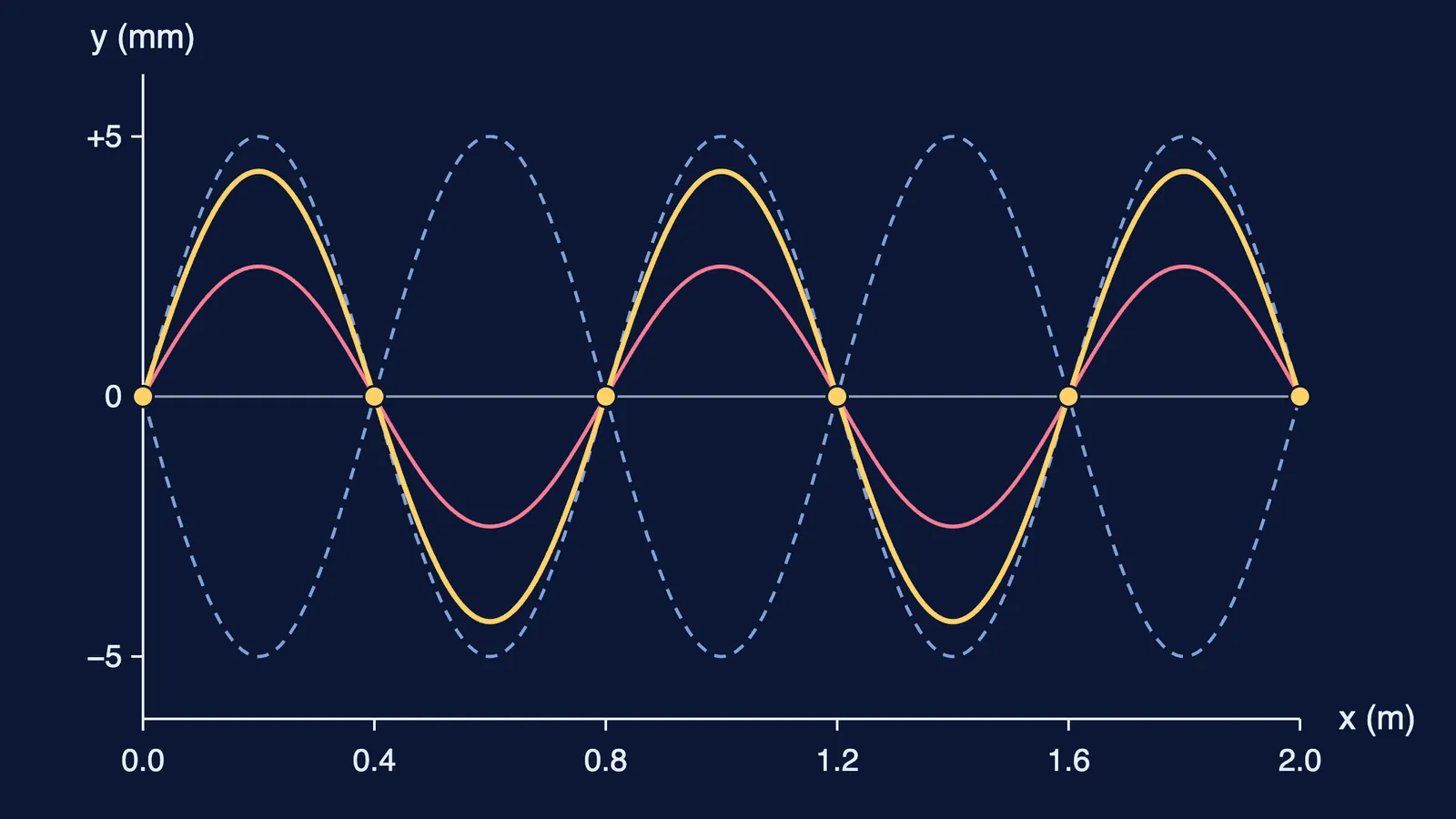
Q4 (medium). A string 2.0 m long, fixed at both ends, vibrates as y = 0.005 sin(2.5πx) cos(500πt), in SI units. What is the string's fundamental frequency?
(A) 50 Hz (B) 100 Hz (C) 125 Hz (D) 250 Hz
Answer: (A). k = 2.5π rad/m gives λ = 0.8 m, and ω = 500π rad/s gives f = 250 Hz. Nodes are λ/2 = 0.4 m apart, so the string holds 5 loops: this is the fifth harmonic. The fundamental is 250/5 = 50 Hz.
Trap: (D) is the frequency of the mode given, not the fundamental.
Q5 (medium, numerical). A pipe has two consecutive natural frequencies of 425 Hz and 595 Hz. Find its fundamental frequency in hertz.
Answer: 85. An open pipe's frequencies would all be multiples of the 170 Hz gap, but 425/170 = 2.5. So the pipe is closed at one end, with odd harmonics only, and consecutive ones differ by 2f₁. Then f₁ = 170/2 = 85 Hz, and 425 and 595 are its 5th and 7th harmonics.
Trap: 170, which assumes an open pipe.
Q6 (medium). Two pipes, each open at both ends, are 50 cm and 51 cm long. Both sound their fundamentals. Use v = 340 m/s. About how many beats per second are heard?
(A) 3.3 (B) 6.7 (C) 13.3 (D) 340
Answer: (B). An open pipe's fundamental is v/2L: 340/1.00 = 340 Hz and 340/1.02 ≈ 333.3 Hz. The beat frequency is the difference, about 6.7 per second.
Trap: (A) uses v/4L, the closed-pipe formula, which halves the gap.
Hard: reflection and a wire that matches a pipe
Q7 (hard). A wave y = a sin(kx − ωt) travels along a string towards a rigidly fixed end at x = 0. Which expression gives the reflected wave?
(A) a sin(kx + ωt) (B) −a sin(kx + ωt) (C) a sin(kx − ωt) (D) a cos(kx + ωt)
Answer: (A). The reflected wave travels towards −x, so it contains kx + ωt, and the fixed end must stay at zero displacement. At x = 0, the incident wave gives −a sin ωt and (A) gives +a sin ωt, which cancel. Reversing the direction alone gives (B); the phase change of π at a rigid boundary flips it to (A).
Trap: (B) leaves out the phase change, so at x = 0 it doubles the displacement. (D) travels along −x but leaves the fixed end moving.
Q8 (hard). A wire 60 cm long, with mass per unit length 5.0 g/m, is fixed at both ends. Its third harmonic is in resonance with the first overtone (the second-lowest natural frequency) of a pipe 51 cm long, closed at one end. Take the speed of sound as 340 m/s. What is the tension in the wire?
(A) 22.2 N (B) 88.9 N (C) 200 N (D) 1800 N
Answer: (C). A closed pipe has only odd harmonics, so its second-lowest frequency is 3v/4L = 3 × 340/(4 × 0.51) = 500 Hz. The wire's third harmonic is 3v_w/2L, so v_w = 500 × 2 × 0.60/3 = 200 m/s. Then T = μv_w² = 0.005 × 200² = 200 N.
Trap: (B) takes the overtone as the second harmonic, 2v/4L ≈ 333 Hz, which a closed pipe cannot produce.
What should you do after checking your answers?
Sort each miss: wrong relation (Q2, Q3), wrong mode (Q4, Q5, Q6, Q8) or wrong sign or phase (Q1, Q7). Redo them the next day without the solutions.
If you cannot see where a solution went wrong, the Fermi Problem Library has worked problems with a step-by-step solver that explains the reasoning rather than printing an answer.
Next, see where a standing wave's amplitude is half its maximum. For the other half of the unit, read how to prepare oscillations for JEE Main.