On this page
Most GOC questions in NEET do not ask for a definition. They give you a structure and test one counting rule or one electron shift. This set has 8 original single-correct questions on Some Basic Principles of Organic Chemistry, from easy to hard, and each wrong option is a mistake students really make.
Every question stays inside Unit 14 of the NEET (UG) syllabus published by NTA and sections 8.1 to 8.7 of NCERT Class 11 Chemistry Unit 8 (Reprint 2026-27). The counts in Q1, Q2, Q4, Q6 and Q8 were checked with a short Python script.
How should you use this GOC practice set?
As in NEET-UG 2026, each correct answer earns +4 and each wrong one costs −1, with 180 minutes for the paper (NEET (UG)-2026 information bulletin, NTA). So a guess has a price. Work like this:
Cover the answers and allow about a minute per question.
Before you look at the options, write down the count or the effect you will use: σ bonds, α-hydrogens, the principal group.
Read the trap line even when you were right; it is the mistake you will make under time pressure.
Redo every miss two days later without the options.
If the chapter itself feels new, read GOC for NEET: how to prepare, with worked examples first.
Easy: can you count bonds and spot the right series?
Q1 (easy). How many σ and π bonds are there in HC≡C–CH=CH–CHO?
(A) 9 σ, 4 π (B) 10 σ, 3 π (C) 8 σ, 5 π (D) 9 σ, 3 π
Answer: (A). Each bond, single or multiple, contains exactly one σ bond. C₅H₄O has 4 C–H bonds, 4 bonds between carbons and 1 C=O, so 9 σ. The extra bonds are π: 2 in C≡C, 1 in C=C and 1 in C=O, so 4 π. Trap: (D) forgets the π bond in the aldehyde group.
Q2 (easy). Which pair are consecutive members of the same homologous series?
(A) CH₃OH and CH₃OCH₃ (B) CH₃CHO and CH₃COCH₃ (C) HCOOH and CH₃COOH (D) C₂H₅OH and C₂H₅OC₂H₅
Answer: (C). NCERT defines a homologous series as compounds with the same characteristic functional group whose successive members differ by a –CH₂ unit. Both acids carry –COOH and differ by exactly CH₂. Trap: (A) and (B) also differ by CH₂, but each pair has two different functional groups (alcohol and ether; aldehyde and ketone).
Q3 (easy). Which set contains only electrophiles?
(A) AlCl₃, (CH₃)₃C⁺, CH₃CH₂Br (B) (CH₃)₂NH, CN⁻, H₂O (C) CH₃⁺, CH₃⁻, BF₃ (D) NH₃, AlCl₃, CH₃⁺
Answer: (A). Al in AlCl₃ has only six valence electrons and can accept a pair; the carbocation carbon has a sextet; the carbon bonded to Br carries a partial positive charge from the polar C–Br bond. Trap: (C) has two genuine electrophiles, CH₃⁺ and BF₃, but the carbanion CH₃⁻ has a lone pair, which makes it a nucleophile.
Medium: can you apply the electronic effects?
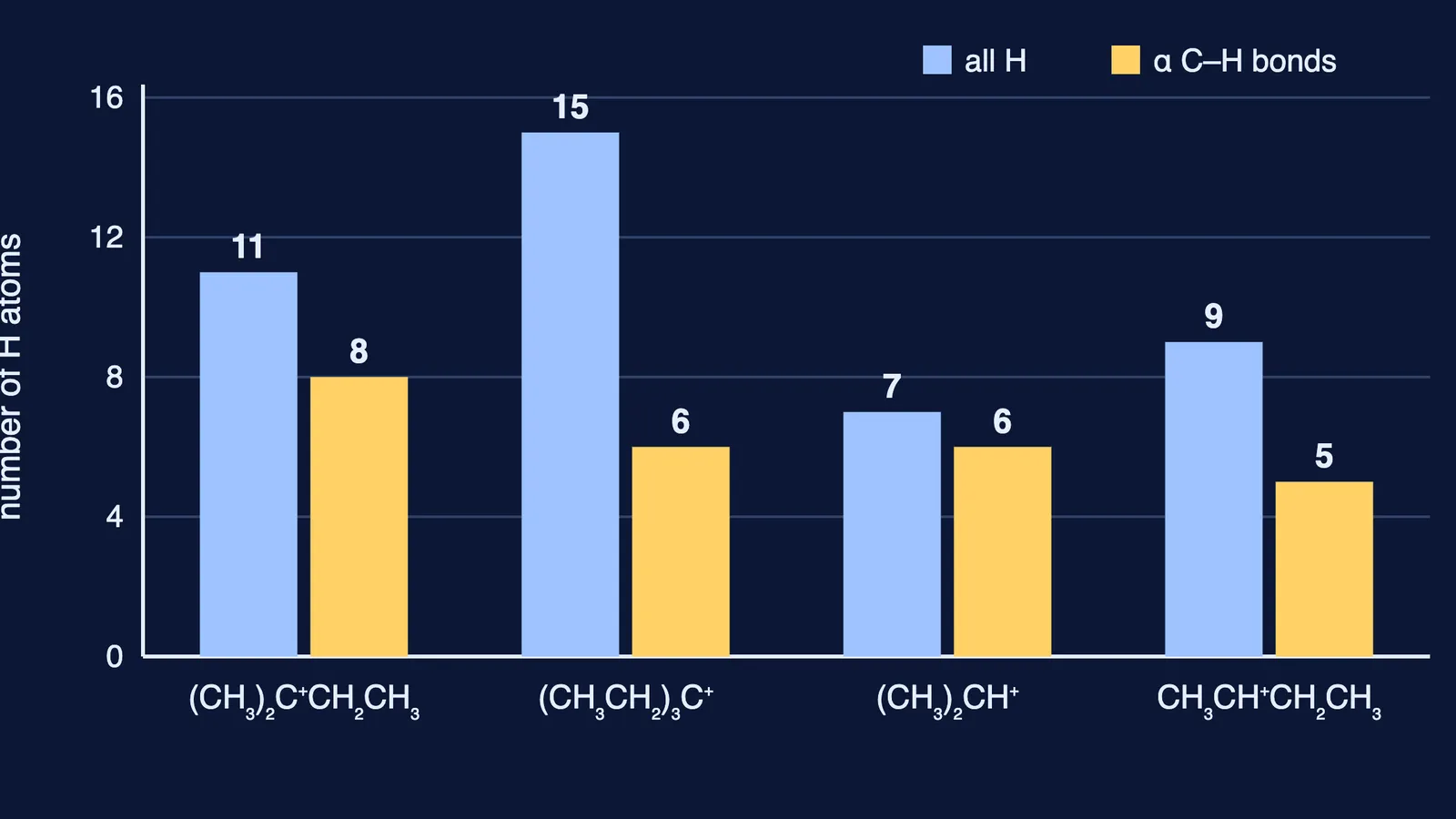
Q4 (medium). Which carbocation has the largest number of C–H bonds able to take part in hyperconjugation?
(A) (CH₃)₂C⁺CH₂CH₃ (B) (CH₃CH₂)₃C⁺ (C) (CH₃)₂CH⁺ (D) CH₃CH⁺CH₂CH₃
Answer: (A). Only C–H bonds on carbons directly attached to the positive carbon count. In (A): two CH₃ groups give 6 and the CH₂ gives 2, so 8. (B) gives 3 × 2 = 6, (C) gives 6 and (D) gives 3 + 2 = 5. Trap: (B) has the most hydrogens overall (15) and three alkyl groups, but only six sit on α-carbons. The chart above compares both counts.
Q5 (medium). Which pair are NOT resonance structures of each other?
(A) CH₂=CH–CH₂⁺ and ⁺CH₂–CH=CH₂ (B) H–C(=O)–O⁻ and H–C(–O⁻)=O (C) CH₃–CO–CH₃ and CH₂=C(OH)–CH₃ (D) CH₂=CH–O–CH₃ and ⁻CH₂–CH=O⁺–CH₃
Answer: (C). NCERT's rule is that resonance structures keep the same positions of nuclei and the same number of unpaired electrons. In (C) a hydrogen has moved from carbon to oxygen, so these are two different compounds. Trap: (D) looks wrong because of the separated charges, but no nucleus moves; it is a valid, minor contributor.
Q6 (medium). How many structural isomers of C₅H₁₂O are ethers?
(A) 4 (B) 6 (C) 7 (D) 14
Answer: (B). Split the five carbons across the oxygen. Methyl and butyl give four (1-methoxybutane, 2-methoxybutane, 1-methoxy-2-methylpropane, 2-methoxy-2-methylpropane); ethyl and propyl give two (1-ethoxypropane, 2-ethoxypropane), so 6. Ethers that differ only in the alkyl groups on either side of the oxygen, such as 1-methoxybutane and 1-ethoxypropane, are metamers. Trap: (A) stops at the methyl ethers; (C) also counts the two mirror-image forms of 2-methoxybutane, which are stereoisomers, not structural isomers; (D) adds the eight alcohols, which are functional group isomers of these ethers.
Hard: can you combine two rules at once?
Q7 (hard). Which carbocation is the most stable?
(A) (CH₃)₂CH⁺ (B) (CH₃)₃C⁺ (C) CF₃–C⁺(CH₃)₂ (D) CH₃⁺
Answer: (B). Three methyl groups donate electron density and supply nine α C–H bonds for hyperconjugation. Trap: (C) is also tertiary, but fluorine pulls electrons strongly (–I), so the CF₃ group withdraws density from a carbon that is already short of electrons, and its carbon carries no C–H bonds to help.
Q8 (hard). What is the IUPAC name of HOOC–CH₂–CH(CN)–CH₂–CH=CH₂?
(A) 3-cyanohex-5-enoic acid (B) 4-cyanohex-1-en-6-oic acid (C) 2-(carboxymethyl)pent-4-enenitrile (D) 3-cyanohept-6-enoic acid
Answer: (A). –COOH ranks above –CN in NCERT's priority list, so it is the suffix and its carbon is C1. The longest chain through C1 has six carbons and ends at the double bond, putting CN on C3 and the double bond at C5. Trap: (C) makes the nitrile the principal group; (D) adds the nitrile carbon to the chain length, but a –CN carbon attached to the chain is named as the cyano prefix.
What should you do after scoring yourself?
7 or 8 correct: move on to timed mixed sets that combine GOC with the next units.
4 to 6 correct: for each miss, name the rule you skipped (α-carbon only, priority order, nuclei fixed) and redo it tomorrow.
3 or fewer: reread NCERT sections 8.5 to 8.7, then try the set again in a week.
Hybridisation and bond counting come from chemical bonding, so if Q1 slowed you down, try the chemical bonding NEET practice questions. Carbocations and resonance return in the Hydrocarbons NEET practice questions.
For more naming and stability problems, the Fermi Problem Library has worked problems with a step-by-step solver that explains the reasoning rather than printing an answer.