On this page
NEET bonding questions are short, but each checks one rule applied cleanly: count lone pairs, fill orbitals in the right order, add bond moments as vectors. These 8 original questions run easy to hard; every wrong option is a real slip.
All of them stay inside Unit 3, Chemical Bonding and Molecular Structure, of the NEET (UG) syllabus posted by NTA, and inside NCERT Class 11 Chemistry Part I, Unit 4 (Reprint 2026-27). Bond angles and dipole moments used below are NCERT's values.
How should you use this chemical bonding practice set?
Cover the solutions. NEET (UG)-2026 had 180 compulsory questions in 180 minutes, according to the NTA information bulletin, so give each question about a minute.
Before you look at the options, write one line: the count or rule you will use.
Read the trap line even when you are right.
Log each miss with the rule you broke; redo it in three days.
For the full chapter plan, read how to prepare chemical bonding for NEET.
Easy: can you count bonds and recall NCERT facts?
Q1 (easy). How many σ and π bonds are there in CH₂=CH–C≡C–CHO?
(A) 9σ, 4π (B) 8σ, 4π (C) 9σ, 3π (D) 13σ, 4π
Answer: (A). Every bond between two atoms contains exactly one σ bond: four C–H, four carbon–carbon bonds and one C=O give 9σ. The extra bonds are π: one in C=C, two in C≡C and one in C=O, so 4π. Trap: (D) counts all 13 lines of the structure as σ bonds, but a double or triple bond holds only one σ bond; (C) forgets the π bond in C=O.
Q2 (easy). Which statement about hydrogen bonding matches NCERT?
(A) In HF, the hydrogen bond forms within a single molecule. (B) In o-nitrophenol, the hydrogen bond is intramolecular, with H between two oxygen atoms of the same molecule. (C) A hydrogen bond is stronger than a covalent bond. (D) Hydrogen bonding is strongest in the gaseous state.
Answer: (B). NCERT uses o-nitrophenol as its example of an intramolecular hydrogen bond. Trap: (A) swaps the two types; HF is NCERT's example of intermolecular bonding. (C) and (D) are reversed: a hydrogen bond is weaker than a covalent bond, and strongest in the solid state.
Q3 (easy). Which molecule has polar bonds but zero dipole moment?
(A) SO₂ (B) SF₄ (C) ClF₃ (D) XeF₄
Answer: (D). Xe in XeF₄ has 4 bond pairs and 2 lone pairs. The lone pairs sit opposite each other, the shape is square planar, and the four Xe–F bond moments cancel in pairs. Trap: (B) also has four fluorines, but SF₄'s single lone pair makes it see-saw shaped, so its bond moments do not cancel.
Medium: can you apply VSEPR, Fajans' rules and MO order?
The angles in Q4 are from NCERT Unit 4.
Q4 (medium). Arrange the H–N–H bond angles in NH₄⁺, NH₃ and NH₂⁻.
(A) NH₄⁺ > NH₃ > NH₂⁻ (B) NH₂⁻ > NH₃ > NH₄⁺ (C) NH₃ > NH₄⁺ > NH₂⁻ (D) all equal, 109.5°
Answer: (A). Each has four electron pairs on N, with 0, 1 and 2 lone pairs. NH₄⁺ is a regular tetrahedron at 109.5°. NCERT gives 107° for NH₃, because lone pair–bond pair repulsion is stronger than bond pair–bond pair repulsion. Two lone pairs in NH₂⁻ close the angle further, as in water at 104.5°. Trap: (D) assumes the same sp³ hybridisation means the same angle; lone pairs change it.
Q5 (medium). Which compound has the most covalent character?
(A) CaF₂ (B) CaCl₂ (C) CaI₂ (D) BaI₂
Answer: (C). By Fajans' rules, covalent character grows as the cation gets smaller and the anion larger. Iodide is the largest anion here, and Ca²⁺ is smaller than Ba²⁺, so Ca²⁺ polarises it more. Trap: (D) has the same anion, but its larger cation distorts the iodide less.
Q6 (medium). Which species is diamagnetic?
(A) B₂ (B) O₂ (C) O₂⁻ (D) C₂
Answer: (D). For B₂, C₂ and N₂, NCERT places π2p below σ2p. C₂'s 8 valence electrons fill σ2s², σ*2s², π2p⁴: all paired, bond order 2. B₂'s 6 valence electrons leave one electron in each π2p orbital, and O₂ and O₂⁻ keep two and one unpaired π* electrons. Trap: (A) is what you get by using the O₂ order for B₂, which pairs its last two electrons in σ2p. See why B₂ is paramagnetic.
Hard: can you combine MO counts and dipole vectors?
Q7 (hard). Which change raises the bond order and also leaves the product with no unpaired electrons?
(A) O₂ → O₂⁺ (B) O₂ → O₂²⁻ (C) N₂ → N₂⁺ (D) O₂ → O₂²⁺
Answer: (D). O₂ has 12 valence electrons, bond order (8 − 4)/2 = 2, with two unpaired electrons in π*2p. Removing both π* electrons gives O₂²⁺, with 10 valence electrons like N₂: bond order (8 − 2)/2 = 3, all paired. Trap: (A) does raise the bond order to 2.5 but leaves one unpaired electron; (B) pairs everything but drops the bond order to 1.
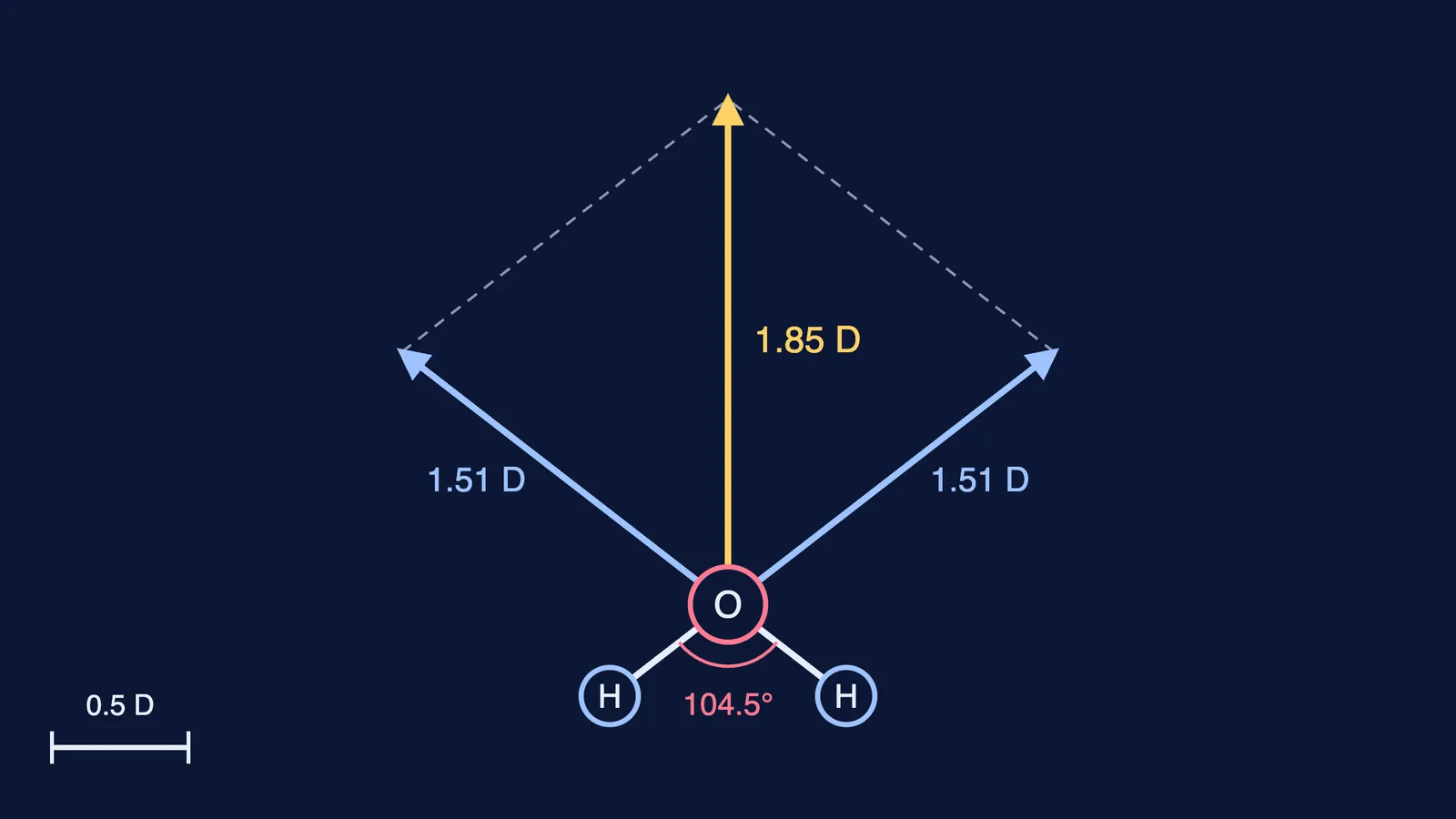
Q8 (hard). NCERT Unit 4 gives water a dipole moment of 1.85 D and an H–O–H angle of 104.5°. Treating the net moment as the vector sum of two equal O–H bond moments, what is each bond moment?
(A) 0.93 D (B) 1.17 D (C) 1.51 D (D) 3.02 D
Answer: (C). The two bond moments add along the bisector, so μ = 2μ(O–H) cos(104.5°/2). Then μ(O–H) = 1.85 ÷ (2 × cos 52.25°) = 1.85 ÷ 1.224 = 1.51 D. Trap: (A) simply halves 1.85 D, as if the two moments were parallel; (B) uses sine instead of cosine. The diagram at the top draws this sum to scale.
What should you do after checking your answers?
7 or 8 correct: move on to mixed timed sets that combine bonding with p-block shapes.
4 to 6 correct: redo each miss tomorrow on a blank page, writing the count before the options.
3 or fewer: reread the VSEPR and MO sections of NCERT Unit 4, then our explainer on why CH₄, NH₃ and H₂O angles shrink, and try the set again in a week.
If a step still does not click, the Fermi Problem Library has worked problems with a step-by-step solver that explains the reasoning rather than printing an answer.