On this page
Shapes, hybridisation, bond order and magnetism from this chapter turn up again in p-block, coordination and organic questions. Learn it as a few methods, not a list of exceptions.
What does the NEET-UG syllabus include in chemical bonding?
The NEET-UG syllabus finalised by the National Medical Commission and posted by NTA lists Unit 3, Chemical Bonding and Molecular Structure, under Physical Chemistry (NEET-UG syllabus, NTA). It covers:
Kossel-Lewis approach to chemical bond formation; ionic and covalent bonds; factors affecting the formation of ionic bonds and calculation of lattice enthalpy
electronegativity, Fajan's rule, dipole moment, and VSEPR theory and shapes of simple molecules
valence bond theory, hybridisation involving s, p and d orbitals, and resonance
molecular orbital theory: LCAOs, bonding and antibonding orbitals, sigma and pi bonds, molecular orbital configurations of homonuclear diatomic molecules, bond order, bond length and bond energy
an elementary idea of metallic bonding, and hydrogen bonding and its applications
This maps to Unit 4 of the NCERT Class 11 Chemistry Part I textbook, whose 2026-27 reprint runs from the Kossel-Lewis approach (4.1) to hydrogen bonding (4.9), including hybridisation involving d orbitals (NCERT Unit 4). One gap: the NCERT chapter has no section on metallic bonding, though the syllabus still names it, so learn the basic electron-sea idea separately.
How is it tested in NEET?
In NEET-UG 2026, the paper had 180 compulsory questions in 180 minutes, 45 of them in Chemistry, with +4 for a correct answer and -1 for a wrong one (NEET-UG 2026 information bulletin, NTA). That is about a minute per question, all single-correct MCQs, with no numerical section. Expect three styles: NCERT statement checks ("which statement is incorrect?"), assertion-reason pairs, and quick comparisons (highest bond order, largest bond angle, paramagnetic species). A short method for each, plus elimination, gives speed.
How do you find shape and hybridisation fast?
Use the steric number: half of (valence electrons of the central atom + number of monovalent atoms bonded - positive charge + negative charge). Steric number 4 means sp³, 5 means sp³d, 6 means sp³d².
Worked example 1. TeCl₄: (6 + 4)/2 = 5, so sp³d. Four Cl atoms use four pairs, leaving one lone pair, which sits equatorial: the shape is see-saw. BrF₂⁺: (7 + 2 - 1)/2 = 4, so sp³, with two lone pairs: bent, not linear. IF₄⁻: (7 + 4 + 1)/2 = 6, so sp³d², with two lone pairs placed opposite each other: square planar.
How do you get bond order and magnetism without drawing the full diagram?
Count valence electrons and fill the orbitals in order. For O₂ and F₂, σ2p comes below π2p; for N₂ and lighter molecules, π2p comes first, as the NCERT chapter explains (NCERT Unit 4). Bond order is half of (bonding electrons - antibonding electrons).
Worked example 2. Arrange C₂⁺, C₂, C₂⁻ and C₂²⁻ by bond length. They have 7, 8, 9 and 10 valence electrons, filled in the π-first order. The ninth and tenth electrons go into σ2p, a bonding orbital. So bond orders are 1.5, 2, 2.5 and 3, and the bond gets shorter as electrons are added: C₂²⁻ < C₂⁻ < C₂ < C₂⁺. Unpaired electrons are 1, 0, 1 and 0, so C₂⁺ and C₂⁻ are paramagnetic. In O₂ ions, added electrons enter π* and lengthen the bond instead.
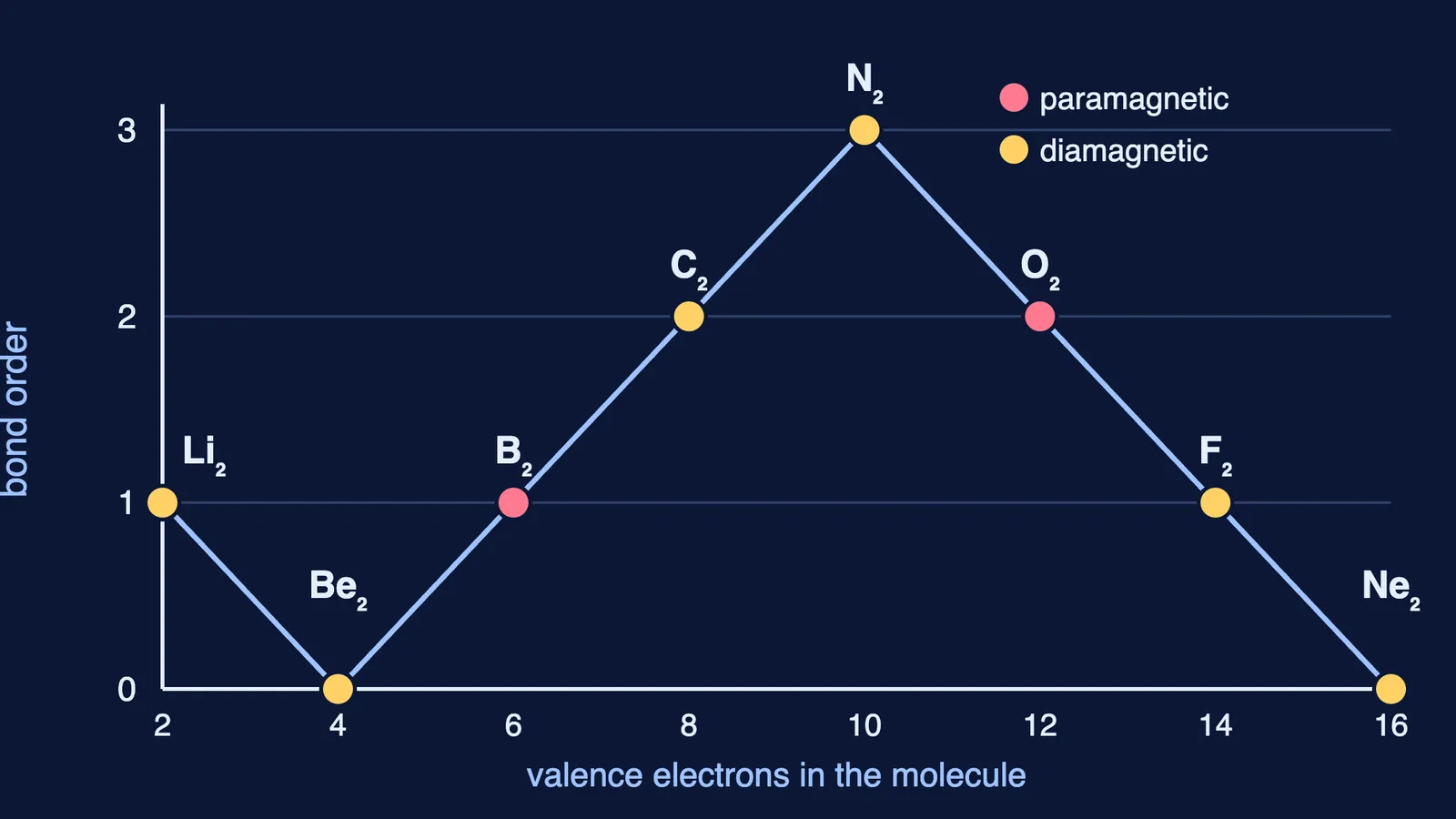
The chart at the top applies this counting from Li₂ to Ne₂: bond order peaks at N₂; B₂ and O₂ are paramagnetic.
Stuck on a step? The Fermi Problem Library has worked problems with a step-by-step solver that explains the reasoning rather than printing an answer.
What are the common traps?
Treating bond order 0 (He₂, Be₂) as a weak bond; it predicts no stable molecule.
Forgetting the π-before-σ switch for B₂, C₂ and N₂, which flips B₂ from diamagnetic to paramagnetic.
Fajans' rules backwards: a smaller cation and a larger anion mean more covalent character, so LiI is more covalent than KI.
A two-week practice plan
Days 1-3: read NCERT Unit 4 line by line and rewrite its tables from memory. Our guide on how to study NCERT for NEET explains the method.
Days 4-6: timed steric-number drills on 20 species.
Days 7-9: MO configurations for every homonuclear diatomic and its ions; predict bond order, length and magnetism.
Days 10-12: mixed MCQs and assertion-reason sets; tag each miss with the rule you broke.
Days 13-14: one timed set of 30 questions in 30 minutes, then redo the misses.
If the gap is a concept, not the method, the Fermi Concept Library covers every concept in physics, chemistry, biology, mathematics and computing, each with its own lesson and its place in the map.
Try these: (a) hybridisation and shape of XeF₃⁺; (b) which of B₂⁺ and B₂ has the longer bond; (c) is N₂²⁻ paramagnetic? Answers: sp³d (T-shaped), B₂⁺ (bond order 0.5 against 1), and yes (two unpaired electrons in π*).
For board-style answers, see our Class 11 chemical bonding guide; if you are also writing JEE, compare the approach in how to prepare chemical bonding for JEE Main.