On this page
Plant anatomy MCQs test one NCERT line at a time: which guard-cell wall is thick, which layer starts a lateral root. These eight questions are new and checked against the current textbook.
Which parts of Anatomy of Flowering Plants does this set test?
The NEET (UG)-2026 syllabus issued by the National Medical Commission lists tissues and the anatomy of root, stem and leaf in Biology Unit 2, Structural Organisation in Animals and Plants. The source text for this set is Chapter 6 of NCERT Class 11 Biology, Reprint 2026-27.
If you have not read the chapter yet, start with our guide on how to prepare Anatomy of Flowering Plants for NEET, and keep the monocot vs dicot comparison open for the stem and root questions.
How should you use this practice set?
Cover the answers and allow about a minute per question.
Give a reason for every option you reject.
Read the trap line even when you were right.
Write each trap that caught you on a card and reread the cards before your next mock test.
Easy: tissue systems, stomata and the root
Q1 (easy). In a primary dicot stem, the pericycle, pith and medullary rays belong to which tissue system?
(A) Epidermal tissue system
(B) Ground tissue system
(C) Vascular tissue system
(D) Meristematic tissue
Answer: (B). NCERT defines ground tissue as all tissues except the epidermis and vascular bundles, so the pericycle, pith and medullary rays all belong to it. Trap: (C) tempts because the pericycle lies inside the stele, but the vascular tissue system is only xylem and phloem.
Q2 (easy). A student examines a stoma on the leaf of a grass. Which description is correct?
(A) The guard cells are bean-shaped
(B) The inner walls of the guard cells, facing the pore, are highly thickened
(C) The guard cells lack chloroplasts
(D) The stomatal apparatus means the pore and guard cells only
Answer: (B). The inner walls towards the pore are thick and the outer walls are thin. Trap: (A) is the default picture, but NCERT says guard cells in grasses are dumb-bell shaped; (D) leaves out the subsidiary cells, which NCERT includes in the stomatal apparatus.
Q3 (easy). In a sunflower root, lateral roots and the vascular cambium (during secondary growth) begin in the
(A) endodermis
(B) pericycle
(C) pith
(D) epiblema
Answer: (B). The pericycle, a few layers of thick-walled parenchyma just inside the endodermis, is where both begin. Trap: (A) is the neighbouring layer; it is known for its suberin casparian strips, not for producing new roots.
Medium: vascular bundles, stems and roots
Q4 (medium). In a transverse section, xylem and phloem lie on the same radius, phloem outside the xylem, and no cambium separates them. This bundle is
(A) radial
(B) conjoint and open
(C) conjoint and closed
(D) radial and open
Answer: (C). Same radius makes it conjoint; no cambium means no secondary xylem and phloem can form, so it is closed. Trap: (B) is the dicot stem bundle; "open" needs cambium between the phloem and xylem.
Q5 (medium). Going from the epidermis inward, which order describes the cortex of a young dicot stem?
(A) Collenchyma hypodermis, then thin-walled parenchyma, then a starch-rich endodermis
(B) Sclerenchyma hypodermis, then thin-walled parenchyma, then a starch-rich endodermis
(C) Thin-walled parenchyma, then collenchyma, then endodermis
(D) Collenchyma hypodermis, then endodermis, then thin-walled parenchyma
Answer: (A). NCERT gives three sub-zones: a few layers of collenchyma, rounded parenchyma with intercellular spaces, and the endodermis, called the starch sheath. Trap: (B) describes the hypodermis of a monocot stem, which is sclerenchymatous.
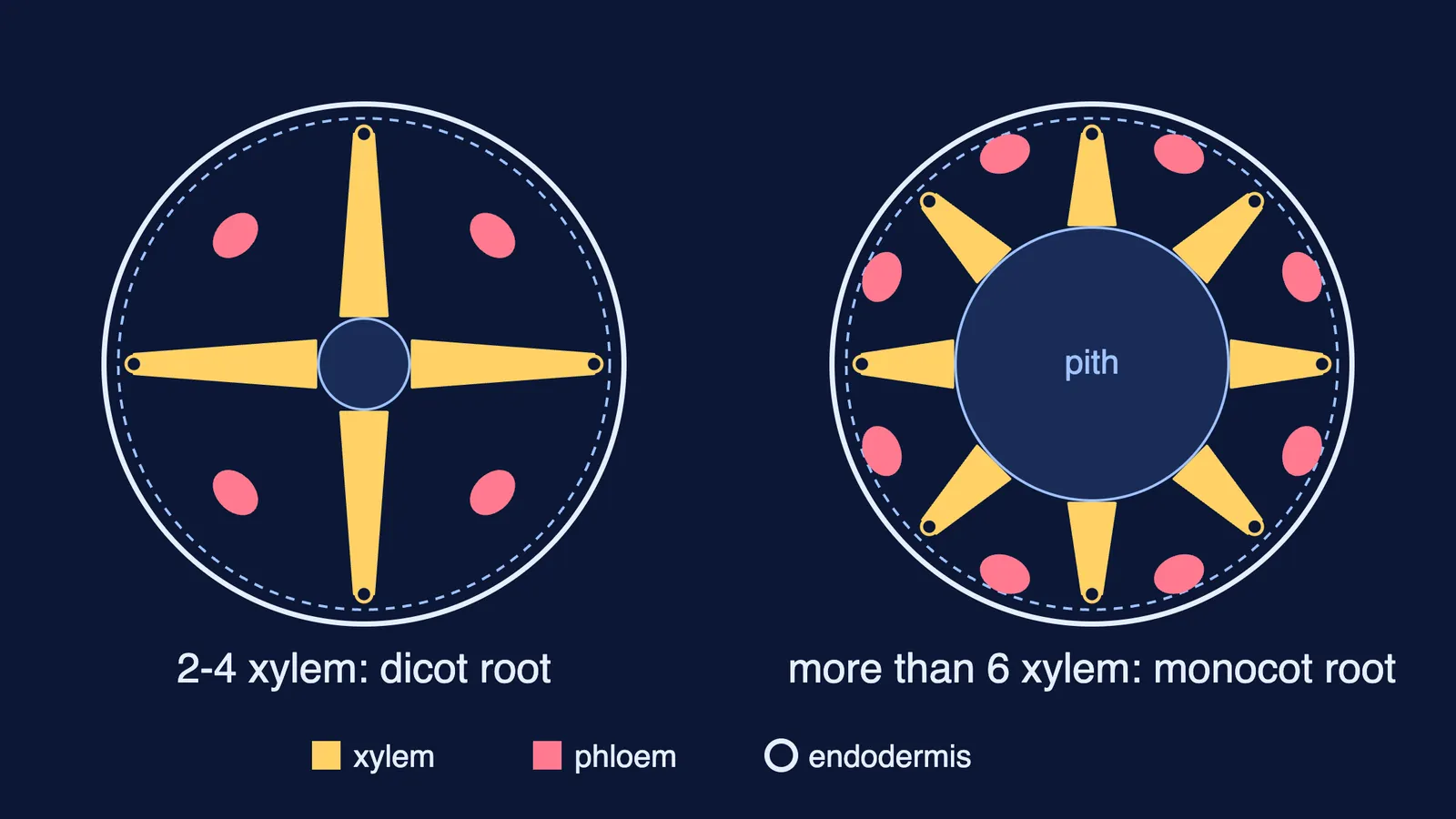
Q6 (medium). Four root sections show these xylem patch counts: P has 2, Q has 4, R has 8 and S has 12. Which are most likely monocot roots?
(A) P and Q
(B) R and S
(C) Q and R
(D) S only
Answer: (B). NCERT gives a dicot root usually two to four xylem patches and a monocot root usually more than six (polyarch), with a large pith, so 8 and 12 both qualify. Trap: (D) comes from treating "polyarch" as "a dozen or more"; the threshold is more than six.
Hard: monocot stem and the isobilateral leaf
Q7 (hard). Consider these statements about a monocot stem.
I. Peripheral vascular bundles are generally larger than the central ones.
II. Phloem parenchyma is absent.
III. Water-containing cavities are present within the vascular bundles.
IV. Each vascular bundle is surrounded by a sclerenchymatous bundle sheath.
Which are correct? (A) II, III and IV only (B) I, II and III only (C) I and IV only (D) I, II, III and IV
Answer: (A). II, III and IV are NCERT lines. Statement I is reversed: the peripheral bundles are generally smaller than the central ones. Trap: (D) catches anyone who reads I quickly, because "larger" and "smaller" look alike in a long list.
Q8 (hard). A vertical section of a leaf shows stomata on both surfaces, mesophyll not split into palisade and spongy layers, and large, empty, colourless cells in the upper epidermis along the veins. On a dry afternoon the leaf rolls inward. Which option is correct?
(A) Isobilateral leaf; the colourless cells become turgid and curl the leaf
(B) Isobilateral leaf; the colourless cells become flaccid and the leaf curls inward to reduce water loss
(C) Dorsiventral leaf; the colourless cells lie in the lower epidermis
(D) Dorsiventral leaf; the palisade cells lose water and curl the leaf
Answer: (B). Stomata on both sides and undifferentiated mesophyll mark an isobilateral (monocot) leaf. The colourless cells are bulliform cells; when flaccid under water stress they curl the leaf inward. Trap: (A) gets the leaf right but reverses turgid and flaccid.
What should you do after this set?
Reread the NCERT line behind every wrong answer. If Q4 or Q5 caught you, redraw both stem sections from memory. If you picked plausible options too fast, try the method in eliminating options in NEET biology MCQs.
For more practice across Class 11 biology, the Fermi Problem Library has worked problems with a step-by-step solver that explains the reasoning rather than printing an answer.