On this page
p-Block questions in NEET reward one habit: tie every trend to its cause. These 8 original single-correct questions run easy to hard; each wrong option is a real slip.
They stay inside Unit 10, p-Block Elements (Group 13 to Group 18), of the NMC's updated NEET (UG)-2026 syllabus. NCERT dropped its separate p-block chapters in the 2023 rationalisation, so every fact and number below comes from NCERT Class 11 Chemistry Unit 3, Classification of Elements (Reprint 2026-27).
How should you use this p-block practice set?
Hide the solutions. NEET-UG 2026 had 180 questions in 180 minutes, marked +4 for a correct answer and −1 for a wrong one, according to the NTA information bulletin. Give each question a minute.
Before reading the options, write the cause you will use: size, electronegativity, valence orbitals or n = 2 repulsion.
Read the trap line even when you got it right.
Log each miss by its cause and redo it after three days.
For the chapter plan and worked examples, start with how to prepare p-Block Elements for NEET.
Easy: can you place the element and name its oxides?
All facts here are from NCERT Unit 3, sections 3.6.2 and 3.7.3.
Q1 (easy). An element sits in period 4, group 15. What is its outer (valence-shell) electronic configuration?
(A) 4s² 4p⁵ (B) 4s² 4p³ (C) 3d³ 4s² (D) 4s² 4p¹
Answer: (B). NCERT gives the p-block outer configuration as ns² np¹ to ns² np⁶ across groups 13 to 18, so group 15 is ns² np³. In period 4, n = 4: 4s² 4p³ (this is arsenic, Z = 33). Trap: (C) treats "group 15" like the old group 5 of the d-block and puts the electrons in 3d.
Q2 (easy). In which pair is the first oxide neutral and the second amphoteric?
(A) NO, Cl₂O₇ (B) Al₂O₃, CO (C) N₂O, As₂O₃ (D) CO, Na₂O
Answer: (C). NCERT lists CO, NO and N₂O as neutral and Al₂O₃ and As₂O₃ as amphoteric. Trap: (B) has the right two kinds in the wrong order.
Medium: can you rank and predict from the trends?
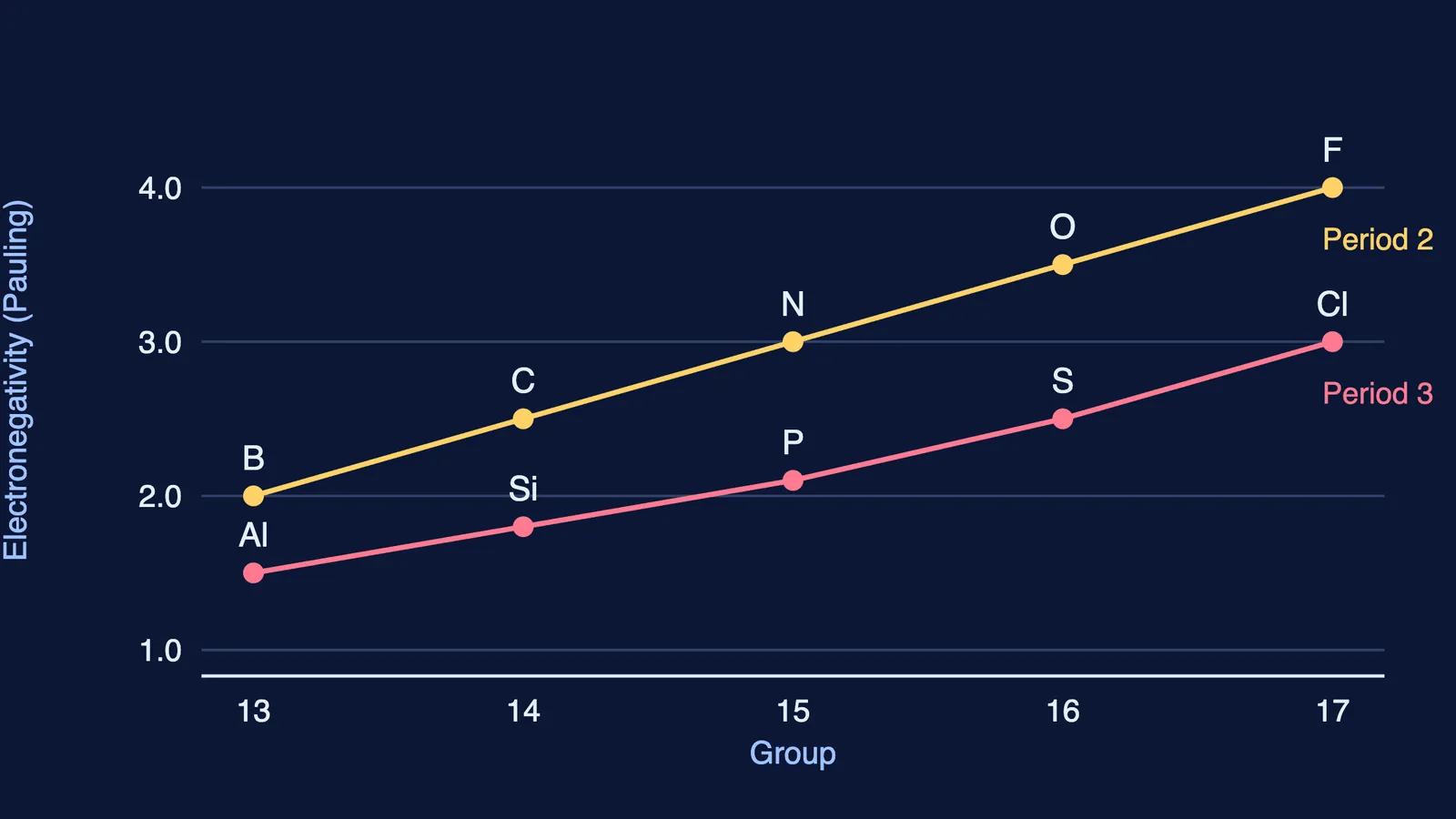
Data from NCERT Unit 3: Pauling electronegativities (Table 3.8), valences (Table 3.9) and electron gain enthalpies, ΔegH (Table 3.7): Br −325 and I −295 kJ/mol.
Q3 (medium). Which order of electronegativity is correct?
(A) Cl > O > S > P (B) O > Cl > S > P (C) O > S > Cl > P (D) Cl > S > O > P
Answer: (B). NCERT's Pauling values are O 3.5, Cl 3.0, S 2.5 and P 2.1. Chlorine is one group further right, but oxygen is one period higher, and the drop down a group wins here: 3.5 against 3.0. Trap: (A) assumes the halogen always wins; that is only true within the same period.
Q4 (medium). Element Q has the outer configuration 3s² 3p⁴. Which pair of formulas fits its typical valences of 2 and 6?
(A) QH₃ and Q₂O₅ (B) HQ and Q₂O₇ (C) H₂Q and QO₃ (D) QH₄ and QO₂
Answer: (C). Six outer electrons put Q in group 16, and NCERT gives group 16 the valences 2 and 6 (8 − 6 and 6): H₂Q and QO₃, like H₂S and SO₃. Trap: (D) counts only the four 3p electrons and gives Q the group-14 valence of 4.
Q5 (medium). 1.5 mol of gaseous bromine atoms and 1.5 mol of gaseous iodine atoms each gain one electron. How much more energy does the bromine sample release?
(A) 30 kJ (B) 45 kJ (C) 81 kJ (D) 90 kJ
Answer: (B). Per mole the difference is 325 − 295 = 30 kJ, so for 1.5 mol it is 1.5 × 30 = 45 kJ. Trap: (A) forgets to multiply by the amount; (D) doubles it as if Br₂ molecules, not atoms, were counted.
Hard: can you explain the exceptions and use the data?
Data from NCERT Unit 3: Table 3.7 (O −141, S −200, Se −195, Te −190 kJ/mol), Table 3.9 and section 3.7.3.
Q6 (hard). The highest oxides of period 3 include Al₂O₃, P₄O₁₀, SO₃ and Cl₂O₇. Which statement is correct?
(A) Al₂O₃ is basic, like Na₂O. (B) Phosphorus is +10 in P₄O₁₀. (C) Chlorine is +7 in Cl₂O₇, and Cl₂O₇ with water gives HClO₄, a strong acid. (D) Cl₂O₇ with water gives HClO₃.
Answer: (C). In Cl₂O₇, 2x + 7(−2) = 0, so x = +7. NCERT shows Cl₂O₇ + H₂O → 2HClO₄ and calls it the most acidic oxide of the period. Trap: (B) forgets to divide by the four P atoms: 4x = 20, so P is +5. (A) misses that NCERT calls Al₂O₃ amphoteric.
Q7 (hard). Statement I: Oxygen has a more negative electron gain enthalpy than sulphur because the added electron is closer to the nucleus. Statement II: Noble gases have positive electron gain enthalpies because the added electron must enter the next principal quantum level.
(A) Both statements are true (B) Both are false (C) I is true, II is false (D) I is false, II is true
Answer: (D). Oxygen's −141 kJ/mol is less negative than sulphur's −200 kJ/mol: NCERT explains that an electron added to the compact n = 2 level meets strong repulsion. Statement II is NCERT's reason for the positive values of the noble gases. Trap: (A) applies "smaller atom, more negative" without the n = 2 exception.
Q8 (hard). 0.40 mol of gaseous atoms of a group-16 element X release 78.0 kJ when each atom gains one electron. What is X?
(A) O (B) S (C) Se (D) Te
Answer: (C). ΔegH = −78.0 / 0.40 = −195 kJ/mol, which is selenium's value in Table 3.7. Trap: (B) rounds 195 to sulphur's 200; Table 3.7 separates them by 5 kJ/mol.
What should you do after this set?
Sort your misses: Q1, Q2 or Q4 point to configurations and valences; Q3, Q5 or Q8 to the data tables; Q6 or Q7 to the exceptions. The periodicity guide for NEET covers the trends behind all three, and our chemical bonding NEET practice set drills the shapes and bonds of the same p-block compounds.
If a wrong method, not a missing fact, cost you the mark, the Fermi Problem Library has worked problems with a step-by-step solver that explains the reasoning rather than printing an answer.