On this page
NEET questions on this chapter hide one wrong word in an option: chalazal for micropylar, monoecy for dioecy, 2n for 3n. These eight questions are new, and every answer is checked against current NCERT text.
What does this set cover from the NEET syllabus?
The NEET (UG)-2026 syllabus issued by the National Medical Commission puts this chapter in Biology Unit 6, Reproduction, from gametophytes to double fertilisation, apomixis and polyembryony. Every answer here rests on Chapter 1 of NCERT Class 12 Biology, Reprint 2026-27.
New to the chapter? Start with our plan on how to prepare sexual reproduction in flowering plants for NEET.
How should you attempt these questions?
Hide the solutions and allow about a minute per question.
Note why each rejected option is wrong.
For ploidy questions, write n and 2n in the margin first.
Read every trap line, even after a right answer.
Easy: anther, pollination and seeds
Q1 (easy). In the transverse section of a young anther, which wall layer of the microsporangium nourishes the developing pollen grains and has cells that often carry more than one nucleus?
(A) Endothecium
(B) Middle layers
(C) Tapetum
(D) Epidermis
Answer: (C). The tapetum, the innermost wall layer, has dense cytoplasm and often more than one nucleus per cell. Trap: (A) is better known, but NCERT gives the outer three layers protection and dehiscence, not nutrition.
Q2 (easy). A bee carries pollen from one flower of a mustard plant to another flower on the same plant. This is
(A) geitonogamy
(B) xenogamy
(C) autogamy
(D) cleistogamy
Answer: (A). Pollen reaches another flower on the same plant. Trap: (B) tempts because an agent carried it, but geitonogamy is genetically like autogamy; only xenogamy brings genetically different pollen.
Q3 (easy). In which pair are both seeds albuminous?
(A) Pea and castor
(B) Maize and barley
(C) Groundnut and wheat
(D) Pea and groundnut
Answer: (B). Albuminous seeds keep part of the endosperm; NCERT's examples are wheat, maize, barley and castor. Trap: (A) and (C) each pair one albuminous seed with a non-albuminous one.
Medium: pollen tubes, ploidy and outbreeding
Q4 (medium). A pollen grain shed at the 2-celled stage lands on a compatible stigma. When and how are its two male gametes formed?
(A) In the anther, just before the pollen is shed
(B) In the synergid, after the pollen tube enters it
(C) The vegetative cell divides as the tube grows
(D) The generative cell divides as the pollen tube grows in the stigma
Answer: (D). In plants that shed 2-celled pollen, the generative cell divides during pollen tube growth in the stigma. Trap: (A) describes the 3-celled species, where the gametes form before shedding; the NCERT chapter says over 60 per cent of angiosperms shed pollen at the 2-celled stage.
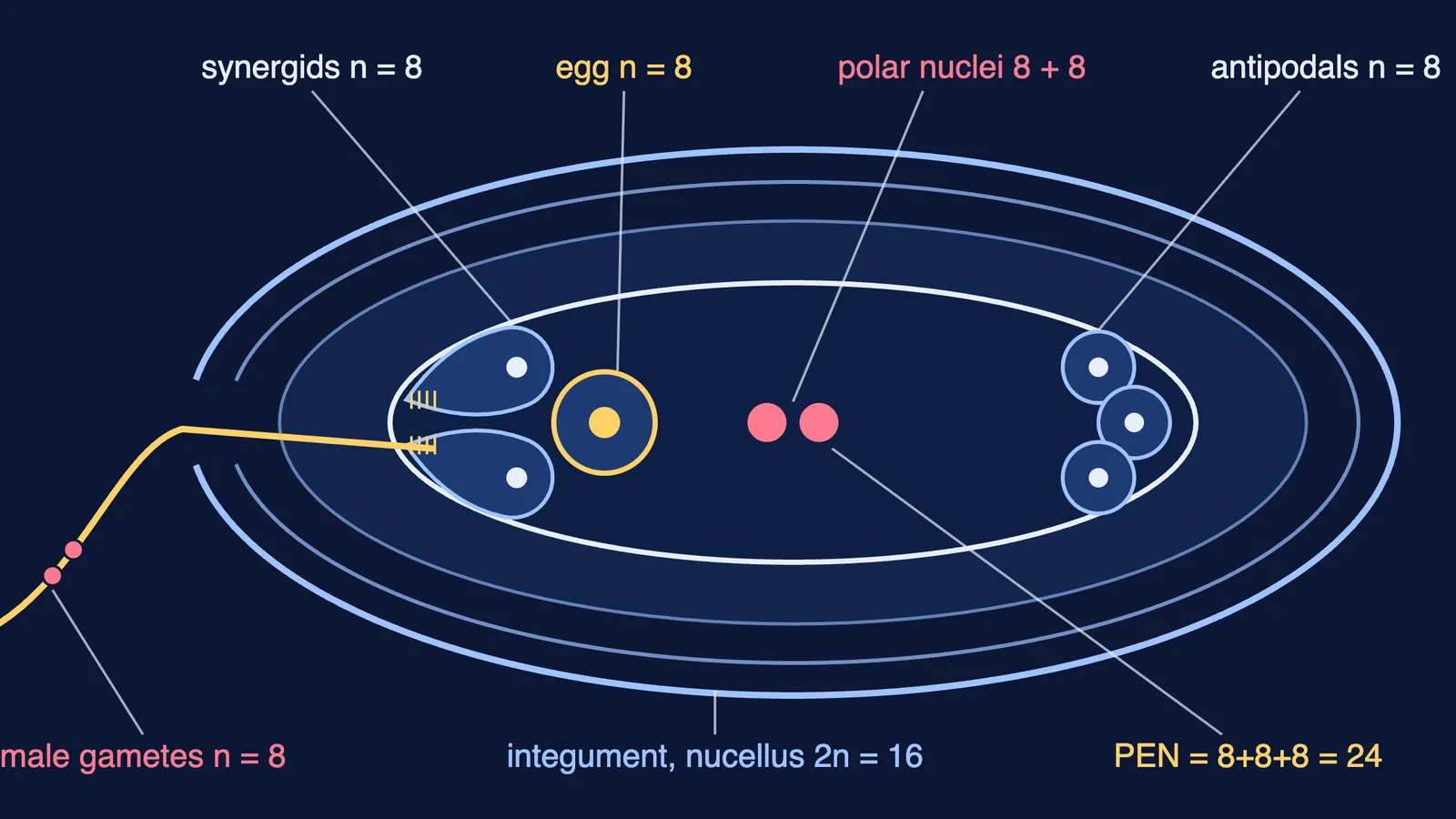
Q5 (medium). A plant's leaf cells have 16 chromosomes. Give the numbers in an antipodal cell, the primary endosperm nucleus and an integument, in that order.
(A) 8, 24, 16
(B) 8, 16, 16
(C) 16, 24, 8
(D) 8, 24, 8
Answer: (A). n = 8. Antipodals come from the meiotic megaspore: 8. The PEN is two polar nuclei plus one male gamete: 8 + 8 + 8 = 24. Integuments, which become the seed coat, are parent tissue: 16. Trap: (D) treats the integument as part of the embryo sac; it stays 2n.
Q6 (medium). A breeder has four lines. P: male and female flowers on the same plant. Q: each plant bears only male or only female flowers. R: bisexual flowers that release pollen before the stigma is receptive. S: cleistogamous flowers. In which line can neither autogamy nor geitonogamy take place?
(A) P
(B) R
(C) Q
(D) S
Answer: (C). Line Q is dioecious, so no pollen from the same plant can reach a stigma. Trap: (A) is monoecy (castor, maize), which prevents autogamy but not geitonogamy. R blocks only autogamy; S is always autogamous.
Hard: the embryo sac and polyembryony
Q7 (hard). Consider these statements about a typical angiosperm embryo sac and its fertilisation.
I. The filiform apparatus lies in the antipodal cells at the chalazal end.
II. Triple fusion involves three haploid nuclei.
III. The two polar nuclei lie below the egg apparatus in the large central cell.
IV. The zygote usually divides before any endosperm has formed.
Which are correct? (A) I and II only (B) II and III only (C) II, III and IV only (D) I, III and IV only
Answer: (B). II and III are NCERT statements. I is wrong: the filiform apparatus is at the micropylar tip of the synergids, which guide the pollen tube. IV is reversed: most zygotes divide only after some endosperm has formed, which assures the embryo's nutrition. Trap: (C) catches anyone who misses that IV reverses NCERT's order.
Q8 (hard). A plant with 2n = 18, pollinated by its own species, shows nucellar polyembryony, as in many Citrus varieties. One seed holds four embryos: one from the fertilised egg, three from nucellar cells. Which statement is correct?
(A) All four embryos are clones of the mother plant
(B) The nucellar embryos have 9 chromosomes, because they develop inside the embryo sac
(C) The nucellar embryos have 27 chromosomes, because they grow beside the endosperm
(D) All four have 18 chromosomes, but only the three nucellar embryos are clones of the mother
Answer: (D). Nucellar cells are the mother's 2n tissue, so their embryos copy her. The zygotic embryo is also 18 (9 from the egg + 9 from the male gamete) but carries the pollen parent's genes. Trap: (A) forgets that one embryo came from fertilisation; (B) confuses where an embryo grows with what it grew from.
What should you do after this set?
Reread the NCERT line behind each miss, and redo Q5 and Q8 for 2n = 20. If half-right options keep catching you, try eliminating options in NEET biology MCQs, and if Q2 and Q4 blurred together, read pollination vs fertilisation: the steps in between.
For more practice, the Fermi Problem Library has worked problems with a step-by-step solver that explains the reasoning rather than printing an answer.