On this page
A flower can be pollinated and never make a seed. That gap is what board and NEET-UG questions test, and it is where answers lose marks: "pollen reaches the egg" squeezes two events, and the steps between them, into one line.
What is the difference between pollination and fertilisation?
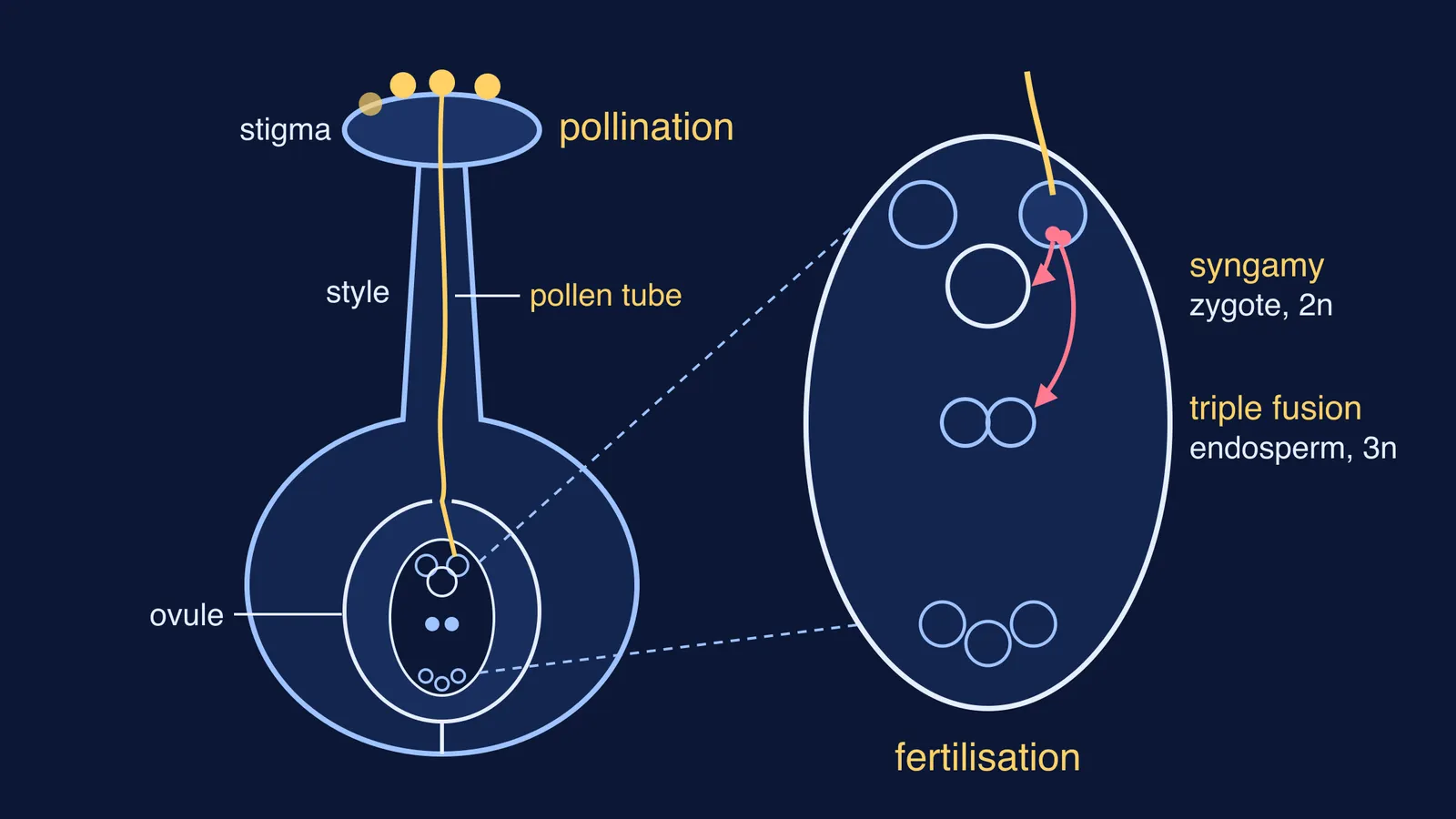
Pollination is the arrival of pollen on a stigma; fertilisation is the fusion of a male gamete with a female cell inside the ovule. A 2021 review in the International Journal of Molecular Sciences traces the journey from the moment "the pollen grain is deposited atop the stigmatic papillar cell" to the moment the pollen tube "bursts and releases two sperm nuclei that fuse with the egg and central cells".
Where: pollination happens on the stigma; fertilisation happens in the embryo sac, inside the ovule.
What moves: wind, water or animals carry the pollen grain; the pollen tube carries the male gametes.
What it makes: pollination makes nothing new; fertilisation makes a diploid zygote and a triploid primary endosperm cell, as this overview of double fertilisation sets out.
What happens between pollination and fertilisation?
The review by Robichaux and Wallace sets out the steps in order:
Landing: the pollen grain sticks to the stigma through an adhesive "foot".
Hydration: if the pollen is compatible, the stigma supplies water and the grain becomes active.
Germination: a pollen tube grows out and pushes into the stigma.
Style: the tube grows down the style towards the ovary.
Guidance: cues steer it to an ovule; synergid cells secrete small peptides called LUREs that attract pollen tubes.
Release: the tube enters a synergid through the filiform apparatus, bursts, and releases two male gametes.
The tube usually reaches the embryo sac through the micropyle, the small opening of the ovule (double fertilisation overview). One male gamete fuses with the egg (syngamy) to form the zygote. The other fuses with the central cell (triple fusion) to form the cell that becomes the endosperm, the tissue that feeds the embryo. Two fusions in one embryo sac: that is double fertilisation.
For steps 1 to 5 in more detail, read our explainers on how the pistil accepts or rejects pollen and why pollen tubes grow towards the ovule.
How long does it take from pollination to fertilisation?
It varies enormously from plant to plant. A 2008 PNAS study by Joseph Williams drew on a survey of more than 900 studies covering 717 seed-plant taxa.
In flowering plants, pollination to fertilisation took anywhere from 15 minutes to more than 12 months (Williams, PNAS).
Gymnosperm pollen tubes grow at under about 20 micrometres per hour, while early flowering-plant lineages grow at about 80 to 600 micrometres per hour (Williams, PNAS).
In oilseed rape (Brassica napus), pollen tubes reached the ovule region within 4 hours of pollination (Parry and colleagues, AoB Plants, 2025).
Worked example: one distance, three speeds
Take a tube path 1 cm long. That is 10,000 micrometres of tube growth. Using the growth rates Williams reported:
At 600 micrometres per hour (fast early flowering plants): 10,000 / 600 is about 17 hours.
At 80 micrometres per hour (slow early flowering plants): 10,000 / 80 = 125 hours, just over 5 days.
At 20 micrometres per hour (about the upper limit for gymnosperms, which have no style): 10,000 / 20 = 500 hours, about 3 weeks.
Tube growth speed is one big reason the gap between pollination and fertilisation varies so much.
Can pollination happen without fertilisation?
Yes. Pollen from another species can land on a stigma, the pistil can reject incompatible pollen, or the tube can stop short of an ovule. In each case pollination has happened and fertilisation has not.
In most flowering plants, pollination and the fertilisation that follows come before seed and fruit development (Parry and colleagues, AoB Plants). Our guide to what happens to each flower part after fertilisation picks up the story from there.
How should you write the difference in an exam?
A five-line answer for a "distinguish between" question:
Pollination: transfer of pollen grains to the stigma.
Fertilisation: fusion of male and female gametes in the embryo sac.
The bridge: pollen germinates and its tube carries two male gametes to the ovule.
The fusions: syngamy gives the zygote (2n); triple fusion gives the primary endosperm cell (3n).
The outcome: the zygote becomes the embryo and the ovary becomes the fruit.
Two traps that cost marks:
"The pollen grain is the male gamete." No: the grain grows the tube that delivers two male gametes.
"Double fertilisation means two eggs are fertilised." No: it means two fusions in one embryo sac, one with the egg and one with the central cell.
If one link in this chain keeps slipping, the Fermi Concept Library covers every concept in biology, each with its own lesson and its place in the map. When you practise long answers, the Fermi Problem Library has worked problems with a step-by-step solver that explains the reasoning rather than printing an answer.