

On this page
After fertilisation, a flower's primary job shifts from attracting pollinators to protecting and nourishing the next generation. The plant redirects its energy, causing the flower to shed its now-useless parts and transform its reproductive organs into a fruit and seeds.
What happens to the ovary and ovule?
The most significant post-fertilisation changes happen within the carpel, the female reproductive organ of the flower.
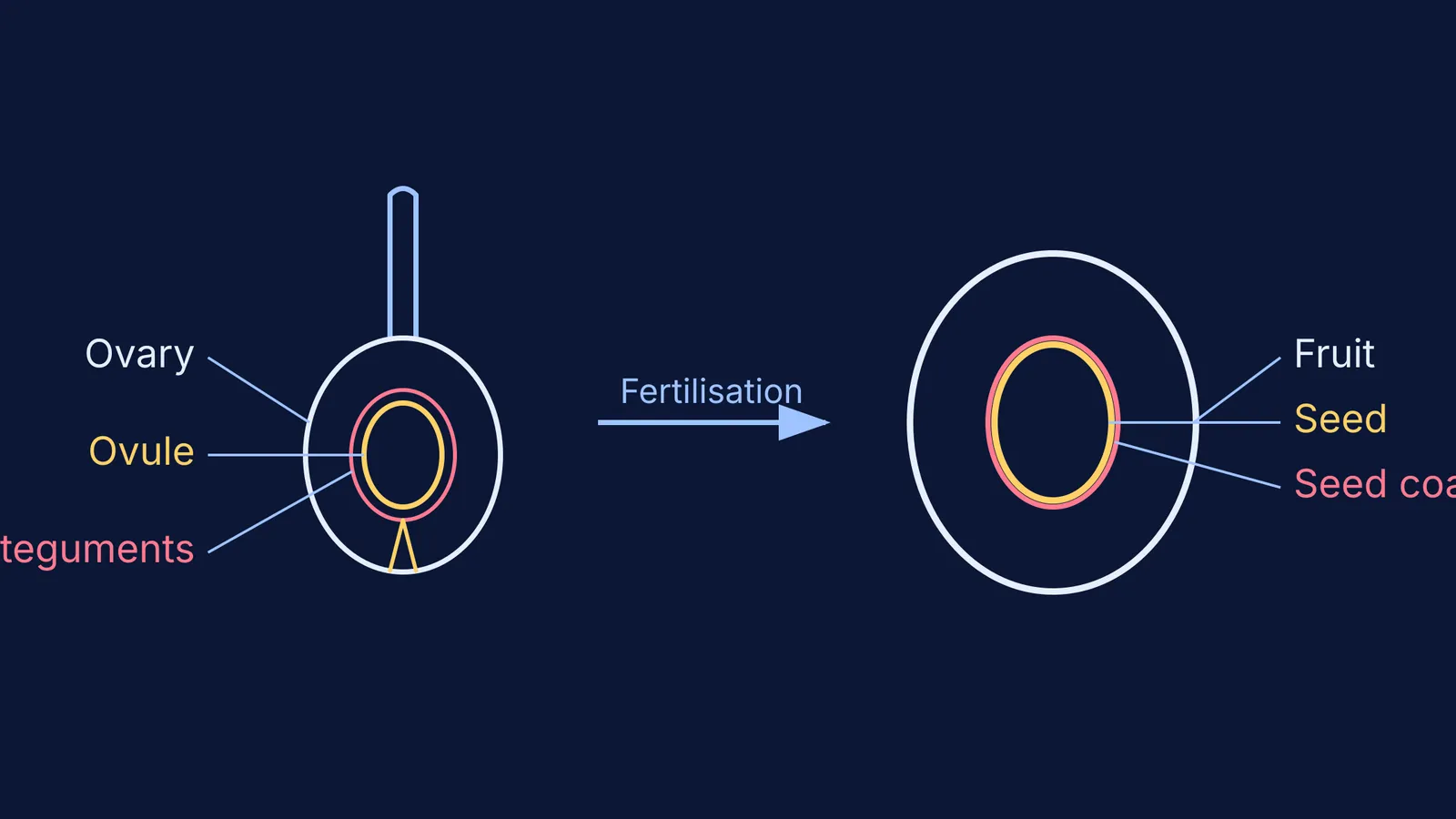
Ovary to fruit: The ovary develops into the fruit. Its outer wall thickens and ripens to become the pericarp (the fruit wall). Depending on the plant, this pericarp can be fleshy and succulent, like in a mango or tomato, or it can become dry and hard, as seen in mustard or peanuts.
Ovule to seed: The ovules inside the ovary mature into seeds. The number of ovules in an ovary determines the number of seeds in the fruit; a mango has one seed from one ovule, while a watermelon has many. (Before this entire process can happen, the plant must first build the embryo sac through megasporogenesis).
Zygote to embryo: The fertilised egg, or zygote, is located within the ovule. It undergoes multiple divisions to develop into the embryo, which contains the radicle (future root), plumule (future shoot), and cotyledons (seed leaves).
Integuments to seed coat: The protective outer layers of the ovule, called integuments, harden into a tough seed coat. As the seed matures, its water content drops to 10–15% moisture by mass. This dehydration forces the embryo to enter a dormant state, allowing the seed to survive harsh environmental conditions until moisture and oxygen are right for germination.
What is the role of the endosperm?
In flowering plants, fertilisation is a double event. While one male gamete fuses with the egg to form the zygote, another fuses with the two polar nuclei in the centre of the embryo sac.
This second fusion creates the Primary Endosperm Nucleus (PEN), which develops into the endosperm. The endosperm is a nutrient-rich tissue designed specifically to feed the growing embryo. In some seeds, like peas and beans, the embryo consumes the endosperm completely before the seed matures. In others, like coconuts and castor beans, the endosperm persists in the mature seed and is used up later during germination. The liquid inside a tender coconut is actually free-nuclear endosperm.
What becomes of the other floral parts?
Because the plant no longer needs to attract insects or protect the delicate inner organs during pollination, the accessory parts of the flower wither and fall away:
Petals and stamens: These dry up, shrink, and drop off the plant.
Stigma and style: The upper parts of the carpel, which caught the pollen and guided the pollen tube, degenerate once fertilisation is complete.
Sepals: In most plants, the sepals wither and fall off. However, in some species, they are persistent and remain attached to the fruit. You can easily spot persistent sepals as the green "cap" on tomatoes, brinjals, and strawberries.
Not all fruits follow this exact path. In some cases, the thalamus (the base of the flower) contributes to the flesh of the fruit, making it a false fruit (like an apple). Occasionally, seeds form without any fertilisation at all, a unique process known as apomixis.
How can you remember these changes for exams?
When studying plant reproduction, you can use this simple framework to test yourself on the post-fertilisation changes of any flower you see:
Identify the ovary and picture it swelling into the fruit, noting whether the pericarp will be fleshy or dry.
Spot the ovules inside the ovary and map them to the resulting seeds.
Check the base of the flower for sepals and ask yourself if they are the type that will persist (like on a tomato) or fall off.
Note that the bright petals, the pollen-bearing stamens, and the long style will all disappear.
Trace the double fertilisation event: the zygote becomes the embryo, and the PEN becomes the endosperm.
If you are struggling to picture these 3D changes from a static textbook page, the Fermi Concept Library can help. Fermi's AI tutor can work out what you already know and build a plan for the session, running interactive simulations of the fertilisation process and checking your understanding as it goes. This ensures you sit down to a clear next step instead of feeling lost in complex biological terms.


