

On this page
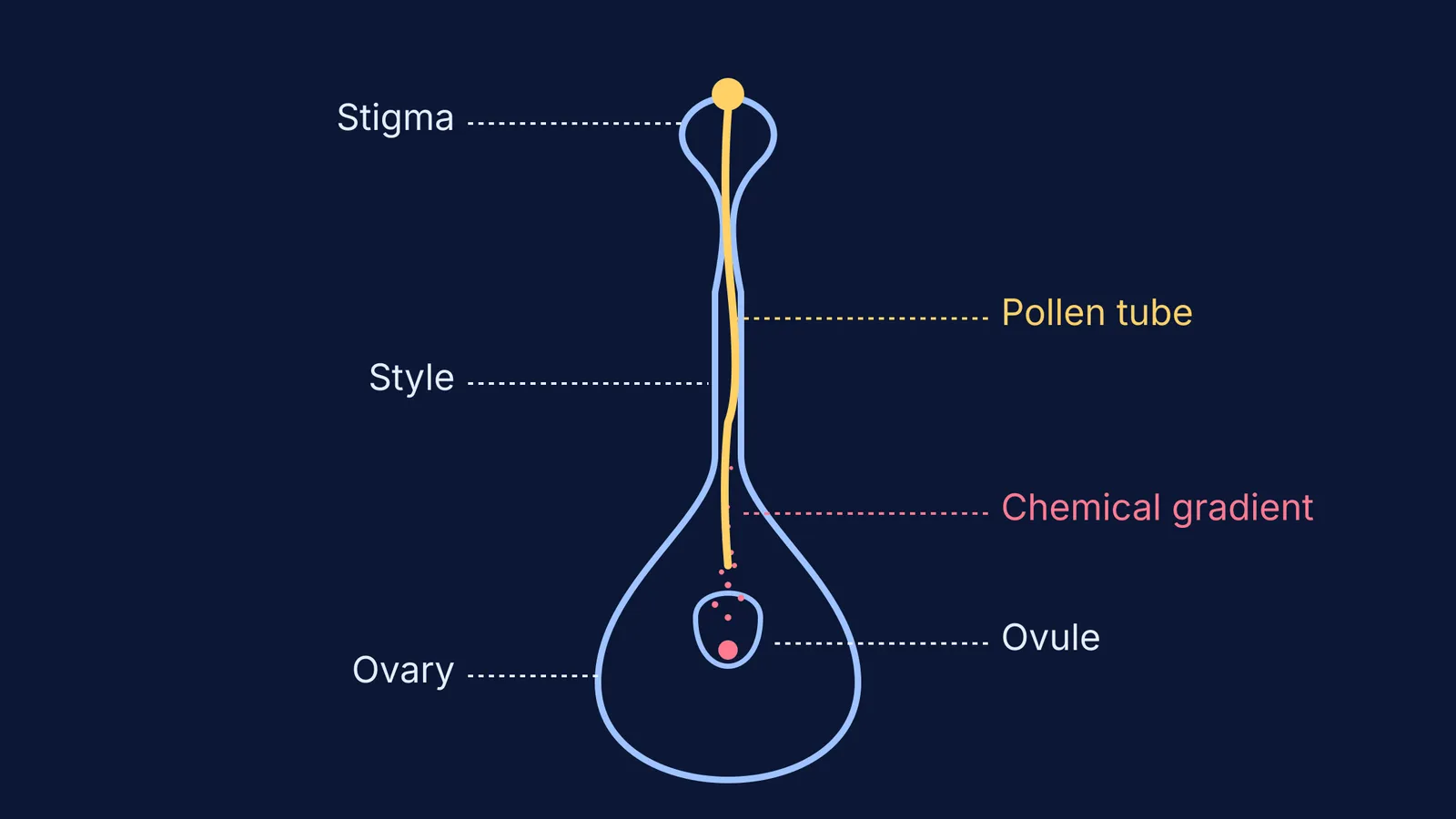
When a pollen grain lands on a compatible stigma after pollination, it absorbs water and nutrients. It swells until it pushes a pollen tube out through a small pore in its tough outer wall. But the stigma is at the top of the carpel, and the ovule—containing the egg cell—is buried deep inside the ovary at the bottom.
The pollen tube has to grow all the way down the style to deliver its two male gametes. The scale of this journey can be immense. In maize (corn), for example, the style is the long silk, which can be up to 30 cm long (Hasanudin et al., 2012). The pollen grain itself is microscopic, measuring just fractions of a millimetre, yet it must grow a tube thousands of times its own diameter, building a new cell wall at a staggering rate to keep moving forward.
How does this single, rapidly growing cell find its target blindly through solid plant tissue? It follows a chemical trail.
What makes this a tropism?
In Class 10 biology, you learn that plants do not have nervous systems. Instead, they respond to their environment using hormones and chemical signals. A tropism is a directional growth movement triggered by an external stimulus, where the direction of the stimulus dictates the direction of growth.
If a plant shoot bends towards the sunlight, it is showing positive phototropism. If a root grows downwards deep into the soil in line with gravity, it is positive geotropism. Chemotropism is a directional growth response to a chemical stimulus.
The pollen tube's journey is the definitive example of positive chemotropism. The tube does not grow randomly through the tissue; it is a single elongated cell extending only at its extreme apex. The tip continuously reads the chemical environment in the style and steers towards the highest concentration of attractants.
What chemicals guide the pollen tube?
For decades, biologists knew the ovule must be releasing something to beckon the pollen tube, but the exact chemicals were a mystery.
In 2009, researchers discovered that synergid cells secrete specific proteins, named LURE peptides, that attract the pollen tube (Okuda et al., 2009). Inside the ovule, these two synergid cells sit right next to the egg cell.
These LURE proteins diffuse out of the ovule, creating a concentration gradient: very concentrated near the synergids, and weaker further away in the ovary. In 2016, researchers discovered that the pollen tube has specialized receptors localized right at its growing tip to detect these LURE peptides (Takeuchi and Higashiyama, 2016). These specialized receptors allow the tube to sense which way is "uphill" on the chemical gradient. By constantly adjusting its growth, it steers precisely towards the ovule's entrance, known as the micropyle.
How do you explain chemotropism in exams?
When board exams ask about chemotropism or plant coordination, the pollen tube is the standard example you are expected to give. Keep your answers structured to pick up every mark:
Define the term: Chemotropism is a directional growth movement of a plant part in response to a chemical stimulus.
Give the example: The growth of the pollen tube towards the ovule in the ovary.
Explain the mechanism: The ovule secretes chemicals (like sugars and peptides) that create a concentration gradient. The pollen tube grows positively towards the higher concentration.
State the purpose: This ensures the male gametes reach the female gamete for fertilisation, overcoming the fact that plant gametes cannot swim.
Understanding the physiological *why* behind plant responses makes the *what* much easier to remember on exam day. The Fermi Concept Library covers every concept in biology, each with its own lesson to help you visualise these gradients. If you struggle to connect pollination to fertilisation, Fermi's AI tutor can build a session around Class 10 reproduction, working out what you already know first and drawing the structures for you step by step.
Read more:


