

On this page
What is pollen-pistil interaction and why is compatibility vital?
Pollination deposits pollen onto the stigma, but it does not guarantee fertilization. Wind, water, and insects routinely carry pollen from foreign species or self-incompatible grains from the same plant. To avoid wasting maternal resources on sterile crosses, the pistil acts as a biochemical gatekeeper.
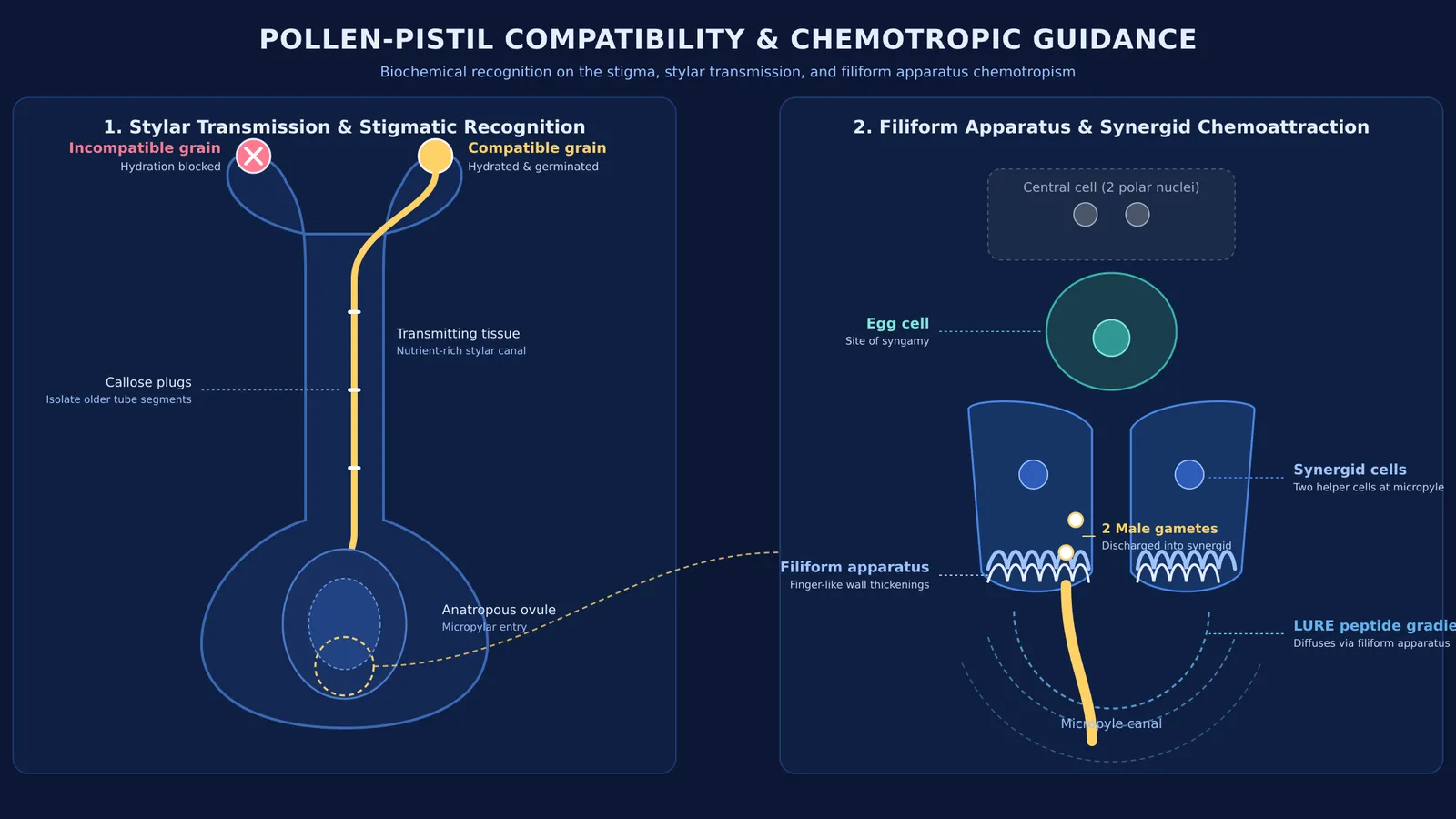
The entire sequence of events—from pollen deposition on the stigma until the pollen tube enters the ovule—is known as pollen-pistil interaction. This is an active dialogue mediated by chemical signalling between the pollen grain and pistil tissues.
When pollen is compatible, the pistil accepts the grain, provides moisture, and promotes germination. When incompatible, the pistil blocks hydration on the stigma or halts tube growth in the style. These events bridge the male gametophyte formed during microsporogenesis and pollen development with the embryo sac built during megasporogenesis.
How does the pistil recognise compatible pollen?
Recognition relies on continuous chemical crosstalk between pollen-wall proteins and receptors on stigmatic papillae. Self-incompatibility operates through two main genetic systems:
Sporophytic self-incompatibility (SSI): Governed by the diploid pollen parent genotype. In Brassicaceae, pollen-coat ligands bind stigma receptor kinases, preventing pollen hydration.
Gametophytic self-incompatibility (GSI): Governed by the haploid pollen genotype. In Solanaceae, pollen hydrates and germinates, but stylar S-RNases enter the tube and degrade male ribosomal RNA unless detoxified by pollen F-box proteins.
In vitro assays in the American Journal of Botany demonstrated that a 10% sucrose medium supplemented with calcium and boric acid provides the osmotic balance and ionic environment needed for viable pollen grains to germinate across 86 plant species.
How does the pollen tube grow through the style?
Once a compatible grain hydrates, its intine emerges through a germ pore to form the pollen tube. Cytoplasm and nuclei stream into the tube, concentrating near the growing tip.
A classic survey in the American Journal of Botany showed that roughly 70% of angiosperm species shed pollen at the 2-celled stage (vegetative and generative cells), while approximately 30% shed at the 3-celled stage with two pre-formed sperm cells. In 2-celled pollen, the generative cell divides mitotically within the growing pollen tube.
The pollen tube advances by tip growth through the style's transmitting tissue, propelled by calcium gradients. It regularly deposits callose plugs behind the apex to seal off older evacuated sections and sustain turgor pressure at the tip.
The Fermi Concept Library maps every concept in physics, chemistry, biology, mathematics and computing, each with its own lesson and its place in the map.
How does the filiform apparatus guide the pollen tube into the ovule?
Reaching the ovary, the pollen tube enters the ovule through the micropyle, where female gametophyte signalling takes over.
At the micropylar tip of the embryo sac, two synergid cells form the filiform apparatus: extensive, finger-like cell-wall invaginations that amplify plasma-membrane surface area (Sexual Plant Reproduction).
Laser ablation experiments in Science established that synergids emit the essential guidance signal; destroying both synergids arrests pollen tubes, whereas one intact synergid directs normal entry.
A study in Nature showed that synergids secrete LURE peptides—cysteine-rich chemoattractants that exit through the filiform apparatus. Pollen tubes detect this gradient via tip receptors like PRK6 (Nature), steering directly into the filiform apparatus.
The pollen tube enters one synergid, the synergid degenerates, and the tube tip bursts to release two male gametes. One fertilises the egg cell (syngamy), while the other fuses with the polar nuclei (triple fusion).
How do breeders manipulate pollen-pistil compatibility?
Plant breeders manipulate these recognition checkpoints to generate desired hybrids:
Bud pollination: Applying pollen to immature stigmas before self-incompatibility proteins accumulate permits self-fertilisation in self-incompatible lines.
In vitro pollination: Applying pollen directly to exposed ovules bypasses stylar barriers to enable distant crosses.
Controlled pollination: Emasculating flowers before anthesis and bagging stigmas prevents contamination, as explained in artificial hybridisation and bagging techniques.
To practise analysing compatibility problems, the Fermi Problem Library provides worked problems with a step-by-step solver that explains the reasoning rather than printing an answer.


