On this page
These eight NEET-UG Biology questions are new, not reworded from NCERT, exemplar or past papers. They cover all six chapters of the unit and end with two calculations.
Which Human Physiology topics do these NEET questions cover?
The NEET (UG)-2026 syllabus from the National Medical Commission puts Human Physiology in Biology Unit 5, with six topics that match Chapters 14 to 19 of NCERT Class 11 Biology, Reprint 2026-27. Every option below can be checked against those chapters. New to the unit? Start with our guide on how to prepare Human Physiology for NEET.
How should you use this practice set?
Cover the answer; allow about a minute per question.
Do Q7 and Q8 on paper, with units.
Read every trap line, even when you were right.
Copy each trap that caught you onto one card.
Easy: can you recall the mechanisms?
Sources: NCERT Chapter 17, Chapter 19 and Chapter 15.
Q1 (easy). A sprinter's thigh muscle fibre contracts. Which region of the sarcomere keeps its length?
(A) I-band (B) A-band (C) H-zone (D) The distance between two Z lines
Answer: (B). The A-band spans the thick filaments, and NCERT states that the I-bands get reduced while the A-bands retain their length. Trap: (A) confuses the band with the actin filaments; the filaments keep their length, but the I-band narrows as they slide in.
Q2 (easy). A hormone raises blood calcium by dissolving bone, increasing renal reabsorption of calcium and increasing its absorption from digested food. Which gland releases it?
(A) Thyroid (B) Thymus (C) Parathyroid (D) Adrenal cortex
Answer: (C). This is parathyroid hormone (PTH), a hypercalcemic hormone. Trap: (A) also regulates calcium, but thyrocalcitonin lowers it.
Q3 (easy). On a standard ECG, which point marks the end of ventricular systole?
(A) The P-wave (B) The peak of the R-wave (C) The start of the T-wave (D) The end of the T-wave
Answer: (D). The T-wave is ventricular repolarisation, and NCERT says the end of the T-wave marks the end of systole. Trap: (C) takes the start of repolarisation as the end of contraction.
Medium: can you apply the rules of the nephron and the nerve?
Sources: NCERT Chapter 16 and Chapter 18.
Q4 (medium). Which statements about the nephron are correct?
(i) The descending limb of Henle's loop is permeable to water but almost impermeable to electrolytes.
(ii) The PCT reabsorbs 70-80 per cent of the electrolytes and water in the filtrate.
(iii) The ascending limb concentrates the filtrate by letting water out.
(iv) The collecting duct lets small amounts of urea into the medullary interstitium.
(A) i, ii and iv (B) i and iii only (C) ii, iii and iv (D) i, ii, iii and iv
Answer: (A). Statement (iii) is wrong: the ascending limb is impermeable to water, and the filtrate is diluted there as electrolytes leave. Trap: (D) assumes both limbs behave alike.
Q5 (medium). A stimulus reaches point X on a resting axon. Put these events at X in order.
P: K+ diffuses out and the resting potential returns
Q: the membrane becomes freely permeable to Na+
R: the inner surface of the membrane becomes positive
S: Na+ rushes into the axon
(A) S, Q, R, P (B) Q, R, S, P (C) Q, S, R, P (D) P, Q, S, R
Answer: (C). The membrane first becomes permeable to Na+, Na+ rushes in and reverses the polarity, then K+ diffuses out to restore the resting potential. Trap: (A) puts the inflow first, but the resting membrane is nearly impermeable to Na+.
Q6 (medium). After heavy bleeding, a person's glomerular blood pressure and GFR fall. Which response does the kidney start?
(A) The atrial wall releases ANF, which dilates blood vessels (B) JG cells release renin; angiotensin II constricts vessels and makes the adrenal cortex release aldosterone (C) The adenohypophysis releases ADH, which reduces water reabsorption (D) JG cells release erythropoietin, which raises GFR directly
Answer: (B). A fall in GFR activates the JG cells; renin leads to angiotensin II, which raises glomerular pressure and triggers aldosterone, so the distal tubule reabsorbs Na+ and water. Trap: (A) is the opposite check; ANF is released when blood flow to the atria rises, and it lowers blood pressure.
Hard: can you work the numbers?
Both answers were checked in Python. Q7 uses the capacities in NCERT Chapter 14 (section 14.2.1). Q8 uses the cardiac output definition in Chapter 15 (section 15.3.2) and Chapter 14's figure that every 100 mL of oxygenated blood delivers about 5 mL of oxygen to the tissues. More of this kind: numerical question types in NEET biology.
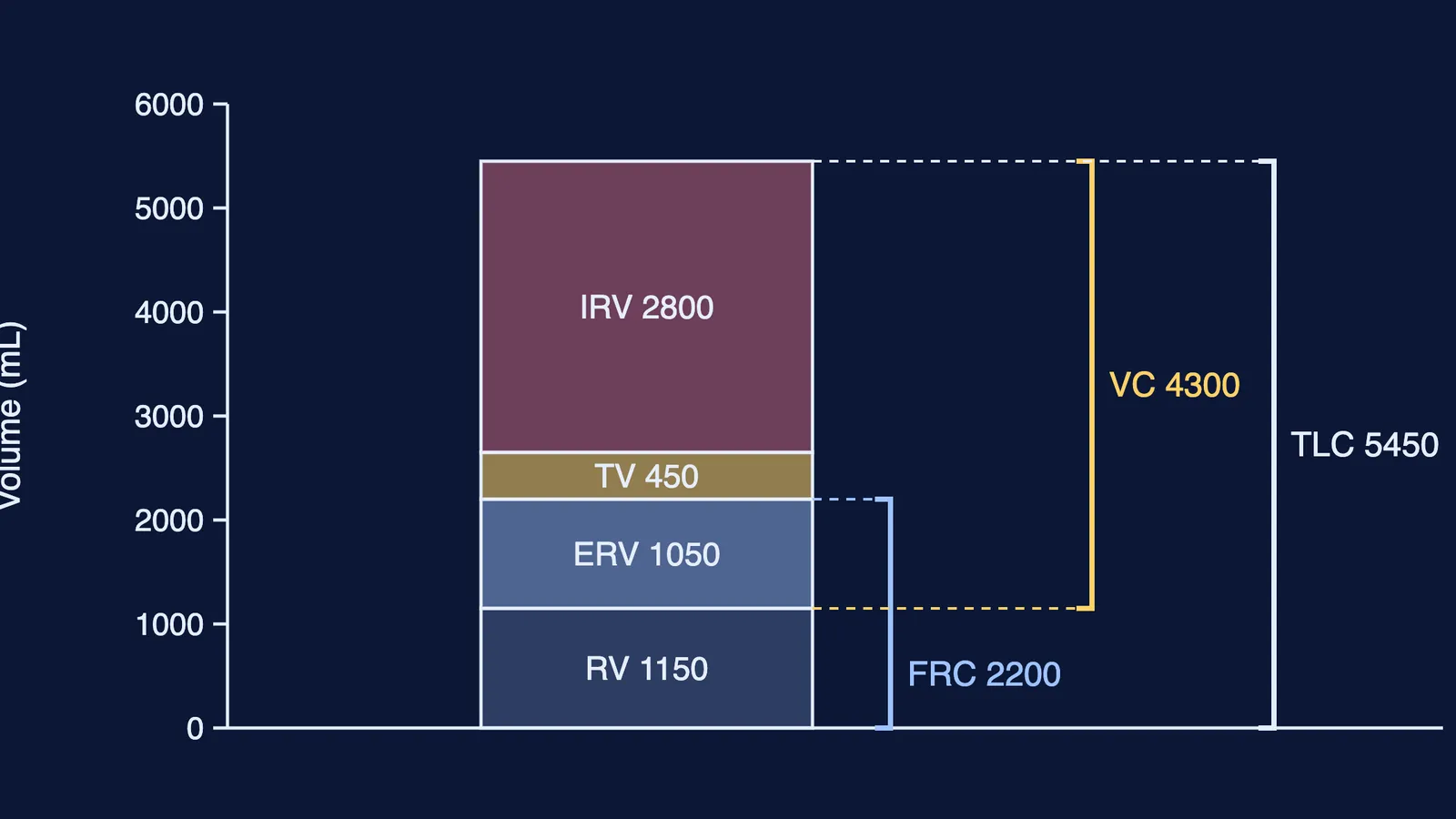
Q7 (hard). A student's spirometer test gives tidal volume 450 mL, inspiratory reserve volume 2800 mL, expiratory reserve volume 1050 mL and residual volume 1150 mL. What are the functional residual capacity (FRC) and vital capacity (VC)?
(A) FRC 2200 mL, VC 4300 mL (B) FRC 1600 mL, VC 4300 mL (C) FRC 2200 mL, VC 5450 mL (D) FRC 3250 mL, VC 4300 mL
Answer: (A). FRC is ERV + RV = 1050 + 1150 = 2200 mL. VC is ERV + TV + IRV = 1050 + 450 + 2800 = 4300 mL. Trap: (C) adds the residual volume, giving total lung capacity (5450 mL); (D) uses inspiratory capacity (TV + IRV) for FRC.
Q8 (hard). During a run, an athlete's heart rate is 120 beats a minute and each ventricle pumps 100 mL per beat. Assume NCERT's normal-conditions figure still applies: 5 mL oxygen per 100 mL blood. What is the length of one cardiac cycle, and the oxygen delivered to the tissues per minute?
(A) 0.8 s, 600 mL (B) 0.5 s, 1200 mL (C) 0.5 s, 60 mL (D) 0.5 s, 600 mL
Answer: (D). One cycle lasts 60 ÷ 120 = 0.5 s. Cardiac output is the volume pumped by each ventricle per minute, so 120 × 100 = 12,000 mL, and 12,000 × 5 ÷ 100 = 600 mL of oxygen. Trap: (B) adds both ventricles, but the right ventricle pumps to the lungs.
What should you do after this set?
If a method step cost you marks, the Fermi Problem Library has worked problems with a step-by-step solver that explains the reasoning. Then add your trap card to our three-week retrieval revision plan for Human Physiology and retry your misses in a week.