On this page
Eight original questions, each with a worked solution and a "Trap" line. Every question sits inside Unit I, Some Basic Concepts in Chemistry, of the NMC syllabus for NEET-UG 2026, and in Unit 1 of NCERT Class 11 Chemistry Part I (Reprint 2026-27).
How should you use this NEET practice set?
As in NEET-UG 2026, each question has four options and one correct answer, a correct answer earns +4 and a wrong one costs 1 mark, and the paper gives 180 minutes, according to the NTA information bulletin. So:
Give yourself 10 minutes for all eight before reading any solution.
Read every "Trap" line, even for questions you got right.
Use H = 1, C = 12, O = 16, Mg = 24, S = 32, K = 39, Cl = 35.5 and an Avogadro constant of 6.022 × 10²³ mol⁻¹.
If the chapter still feels new, start with our guide on how to prepare Some Basic Concepts of Chemistry for NEET.
Easy: do you know the laws and atomic masses?
Q1 (easy). An element X forms two oxides containing 75.0% and 60.0% X by mass. For a fixed mass of X, the masses of oxygen in the two oxides are in the ratio
(A) 5 : 8 (B) 1 : 2 (C) 5 : 4 (D) 2 : 3
Answer: (B). Per 1 g of X, the first oxide has 25.0 ÷ 75.0 = 0.333 g of O and the second has 40.0 ÷ 60.0 = 0.667 g, a ratio of 1 : 2 (law of multiple proportions). Trap: (A) compares the oxygen percentages, 25 : 40, without fixing the mass of X.
Q2 (easy). An element X has two isotopes, of mass 69.0 u (60.0% abundance) and 71.0 u (40.0%). Its average atomic mass is
(A) 69.8 u (B) 70.0 u (C) 70.2 u (D) 69.4 u
Answer: (A). 0.600 × 69.0 + 0.400 × 71.0 = 41.4 + 28.4 = 69.8 u. Trap: (B) is the plain average of the two masses and ignores abundance. (C) swaps the abundances.
Q3 (easy). 40 mL of methane is burnt in 100 mL of oxygen: CH₄ + 2O₂ → CO₂ + 2H₂O. All volumes are measured at the same temperature and pressure, and the water condenses. The volume of gas left is
(A) 40 mL (B) 60 mL (C) 80 mL (D) 140 mL
Answer: (B). By Gay Lussac's law, volumes react in the ratio of the coefficients. 40 mL CH₄ uses 80 mL O₂, leaving 20 mL O₂, and makes 40 mL CO₂: 20 + 40 = 60 mL. Trap: (D) counts 80 mL of water vapour, which has condensed. (A) forgets the unused oxygen.
Medium: can you move between molecules, formulae and grams?
Q4 (medium). The mass of one molecule of ribose, C₅H₁₀O₅, is
(A) 2.49 × 10⁻²² g (B) 4.98 × 10⁻²³ g (C) 2.49 × 10⁻²³ g (D) 9.03 × 10²⁵ g
Answer: (A). M = 5(12) + 10(1) + 5(16) = 150 g mol⁻¹, so one molecule weighs 150 ÷ (6.022 × 10²³) = 2.49 × 10⁻²² g. Trap: (B) uses the empirical formula CH₂O (30 g mol⁻¹) instead of the molecular formula. (D) multiplies by Avogadro's constant instead of dividing.
Q5 (medium). A hydrocarbon is 90.0% carbon and 10.0% hydrogen by mass. Its molar mass is 120 g mol⁻¹. Its molecular formula is
(A) C₃H₄ (B) C₉H₁₂ (C) C₆H₈ (D) C₈H₁₀
Answer: (B). Per 100 g: C = 90.0 ÷ 12 = 7.5 mol and H = 10.0 ÷ 1 = 10 mol. Triple the 1 : 1.33 ratio to 3 : 4; the empirical formula is C₃H₄ (40 g mol⁻¹). Then n = 120 ÷ 40 = 3, giving C₉H₁₂. Trap: (A) stops at the empirical formula. (D) is a familiar formula, but its molar mass is 106, not 120.
Q6 (medium). How much potassium chlorate must be heated to give 7.2 g of oxygen? 2KClO₃ → 2KCl + 3O₂
(A) 18.4 g (B) 27.6 g (C) 41.3 g (D) 55.1 g
Answer: (A). O₂ = 7.2 ÷ 32 = 0.225 mol. KClO₃ = 0.225 × 2/3 = 0.150 mol, and M(KClO₃) = 39 + 35.5 + 48 = 122.5 g mol⁻¹, so 0.150 × 122.5 = 18.4 g. Trap: (B) uses a 1 : 1 ratio. (C) flips the ratio to 3/2. (D) counts 0.45 mol of O atoms as if each gave one KClO₃.
Hard: can you handle hydrates and gas mixtures?
Q7 (hard). 4.92 g of hydrated magnesium sulphate, MgSO₄·xH₂O, is heated until all the water is lost, leaving 2.40 g of MgSO₄. The value of x is
(A) 5 (B) 7 (C) 10 (D) 14
Answer: (B). MgSO₄ = 2.40 ÷ 120 = 0.020 mol. Water = 4.92 − 2.40 = 2.52 g = 2.52 ÷ 18 = 0.14 mol. x = 0.14 ÷ 0.020 = 7. Trap: (A) is the x you may remember from blue vitriol, CuSO₄·5H₂O. (D) reads 0.14 mol of water as the answer without dividing by the moles of salt.
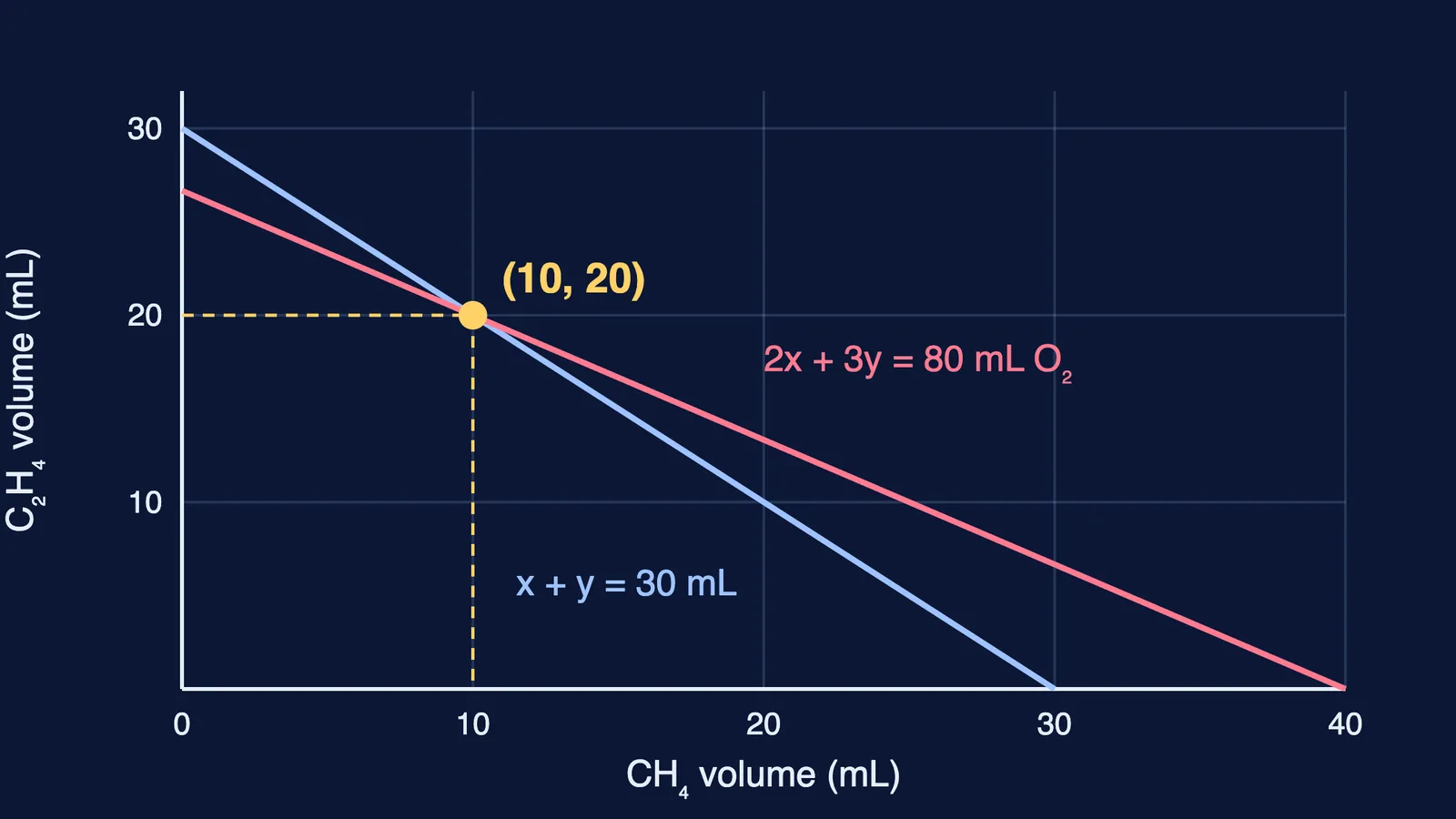
Q8 (hard). 30 mL of a mixture of methane and ethene needs exactly 80 mL of oxygen for complete combustion, all volumes at the same temperature and pressure. The percentage of methane in the mixture by volume is
(A) 33.3% (B) 66.7% (C) 50.0% (D) 22.2%
Answer: (A). CH₄ + 2O₂ → CO₂ + 2H₂O and C₂H₄ + 3O₂ → 2CO₂ + 2H₂O. Let x and y be the volumes of CH₄ and C₂H₄: x + y = 30 and 2x + 3y = 80, so x = 10 mL and y = 20 mL. Methane is 10 ÷ 30 = 33.3% by volume. Trap: (B) is ethene's share. (D) is methane's share by mass, not by volume.
What should you do after this set?
Sort your misses by trap. If Q1 or Q3 went wrong, revise the laws with our numericals on constant and multiple proportions. If Q6 or Q7 went wrong, the issue is usually the mole ratio; drill the method in our piece on mass-to-mass stoichiometry.
Redo every miss from a blank page two days later. If a method keeps breaking down, the Fermi Problem Library has worked problems with a step-by-step solver that explains the reasoning rather than printing an answer.