

On this page
Most numericals on the laws of chemical combination ask you either to check whether lab data obey the law of definite proportions, or to find the whole-number ratio behind the law of multiple proportions. Both need the same move: turn raw masses into a fair comparison before looking for a pattern.
What do the two laws actually say?
The NCERT Class 11 chemistry textbook (Unit 1, Some Basic Concepts of Chemistry) gives Proust's law of definite proportions as: a given compound always contains exactly the same proportion of elements by weight.
The same chapter gives Dalton's law of multiple proportions, proposed in 1803, as: if two elements form more than one compound, the masses of one element that combine with a fixed mass of the other are in a ratio of small whole numbers.
NCERT's evidence for the first law is Proust's cupric carbonate. A natural sample and a synthetic sample both contained 51.35% copper, 9.74% carbon and 38.91% oxygen (NCERT, section 1.5.2). If you want the story of how Proust argued his case, read our piece on Joseph Proust and definite proportions.
How do you check data against the law of definite proportions?
Use this three-step check:
Work out the mass fraction of one element in every sample: mass of element ÷ mass of compound.
Compare the fractions. Small differences come from measurement error. A large gap needs an explanation.
If you can, compare with the value from the formula, using standard atomic weights.
Worked example. Copper oxide is made two ways. In method A, 1.375 g of the oxide is reduced in hydrogen and leaves 1.098 g of copper. In method B, 1.179 g of copper is dissolved in nitric acid and heated strongly, giving 1.476 g of oxide.
Method A: 1.098 ÷ 1.375 = 0.7985, so 79.85% copper.
Method B: 1.179 ÷ 1.476 = 0.7988, so 79.88% copper.
The two results differ by 0.03 percentage points, so the data obey the law. As a cross-check, the IUPAC CIAAW abridged atomic weights give Cu = 63.546 and O = 15.999. That puts copper in CuO at 63.546 ÷ 79.545, or 79.89%.
For more practice turning masses into percentages, see our guide to percentage composition of a compound.
How do you find the whole-number ratio for multiple proportions?
Use this four-step recipe:
For each compound, write the mass of each element (use percentages if that is what you are given).
Divide so that every compound has 1 g of the same element.
Divide every answer by the smallest one.
Round to the nearest small whole number. Values such as 1.99 or 2.99 miss 2 and 3 only because the data were rounded.
NCERT's own example uses hydrogen. In water, 16 g of oxygen combines with 2 g of hydrogen. In hydrogen peroxide, 32 g of oxygen combines with the same 2 g. That gives a ratio of 1:2 (NCERT, section 1.5.3).
Worked example: the five oxides of nitrogen
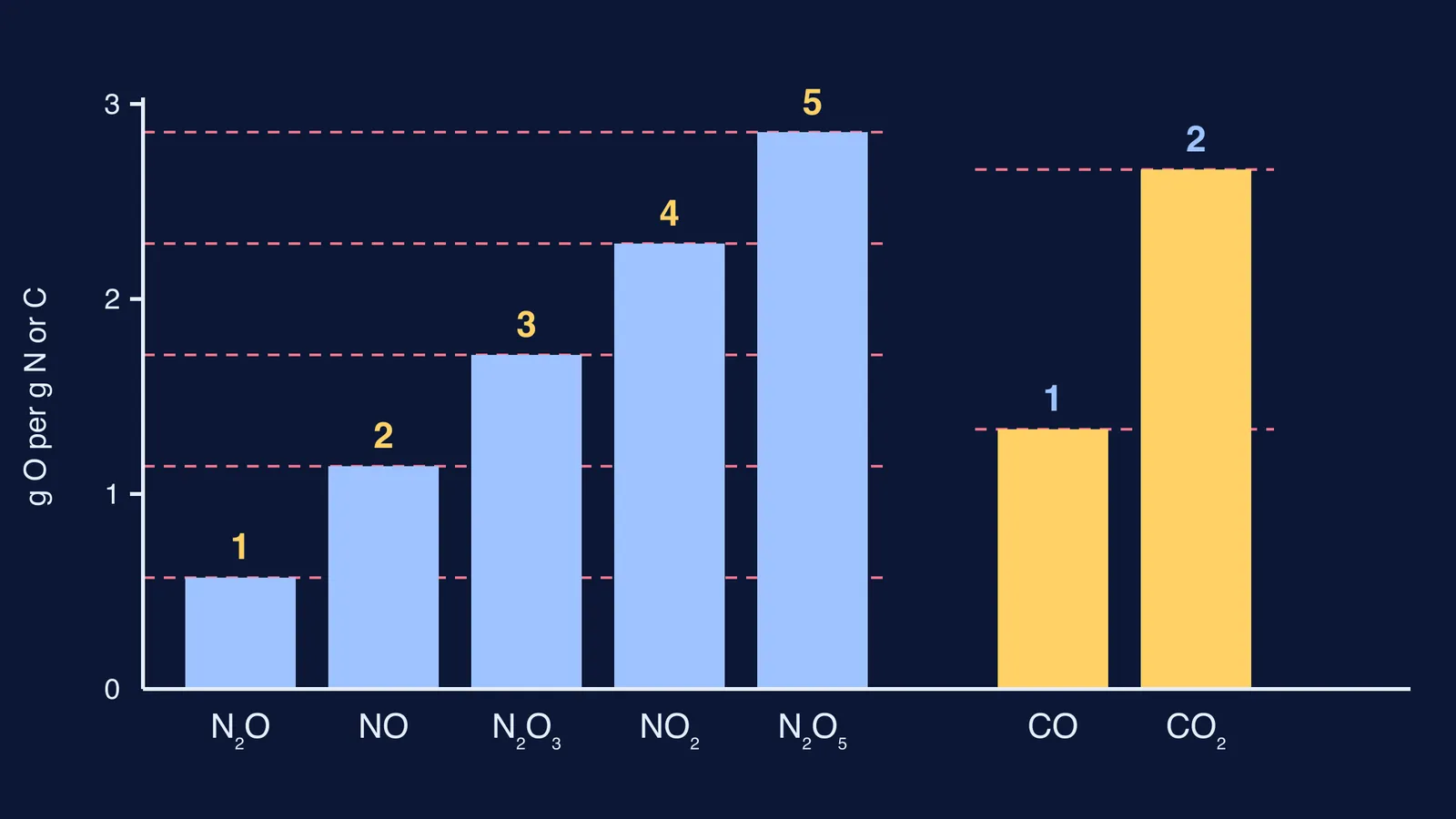
Suppose you are told that five oxides contain 63.6%, 46.7%, 36.9%, 30.4% and 25.9% nitrogen by mass. These are the values you get for N₂O, NO, N₂O₃, NO₂ and N₂O₅ from the CIAAW atomic weights (N = 14.007, O = 15.999), rounded to three figures.
The oxygen per gram of nitrogen is (100 − %N) ÷ %N:
36.4 ÷ 63.6 = 0.572
53.3 ÷ 46.7 = 1.141
63.1 ÷ 36.9 = 1.710
69.6 ÷ 30.4 = 2.289
74.1 ÷ 25.9 = 2.861
Divide each by 0.572 and you get 1, 1.99, 2.99, 4.00 and 5.00. So the masses of oxygen that combine with a fixed mass of nitrogen are in the ratio 1:2:3:4:5.
Worked example: CO and CO₂
Two oxides of carbon contain 42.9% and 27.3% carbon. The oxygen per gram of carbon is 57.1 ÷ 42.9 = 1.331 in the first and 72.7 ÷ 27.3 = 2.663 in the second. The ratio is 2.663 ÷ 1.331 = 2.00, so 1:2, which is what CO and CO₂ predict.
Which mistakes cost marks in these numericals?
Comparing raw masses of oxygen without first fixing the mass of the other element.
Fixing different elements in different compounds, such as nitrogen in one and oxygen in another.
Rounding 1.99 to 1.9 and then hunting for a strange ratio. Keep three significant figures until the last step.
Writing "the law is proved" without the ratio. The ratio is the proof.
Dalton's atomic theory went on to explain these laws, as our article on Dalton's atomic theory traces.
If you keep fixing the wrong element, try the Fermi Problem Library. It has worked problems with a step-by-step solver that explains the reasoning rather than printing an answer. If the idea of "a fixed mass of the other element" still feels slippery, the Fermi Concept Library gives each concept in chemistry its own lesson.
Next, run the four-step recipe on SO₂ and SO₃ yourself.


