

On this page
When chemists want to know exactly how much of a specific element is locked inside a molecule, they calculate its percentage composition. Whether you are finding the amount of nitrogen in a fertiliser or extracting copper from an ore, this fundamental calculation tells you the mass fraction of each element.
What is percentage composition?
The percentage composition of a compound is the percentage by mass of each element within it. Because atoms have different masses, a formula like H₂O does not mean water is half hydrogen and half oxygen by mass. Instead, the heavy oxygen atom makes up most of the molecule's weight.
According to standard definitions in chemistry, you calculate this by taking the mass of the specific element in one mole of the compound, dividing it by the compound's total molar mass, and multiplying by 100 [[1]](https://openstax.org/books/chemistry-2e/pages/3-2-determining-empirical-and-molecular-formulas).
If you are struggling with molar masses or mole concepts, the Fermi Concept Library covers every concept in physics, chemistry, biology, mathematics and computing, each with its own lesson and its place in the map.
How do you calculate the percentage of an element in a compound?
To find the percentage composition, you need the chemical formula and the standard atomic weights of the elements involved. The Commission on Isotopic Abundances and Atomic Weights (CIAAW) provides the official masses we use for these calculations [[2]](https://ciaaw.org/atomic-weights.htm).
Here is the step-by-step framework:
Identify the atomic mass of the element from the periodic table.
Count how many atoms of that element are in the chemical formula.
Multiply the atomic mass by the number of atoms to find the total mass of that element in one mole.
Calculate the total molar mass of the entire compound by adding up the masses of all atoms in the formula.
Divide the element's mass by the total molar mass, then multiply by 100.
Let's look at three common examples: water, urea, and copper sulphate pentahydrate.
How to find the percentage of elements in water (H₂O)?
Water is the simplest starting point. Using standard atomic weights, hydrogen (H) is 1.008 g/mol and oxygen (O) is 16.00 g/mol [[2]](https://ciaaw.org/atomic-weights.htm).
Mass of Hydrogen: 2 atoms × 1.008 = 2.016 g/mol
Mass of Oxygen: 1 atom × 16.00 = 16.00 g/mol
Total Molar Mass: 2.016 + 16.00 = 18.016 g/mol
Now, apply the percentage formula:
Hydrogen: (2.016 / 18.016) × 100 = 11.19%
Oxygen: (16.00 / 18.016) × 100 = 88.81%
Even though there are twice as many hydrogen atoms as oxygen atoms, oxygen accounts for nearly 89% of water's mass. This kind of mass-based reasoning is also central when calculating the average molar mass of a gas mixture.
How to find the percentage of nitrogen in urea?
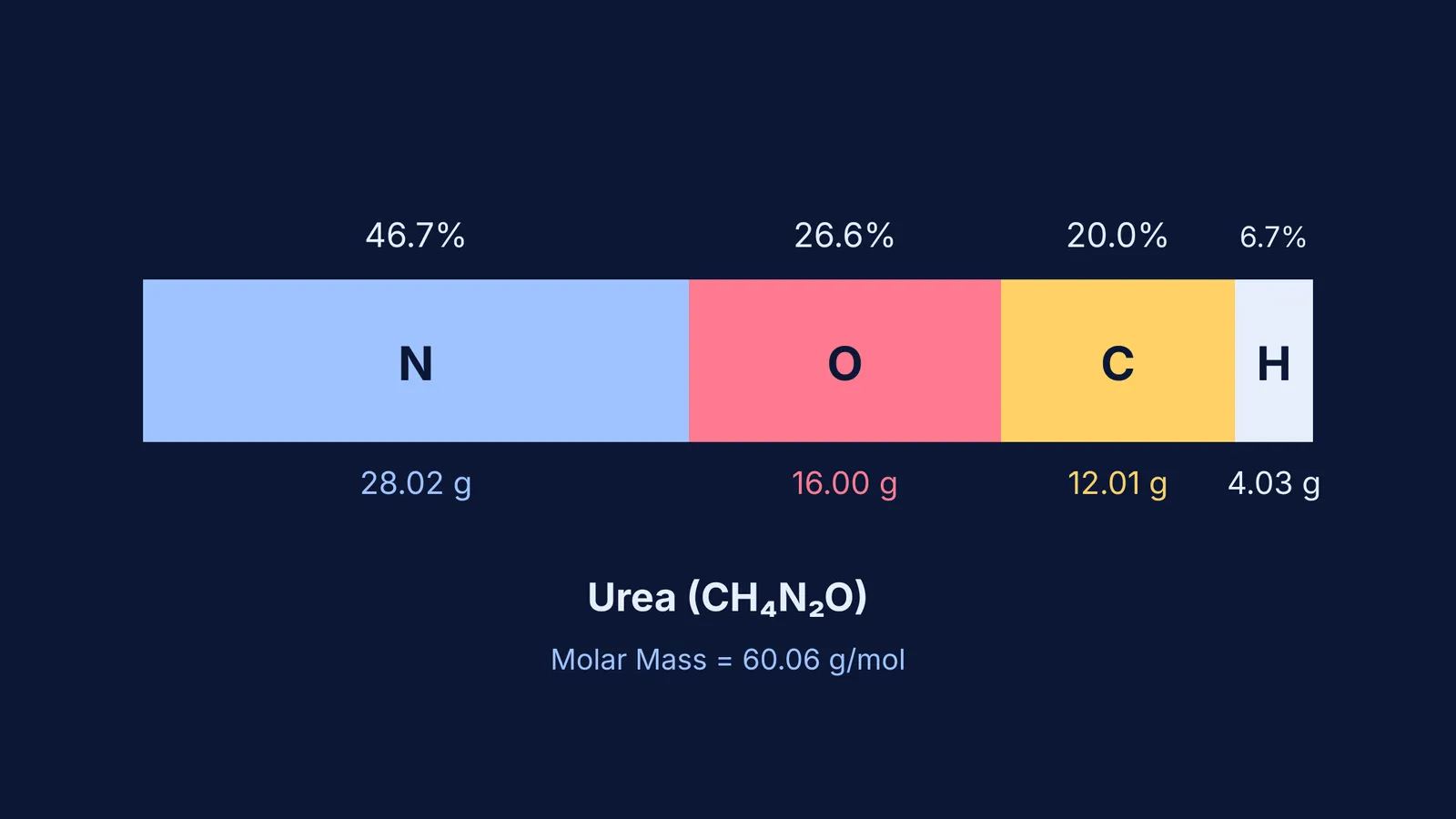
Urea (NH₂CONH₂ or CH₄N₂O) is a widely used agricultural fertiliser, and its value depends entirely on its high nitrogen content.
First, list the atomic weights and count the atoms [[2]](https://ciaaw.org/atomic-weights.htm):
Carbon (C): 1 atom × 12.01 = 12.01 g/mol
Oxygen (O): 1 atom × 16.00 = 16.00 g/mol
Nitrogen (N): 2 atoms × 14.01 = 28.02 g/mol
Hydrogen (H): 4 atoms × 1.008 = 4.03 g/mol
Adding these together gives a total molar mass of 60.06 g/mol.
To find the nitrogen content:
Percentage of Nitrogen: (28.02 / 60.06) × 100 = 46.65%
This high percentage (nearly 47%) is exactly why urea is such an effective nitrogen source for plants. If you ever get stuck setting up similar calculations, the Fermi Problem Library features a step-by-step solver that explains the reasoning rather than printing an answer.
How to find the percentage of water of crystallisation in copper sulphate?
Many salts exist as hydrates, meaning water molecules are locked into their crystal structure. A classic exam question asks for the percentage of this "water of crystallisation" in blue copper sulphate pentahydrate (CuSO₄·5H₂O).
We calculate the masses in two parts: the dry salt and the water [[2]](https://ciaaw.org/atomic-weights.htm).
Copper (Cu): 63.55 g/mol
Sulphur (S): 32.06 g/mol
Oxygen in sulphate (O₄): 4 × 16.00 = 64.00 g/mol
Mass of 5H₂O: 5 × 18.016 = 90.08 g/mol
The total molar mass of the hydrated crystal is: 63.55 + 32.06 + 64.00 + 90.08 = 249.69 g/mol.
Now, treat the five water molecules as a single group to find their percentage:
Percentage of Water: (90.08 / 249.69) × 100 = 36.08%
This means that when you heat 100 grams of blue copper sulphate crystals until they turn into a white, dry powder, the sample will lose about 36 grams of water to the air. Similar structural breakdowns are useful when figuring out the oxidation numbers from structure for complex ions.


