On this page
Eight original JEE Main-style questions on heat, work and the laws of thermodynamics, easy to hard, each solved with a trap line. Q3 and Q8 are numerical.
Which Thermodynamics topics does this JEE Main set cover?
Unit 8 of the official Syllabus for JEE (Main) - 2027 covers heat, work and internal energy, the zeroth, first and second laws, isothermal and adiabatic processes, and reversibility. The set also uses the Carnot engine from Chapter 11 of NCERT Class 11 Physics Part II (Reprint 2026-27) and, for the specific heats in Unit 9, C_v = 3R/2 (monatomic) and 5R/2 (rigid diatomic) from NCERT Chapter 12.
We use NCERT's ΔQ = ΔU + ΔW (W done by the gas) and R = 8.3 J mol⁻¹ K⁻¹. New to the chapter? Start with how to prepare Thermodynamics for JEE Main.
How should you use this practice set?
The JEE (Main) 2027 information bulletin gives +4 for a correct answer and −1 for a wrong one, and numerical answers are rounded to the nearest integer.
Set a 20-minute timer and work on paper.
Before any formula, write which of Q, W and ΔU is zero.
Easy: first law, isobaric heat and isothermal work
Q1 (easy). Along path 1 from state i to state f, a gas absorbs 900 J and does 350 J of work. Along path 2 between the same states, it does 200 J of work. What heat does it absorb on path 2?
(A) 350 J (B) 700 J (C) 750 J (D) 900 J
Answer: (C). ΔU is a state variable: 900 − 350 = 550 J on both paths. Path 2: ΔQ = 550 + 200 = 750 J.
Trap: (D) treats heat as path-independent; only ΔU is.
Q2 (easy). An ideal diatomic gas absorbs 700 J of heat at constant pressure. How much work does it do?
(A) 200 J (B) 280 J (C) 500 J (D) 700 J
Answer: (A). ΔQ = (7/2)nRΔT and W = nRΔT, so W = (2/7) × 700 = 200 J.
Trap: (B) uses R/C_v = 2/5; at fixed pressure the heat is set by C_p.
Q3 (easy, numerical). Half a mole of an ideal gas is compressed slowly at 400 K from 12 L to 3 L. How much heat, in joules, does it give out?
Answer: 2301. ΔU = 0, so heat out equals work done on the gas: nRT ln(V₁/V₂) = 0.5 × 8.3 × 400 × ln 4 ≈ 2301 J.
Trap: 999, from log₁₀ 4 instead of ln 4.
Medium: linear processes, adiabatic work and engines in series
Q4 (medium). Two moles of a monatomic ideal gas are heated with P ∝ V (a straight line through the origin on a P–V diagram), and the temperature rises by 60 K. How much heat is absorbed?
(A) 498 J (B) 1494 J (C) 1992 J (D) 2490 J
Answer: (C). ΔU = n(3R/2)ΔT = 1494 J. Work, the area under the line, is ½(P₂V₂ − P₁V₁) = ½nRΔT = 498 J. ΔQ = 1494 + 498 = 1992 J.
Trap: (D) uses the constant-pressure work nRΔT; along this line the work is half that.
Q5 (medium). Three moles of an ideal diatomic gas (γ = 7/5) expand adiabatically, and the temperature falls from 450 K to 350 K. How much work does the gas do?
(A) 2490 J (B) 3735 J (C) 6225 J (D) 8715 J
Answer: (C). Q = 0, so W = nRΔT/(γ − 1) = 3 × 8.3 × 100/0.4 = 6225 J.
Trap: (D) uses C_p; here W = −ΔU, set by C_v.
Q6 (medium). Carnot engine X works between 900 K and T; Carnot engine Y takes the heat X rejects and works between T and 300 K. If X does twice as much work per cycle as Y, what is T?
(A) 500 K (B) 520 K (C) 600 K (D) 700 K
Answer: (A). For Carnot engines, Q ∝ T, so each engine's work is proportional to its temperature drop. 900 − T = 2(T − 300), so 3T = 1500 and T = 500 K.
Trap: (C) is for equal work; (B) ≈ √(900 × 300) is for equal efficiencies.
Hard: a three-step cycle and mixing two gases
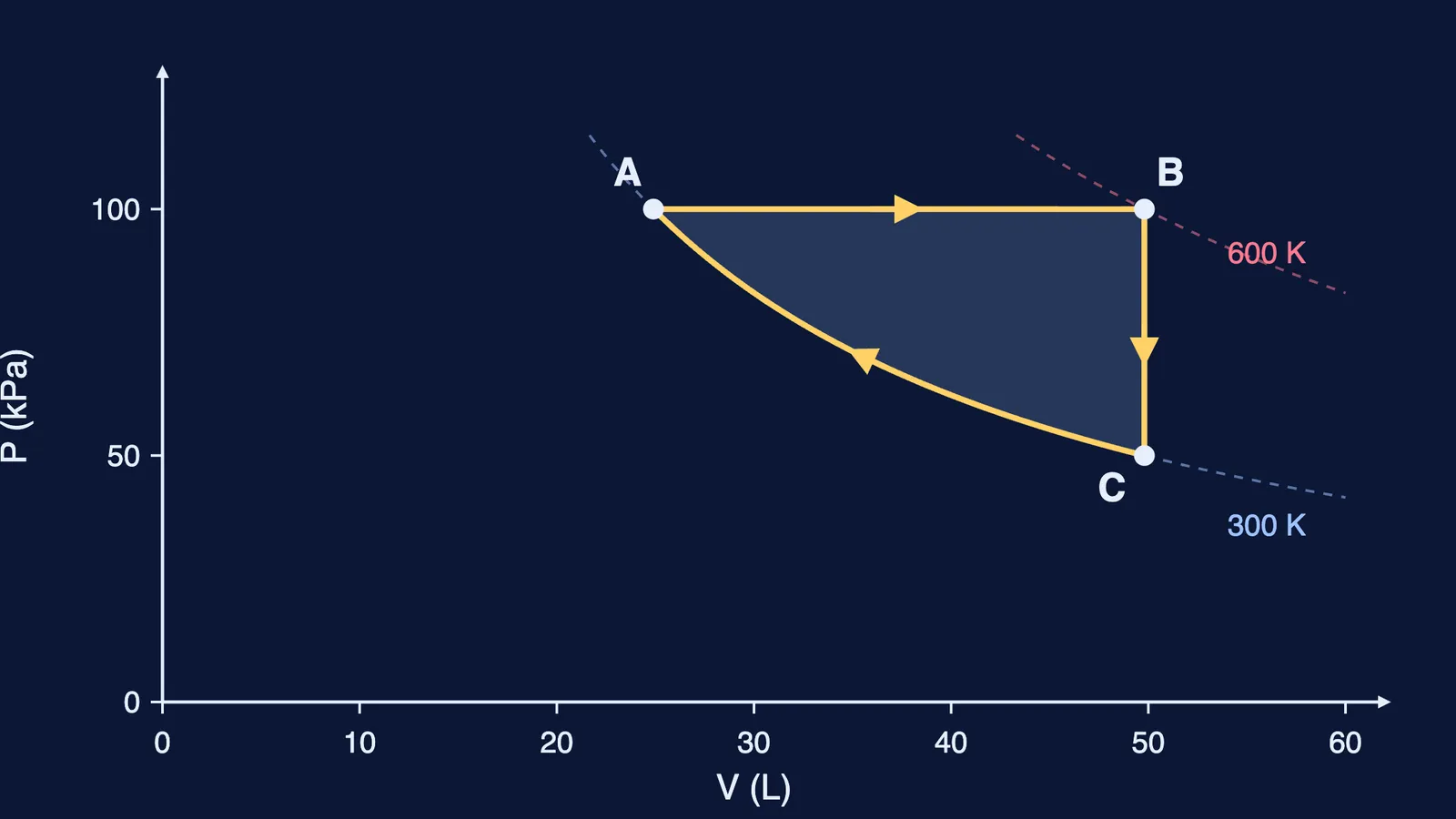
Q7 (hard). One mole of a monatomic ideal gas starts at A (100 kPa, 300 K), expands at constant pressure to B at double the volume, cools at constant volume to C at 300 K, then is compressed isothermally back to A (the diagram above). What is the efficiency of the cycle?
(A) about 12% (B) about 20% (C) about 31% (D) 50%
Answer: (A). B is at 600 K. Work: A→B gives R × 300 = 2490 J; C→A gives −R × 300 × ln 2 ≈ −1726 J; net ≈ 764 J. Heat enters only on A→B: (5/2)R × 300 = 6225 J. Efficiency = 764/6225 ≈ 12%.
Trap: (B) divides by the C_v heat, (3/2)R × 300; A→B is at constant pressure. (D) is the Carnot limit between 600 K and 300 K.
Q8 (hard, numerical). A rigid insulated container is split by a partition. One side holds 2 mol of a monatomic ideal gas at 300 K, and the other 3 mol of a rigid diatomic ideal gas at 400 K. The partition is removed. Find the final temperature in kelvin.
Answer: 371. Rigid and insulated means W = 0 and Q = 0, so the total ΔU = 0: 2 × (3/2)R(T − 300) + 3 × (5/2)R(T − 400) = 0. That gives 10.5T = 3900, so T ≈ 371.4 K, which rounds to 371.
Trap: 360, the mole-weighted average. The diatomic gas has the larger heat capacity.
What should you do after checking your answers?
Sort your misses by cause:
Heat or work treated as a state variable: Q1, Q7
C_p and C_v swapped: Q2, Q5, Q7
Wrong work formula for the process: Q3, Q4
Ratios misread: Q6, Q8
Redo your weakest group, then retry the set in three days.
For more engines, try our heat engine and Carnot cycle problems. For a routine for Section B, see JEE Main physics numerical questions.
For more questions like these, the Fermi Problem Library has worked problems with a step-by-step solver that explains the reasoning rather than printing an answer.