On this page
How should you use this electronic devices question set?
Unit 19 (Electronic Devices) of the NMC syllabus for NEET (UG)-2026 covers semiconductors, diode I-V characteristics in both biases, the rectifier, the LED, photodiode, solar cell and Zener diode, the Zener regulator, and the OR, AND, NOT, NAND and NOR gates. These eight questions stay inside that list.
As in NEET-UG 2026, the NTA information bulletin gives +4 for a correct answer and takes away 1 mark for a wrong one, so a guess you cannot narrow down is not free.
Give yourself 12 minutes, pen and paper, no calculator.
Write your answer before reading each solution.
Read every trap line, even when you were right.
New to the unit? Start with our guide on how to prepare Electronic Devices for NEET.
Easy: bands, rectifiers and bias
The first three use NCERT Chapter 14, Semiconductor Electronics: insulators have a band gap above 3 eV, semiconductors below 3 eV, and in metals the bands overlap.
Q1 (easy). Solid X has a band gap of 5.5 eV, solid Y has 1.1 eV, and in solid Z the valence and conduction bands overlap. X, Y and Z are, in order:
(A) conductor, semiconductor, insulator (B) insulator, semiconductor, conductor (C) semiconductor, insulator, conductor (D) insulator, conductor, semiconductor
Answer: (B). Above 3 eV, X insulates; 1.1 eV lets some electrons cross thermally, so Y is a semiconductor; overlapping bands make Z a conductor. Trap: (A), which reads a bigger gap as a better conductor.
Q2 (easy). A full-wave rectifier gives 100 output pulses per second. One of its two diodes then burns out and stops conducting. The output now has:
(A) 100 pulses per second (B) 200 pulses per second (C) 50 pulses per second (D) no output
Answer: (C). 100 pulses per second from full-wave means 50 Hz input. The working diode still passes one half of every cycle, so the circuit acts as a half-wave rectifier: 50 pulses per second. Trap: (D), which assumes one failed diode kills the whole circuit.
Q3 (easy). In which case is the p-n junction forward biased?
(A) p-side +2 V, n-side +5 V (B) p-side −4 V, n-side −2 V (C) p-side −3 V, n-side −5 V (D) p-side 0 V, n-side +1 V
Answer: (C). Forward bias needs the p-side at the higher potential, and −3 V is higher than −5 V. In A, B and D the n-side is higher. Trap: (B), which compares sizes (4 against 2) and ignores the signs.
Medium: can you size a Zener resistor and read a photodiode cut-off?
A Zener regulates only in reverse breakdown: the series current splits into the load current and the Zener current.
Q4 (medium). A 12 V supply feeds a 5.0 V Zener through a series resistor R, with a 250 Ω load across the Zener. For a Zener current of 12 mA, R should be closest to:
(A) 350 Ω (B) 583 Ω (C) 375 Ω (D) 219 Ω
Answer: (D). Load current = 5.0/250 = 20 mA, so the series current is 20 + 12 = 32 mA. R = (12 − 5)/0.032 ≈ 219 Ω. Trap: (A), which sends only the load current through R.
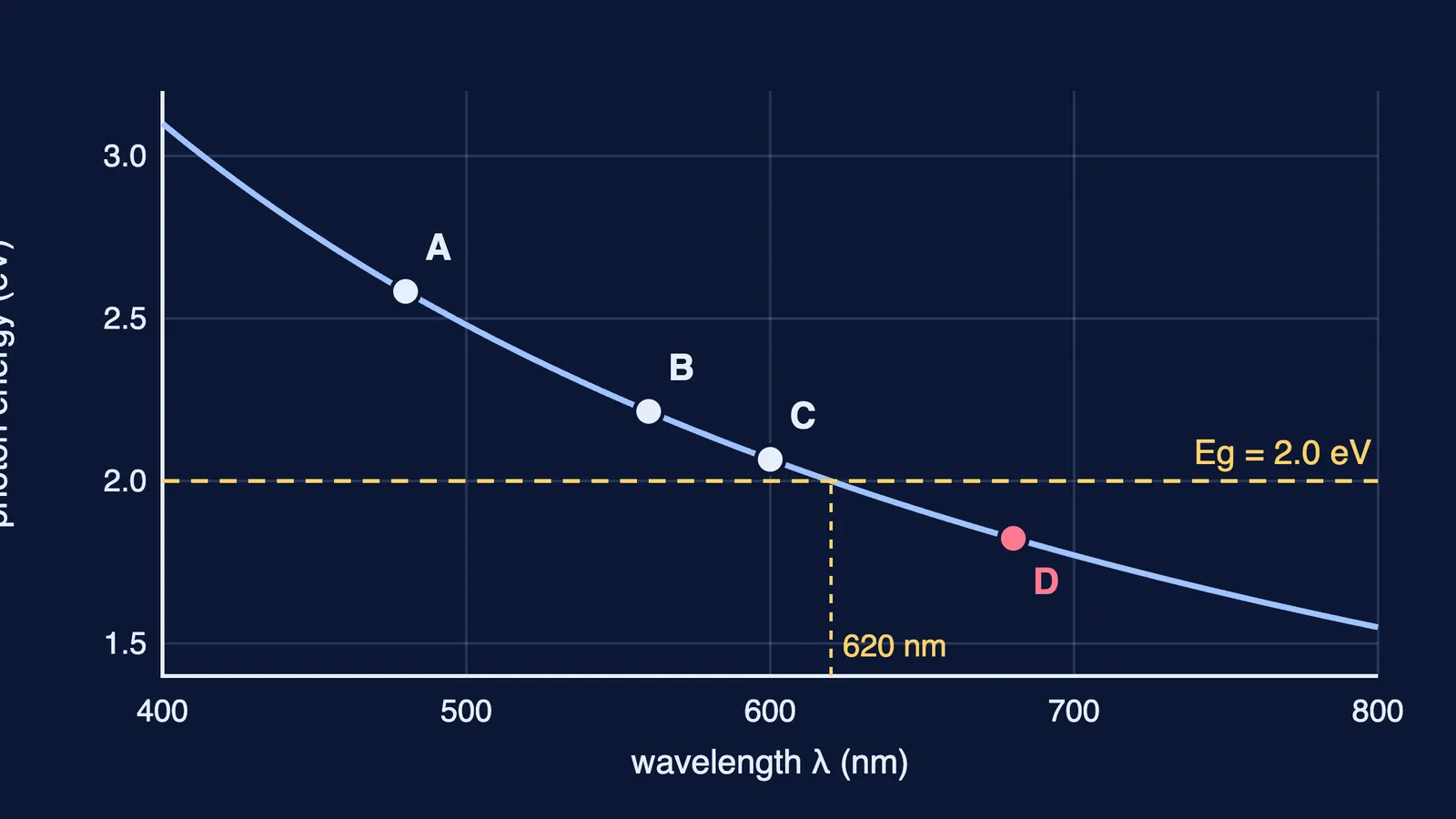
Q5 (medium). A photodiode is made from a semiconductor with a band gap of 2.0 eV. Take hc = 1240 eV nm. Light of which wavelength will NOT produce a photocurrent?
(A) 480 nm (B) 560 nm (C) 600 nm (D) 680 nm
Answer: (D). The cut-off is λ = 1240/2.0 = 620 nm. At 680 nm each photon carries 1240/680 ≈ 1.82 eV, less than the gap. Trap: (A), which assumes longer wavelengths carry more energy.
Q6 (medium). Both inputs of a NAND gate are tied to A. Its output and B feed a NOR gate with output Y. Y is:
(A) A AND (NOT B) (B) (NOT A) AND B (C) A NOR B (D) 1 for every input
Answer: (A). Tied inputs make the NAND a NOT gate, so the NOR sees NOT A and B: Y = NOT(NOT A + B) = A AND (NOT B), which is 1 only for A = 1, B = 0. Trap: (C), which treats the tied NAND as passing A through unchanged.
Hard: which diode conducts, and how much Zener current flows?
Q7 (hard). A supply that varies between 14 V and 20 V feeds a 10 V Zener through 200 Ω, with a 1.0 kΩ load across the Zener. The output stays at 10 V. Over this range, the Zener current varies from:
(A) 20 mA to 50 mA (B) 60 mA to 90 mA (C) 10 mA to 40 mA (D) 10 mA to 10 mA
Answer: (C). Even at 14 V the load alone would see 14 × 1000/1200 ≈ 11.7 V, so the Zener stays in breakdown. Series current = (14 − 10)/200 = 20 mA up to (20 − 10)/200 = 50 mA. The load always takes 10/1000 = 10 mA, so the Zener carries 10 mA to 40 mA: it absorbs the change. Trap: (A), which forgets the load current.
Q8 (hard). A 10 V battery and a 2 Ω resistor feed two parallel branches. Branch 1: an ideal diode, forward biased, in series with 3 Ω. Branch 2: an ideal diode pointing the other way, in series with 6 Ω. Find the battery current, then the current after the battery is reversed.
(A) 2.5 A, then 2.5 A (B) 2.0 A, then 1.25 A (C) 2.0 A, then 2.0 A (D) 1.25 A, then 2.0 A
Answer: (B). At first only branch 1 conducts: 10/(2 + 3) = 2.0 A. Reversed, only branch 2 conducts: 10/(2 + 6) = 1.25 A. Trap: (A), which lets both diodes conduct and uses 3 Ω and 6 Ω in parallel (2 Ω).
What should you revise after this set?
Group your misses: bands and bias (Q1, Q3), rectifiers (Q2), Zener circuits (Q4, Q7), photodiode energy (Q5), gates (Q6) and diode networks (Q8). Our post on common mistakes in semiconductor questions explains each type, and the semiconductors, diodes and logic gates guide covers the Zener, photodiode and gates that the current NCERT chapter omits.
For more Zener and diode-network practice, the Fermi Problem Library has worked problems with a step-by-step solver that explains the reasoning rather than printing an answer. Redo this set in a week.