On this page
These eight original JEE Main-style questions each end with the trap: the wrong option most students pick, and why.
What does JEE Main test in Units and Measurements?
NTA's Syllabus for JEE (Main) - 2027, linked from jeemain.nta.nic.in, makes Units and Measurements Physics Unit 1: SI units, least count, significant figures, errors in measurements, and dimensional analysis. Unit 20 adds the vernier calipers and screw gauge. The textbook match is NCERT Class 11 Physics Chapter 1. For the theory and a two-week plan, read our guide on how to prepare Units and Measurements for JEE Main.
How should you use this practice set?
Cover the answers and give yourself 16 minutes for all eight.
Mark every miss as concept, arithmetic or misreading.
Redo the misses two days later on a blank page.
Easy: dimensions, significant figures and units
Q1 (easy). The energy stored in a stretched rubber cord is modelled as U = αx² + βx⁴, where x is the extension. What are the dimensions of α/β?
(A) [L²] (B) [L⁻²] (C) [M L² T⁻²] (D) dimensionless
Answer: (A). Each term is an energy. α = [M L² T⁻²]/[L²] = [M T⁻²] and β = [M L² T⁻²]/[L⁴] = [M L⁻² T⁻²], so α/β = [L²].
Trap: (B) is β/α, the ratio taken upside down.
Q2 (easy). A metal block has a mass of 25.0 g and a volume of 9.2 cm³. How should its density be reported?
(A) 2.717 g/cm³ (B) 2.72 g/cm³ (C) 2.7 g/cm³ (D) 3 g/cm³
Answer: (C). 25.0/9.2 = 2.717... A quotient keeps the fewest significant figures in the data. 9.2 has two, so the answer is 2.7 g/cm³.
Trap: (B) follows the three figures of 25.0 instead of the weaker 9.2.
Q3 (easy). A new system uses 5 kg as the unit of mass, 2 m as the unit of length and 0.5 s as the unit of time. What is 200 J in this system's unit of energy?
(A) 2.5 (B) 5 (C) 40 (D) 16000
Answer: (A). The new energy unit is 5 kg × (2 m)² / (0.5 s)² = 80 J. So 200 J = 200/80 = 2.5 units.
Trap: (D) multiplies by 80 instead of dividing. A bigger unit gives a smaller number.
Medium: errors, the screw gauge and dimensional analysis
Q4 (medium). A trolley's kinetic energy is found from K = ½ m (d/t)². The measurements are m = 200 ± 1 g, d = 50.0 ± 0.1 cm and t = 2.50 ± 0.05 s. What is the maximum percentage error in K?
(A) 2.7% (B) 3.1% (C) 4.9% (D) 9.8%
Answer: (C). The relative errors are 0.5% in m, 0.2% in d and 2% in t. K varies as m d² t⁻², so the error is 0.5 + 2(0.2) + 2(2) = 4.9%.
Trap: (B) subtracts the time term because t is in the denominator. Errors always add.
Q5 (medium). A screw gauge's spindle moves 1 mm for two full turns, and its circular scale has 100 divisions. With the studs closed, the circular scale's zero stops 6 divisions above the reference line (a negative zero error). For a wire, the linear scale shows 1.5 mm and the circular scale 34 divisions. What is the wire's diameter?
(A) 1.64 mm (B) 1.67 mm (C) 1.70 mm (D) 1.90 mm
Answer: (C). The pitch is 0.5 mm, so the least count is 0.5/100 = 0.005 mm. Reading = 1.5 + 34 × 0.005 = 1.67 mm. The zero error is −6 × 0.005 = −0.03 mm, so the diameter is 1.67 − (−0.03) = 1.70 mm.
Trap: (A) subtracts 0.03 mm as if the error were positive; (D) takes the least count as 0.01 mm. Our explainer on positive and negative zero error draws both cases.
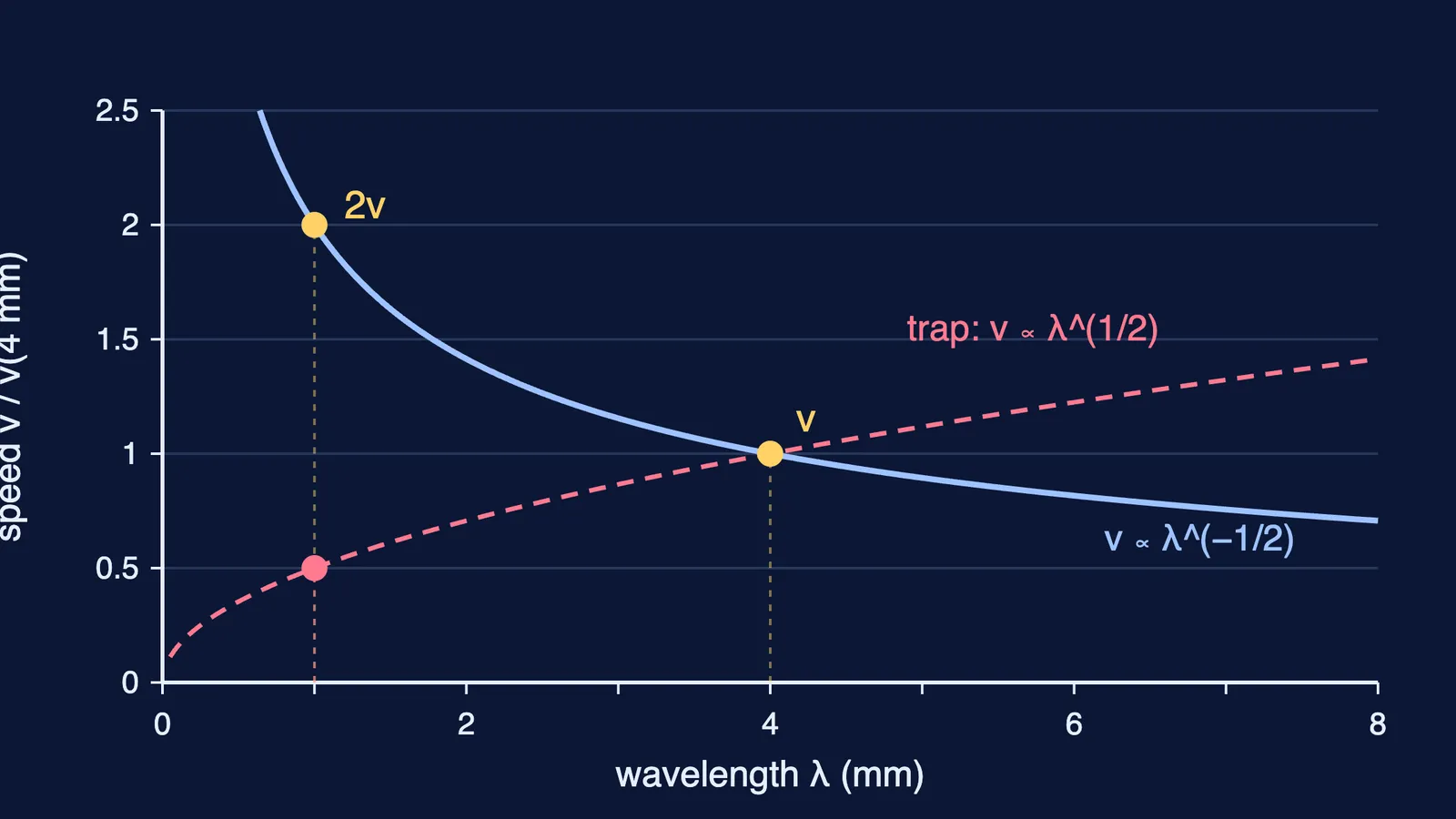
Q6 (medium). The speed of very short ripples on water depends only on surface tension σ, density ρ and wavelength λ. A 4 mm ripple travels at speed v. Assuming the same dimensionless constant, how fast does a 1 mm ripple travel?
(A) v/4 (B) v/2 (C) 2v (D) 4v
Answer: (C). Write v = k σᵃ ρᵇ λᶜ with σ = [M T⁻²]. Matching powers: T gives a = 1/2, M gives b = −1/2, L gives c = −1/2. So v ∝ √(σ/ρλ), and quartering λ doubles the speed.
Trap: (B) borrows v ∝ √λ from long gravity waves.
Hard: can you combine errors and derive an exponent?
Q7 (hard). To find a wire's resistivity ρ = πd²R/(4L), a student measures d = 0.50 ± 0.01 mm and R = 5.00 ± 0.05 Ω. The length comes from two metre-scale positions, 85.30 ± 0.05 cm and 15.30 ± 0.05 cm. What is the maximum percentage error in ρ, to two significant figures?
(A) 3.1% (B) 5.0% (C) 5.1% (D) 5.4%
Answer: (C). For a difference, absolute errors add: L = 70.00 ± 0.10 cm, a 0.14% error. Then 2(2%) + 1% + 0.14% = 5.14%, which is 5.1%.
Trap: (D) adds the two positions' percentage errors (0.06% and 0.33%) instead of their absolute errors. Our post on why subtraction costs precision explains the rule.
Q8 (hard, numerical value). The time τ a small raindrop takes to approach its terminal speed depends on its radius r, the density of water ρ and the viscosity of air η, as τ ∝ rᵃ ρᵇ ηᶜ. Find a + b + c.
Answer: 2. With η = [M L⁻¹ T⁻¹]: T gives −c = 1, so c = −1; M gives b + c = 0, so b = 1; L gives a − 3b − c = 0, so a = 2. τ ∝ ρr²/η and a + b + c = 2.
Trap: −2, from a sign slip on viscosity's T exponent that flips b and c.
What should you do after this set?
7 or 8 correct: try harder error and dimension problems at JEE Advanced level.
4 to 6: redo your misses, then attempt 15 fresh error and dimension questions.
Under 4: reread the NCERT sections on significant figures and dimensions first.
If you reach right numbers by wrong methods, the Fermi Problem Library has worked problems with a step-by-step solver that explains the reasoning rather than printing an answer.