On this page
These eight NEET-UG Biology questions on Microbes in Human Welfare are new, not copied or reworded from NCERT, exemplar or past papers. They climb from single pairings to a sewage calculation and statement counting.
Is Microbes in Human Welfare in the NEET syllabus?
Yes. The NEET (UG)-2026 syllabus from the National Medical Commission, dated 22-12-2025, lists microbes in household food processing, industrial production, sewage treatment, energy generation, biocontrol agents and biofertilisers under Biology Unit 8, Biology and Human Welfare. Every fact in these questions comes from Chapter 8 of the NCERT Class 12 Biology book, Reprint 2026-27.
If you have not revised the chapter yet, start with our guide to preparing Microbes in Human Welfare for NEET.
How should you use this practice set?
Hide the answers and allow about a minute per question.
Work Q5 on paper before reading its options.
Read the trap line even when you were right.
List the traps that caught you and reread them before your next mock test.
Easy: do you know which microbe does what?
Q1 (easy). A batch of Swiss cheese ripens without its usual large holes. Which microbe was most likely missing from the batch?
(A) Lactobacillus (B) Propionibacterium sharmanii (C) Saccharomyces cerevisiae (D) Aspergillus niger
Answer: (B). NCERT says the large holes in Swiss cheese come from a large amount of CO2 made by the bacterium Propionibacterium sharmanii. Trap: (C) tempts because baker's yeast releases the CO2 that puffs up bread dough, but NCERT ties the cheese holes to P. sharmanii.
Q2 (easy). Which product is correctly paired with the organism that makes it?
(A) Cyclosporin A, Streptococcus (B) Streptokinase, Trichoderma polysporum (C) Statins, Monascus purpureus (D) Citric acid, Acetobacter aceti
Answer: (C). Statins come from the yeast Monascus purpureus and lower blood cholesterol. Cyclosporin A comes from the fungus Trichoderma polysporum, streptokinase from the bacterium Streptococcus, and citric acid from Aspergillus niger. Trap: (A) and (B) are the two right organisms swapped.
Q3 (easy). A soil test shows enough nitrogen but too little phosphorus. Which biofertiliser targets that shortage?
(A) Rhizobium (B) Azotobacter (C) Mycorrhiza formed by Glomus (D) Anabaena
Answer: (C). In mycorrhiza, the fungal partner absorbs phosphorus from the soil and passes it to the plant. Trap: (A) and (D) are well-known biofertilisers, but both fix nitrogen, which this soil already has.
Medium: can you follow a sewage plant step by step?
Q4 (medium). Where does activated sludge form, and where does most of it go?
(A) In the primary settling tank; it is released into the river (B) In the settling tank after the aeration tank; a small part returns to the aeration tank and most goes to anaerobic sludge digesters (C) In the aeration tank; all of it is pumped back (D) In the anaerobic sludge digester; it is dried as fertiliser
Answer: (B). After BOD falls in the aeration tanks, the bacterial flocs settle in a settling tank as activated sludge. A small part is pumped back as inoculum; the major part goes to anaerobic sludge digesters. Trap: (A) confuses activated sludge with primary sludge, the solids that settle during physical primary treatment.
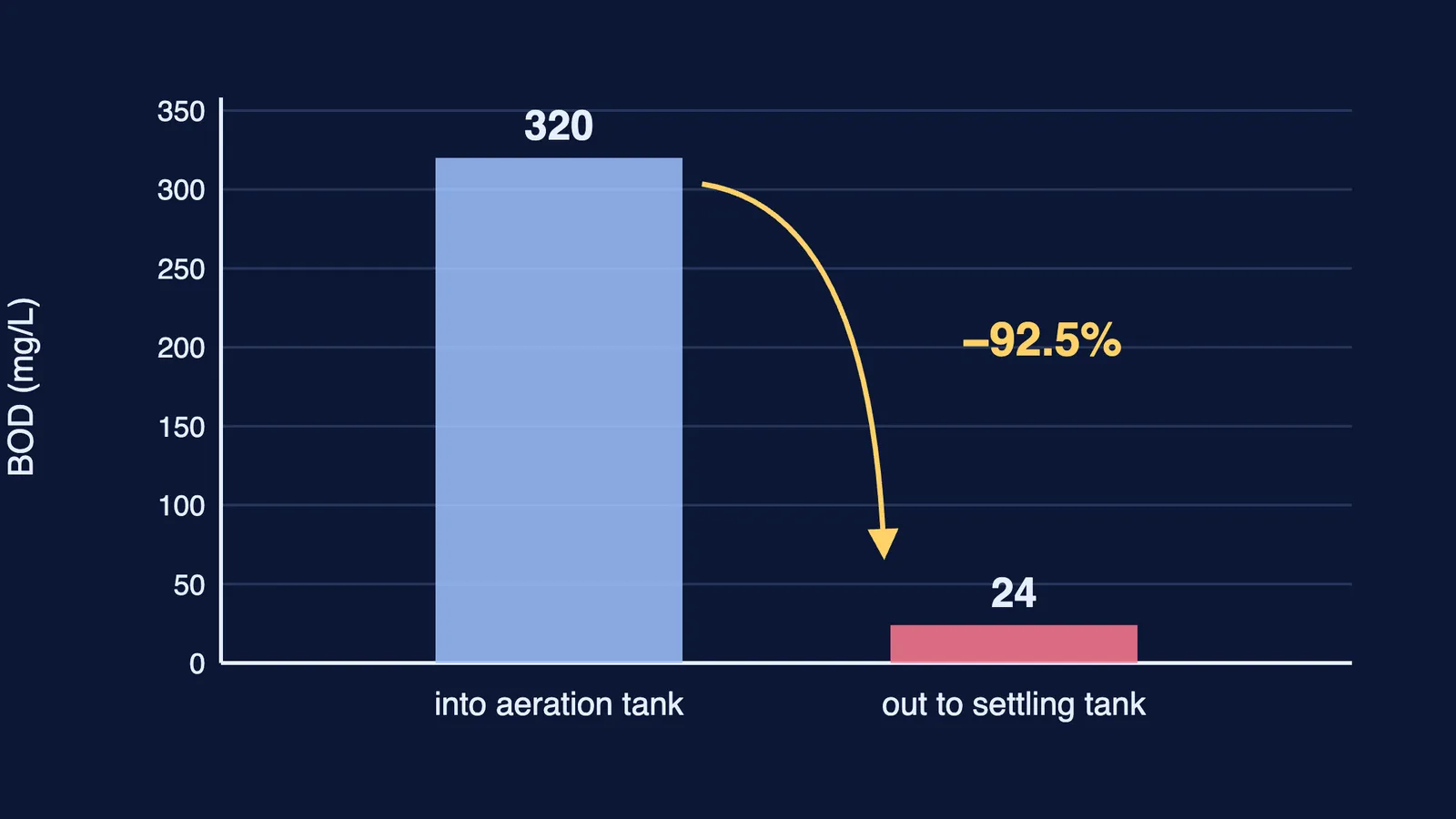
Q5 (medium). A plant log shows the effluent entering the aeration tank at a BOD of 320 mg/L and leaving for the settling tank at 24 mg/L. By what percentage has the BOD fallen?
(A) 7.5% (B) 13.3% (C) 92.5% (D) 296%
Answer: (C). The fall is 320 − 24 = 296 mg/L, and 296 ÷ 320 × 100 = 92.5%. BOD indirectly measures organic matter, so the flocs have consumed most of it. Trap: (A) is 24 ÷ 320, the share that remains, not the share removed.
Q6 (medium). Read both statements.
Statement I: Methanobacterium, found in the cattle rumen and in anaerobic sludge, grows anaerobically on cellulosic material and releases methane with CO2 and H2.
Statement II: In a sewage treatment plant, the primary sludge is pumped into anaerobic sludge digesters, where biogas forms.
(A) Both statements are true (B) Both statements are false (C) Statement I is true, Statement II is false (D) Statement I is false, Statement II is true
Answer: (C). Statement I matches NCERT section 8.4. Statement II fails on one word: the digesters receive the activated sludge from secondary treatment, not the primary sludge. Trap: (A) tempts because biogas really does form in those digesters.
Hard: can you handle matching and counting?
Q7 (hard). Match List I with List II.
List I: (a) Bacillus thuringiensis (b) Trichoderma (c) Nucleopolyhedrovirus (d) Glomus
List II: (i) free-living fungus of root ecosystems that acts against plant pathogens (ii) baculovirus used as a species-specific, narrow-spectrum insecticide (iii) toxin released in the larval gut kills caterpillars (iv) passes soil phosphorus to the plant
(A) a-iii, b-i, c-ii, d-iv (B) a-iii, b-iv, c-ii, d-i (C) a-ii, b-i, c-iii, d-iv (D) a-i, b-iii, c-ii, d-iv
Answer: (A). Bt toxin is released in the caterpillar's gut; Trichoderma fights plant pathogens around roots; Nucleopolyhedrovirus is a narrow-spectrum insect pathogen; Glomus forms phosphorus-absorbing mycorrhiza. Trap: (B) swaps the two root fungi, Trichoderma and Glomus. Our explainer on biocontrol agents and biofertilisers separates them.
Q8 (hard). How many of these statements are correct?
(i) Lactic acid bacteria raise the vitamin B12 content when milk becomes curd.
(ii) Wine and beer are made by distilling the fermented broth.
(iii) Bottled fruit juices are clarified using pectinases and proteases.
(iv) Statins lower blood cholesterol by competitively inhibiting the enzyme for cholesterol synthesis.
(v) Azospirillum fixes nitrogen inside the root nodules of legumes.
(A) Two (B) Three (C) Four (D) Five
Answer: (B). Statements (i), (iii) and (iv) are true. (ii) is false: NCERT says wine and beer are made without distillation, while whisky, brandy and rum are distilled. (v) is false: Azospirillum fixes nitrogen free-living in soil; root nodules belong to Rhizobium. Trap: (C) comes from accepting (ii), because distillation is familiar from the other drinks.
What should you do after this set?
Count your traps, not just your score. If pairings slipped, redo the organism-product list; if sewage slipped, draw the plant from filter to digester. For the board-exam angle on the same chapter, see our Class 12 Microbes in Human Welfare answer guide.
For more worked practice, the Fermi Problem Library has problems with a step-by-step solver that explains the reasoning rather than printing an answer.