On this page
Microbes in Human Welfare is Chapter 8 of NCERT Class 12 Biology, and it sits in Unit VIII, Biology and Human Welfare, which carries 12 marks in the CBSE Biology curriculum for 2026-27. That unit also holds Human Health and Diseases, so the two chapters share those marks. Facts below follow NCERT Chapter 8, Reprint 2026-27. For MCQ drills, see our NEET guide to Microbes in Human Welfare.
What must you know from each section?
Household products: lactic acid bacteria such as *Lactobacillus* turn milk into curd and raise its vitamin B12; baker's yeast, *Saccharomyces cerevisiae*, ferments bread dough; *Propionibacterium sharmanii* makes the large holes in Swiss cheese.
Industrial products: *Aspergillus niger* gives citric acid, *Acetobacter aceti* acetic acid, *Clostridium butylicum* butyric acid and *Lactobacillus* lactic acid. *Trichoderma polysporum* gives cyclosporin A, *Monascus purpureus* gives statins, *Streptococcus* gives streptokinase, and penicillin came from *Penicillium notatum*.
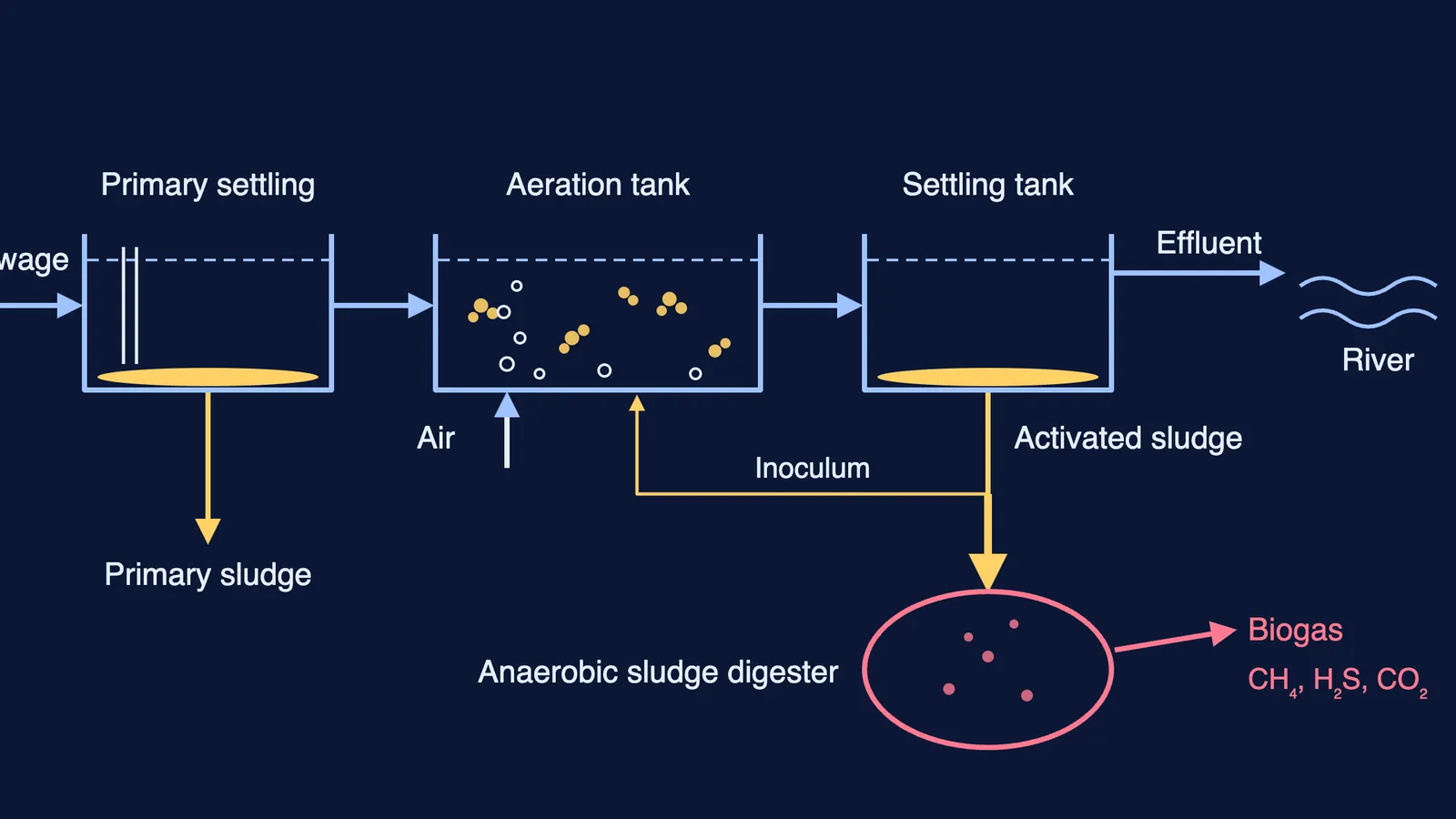
Sewage treatment: primary treatment is physical (filtration and sedimentation). Secondary treatment is biological: in aeration tanks, flocs of aerobic microbes consume most of the organic matter.
Biogas: methanogens such as *Methanobacterium* live without oxygen on cellulose-rich matter and give off mostly methane, plus CO2 and H2. See why paddy fields release methane.
Biocontrol: *Bacillus thuringiensis* (Bt) kills caterpillars, the fungus *Trichoderma* acts against plant pathogens, and baculoviruses of the genus *Nucleopolyhedrovirus* hit only their target insects.
Biofertilisers: *Rhizobium* in legume root nodules, free-living *Azospirillum* and *Azotobacter*, *Glomus* mycorrhiza that passes phosphorus to the plant, and cyanobacteria such as *Anabaena* and *Nostoc* in paddy fields.
BOD (biochemical oxygen demand) is the oxygen bacteria would use up in oxidising all the organic matter in one litre of water, so higher BOD means more polluting water (NCERT section 8.3).
How do you set out 2-, 3- and 5-mark answers?
The CBSE 2026-27 sample paper puts 2-mark questions in Section B, 3-mark questions in Section C, two 4-mark case-based questions in Section D and 5-mark questions in Section E.
2 marks: two clean points, such as physical removal of particles (primary) versus organic matter consumed by aerobic microbes (secondary).
3 marks: three points, each a fact with an example. For biofertilisers: a nitrogen fixer, *Glomus* for phosphorus, cyanobacteria in paddy fields.
5 marks: start with the labelled flow (sewage, primary settling, aeration tank, settling tank, effluent to river; activated sludge partly returned to the aeration tank as inoculum, the rest sent to the anaerobic sludge digester), then one line per stage. Also practise the biogas plant: concrete tank, dung slurry, floating cover, gas outlet, spent-slurry outlet.
How do you solve a BOD comparison question?
An original practice question with illustrative BOD values (made up for practice, not real plant data): a sewage treatment plant sends two unlabelled samples, K and L, to a lab. One is primary effluent and the other is secondary effluent. K has a BOD of 240 mg/L and L has 24 mg/L. Identify each and say which can be released into a river. (3 marks)
Way 1, from the definition. Higher BOD means more organic matter, and secondary treatment is the step that removes most of it. K carries more organic matter than L, so K is the primary effluent and L is the secondary effluent.
Way 2, from the process, ignoring the numbers. Primary treatment only removes particles. In the aeration tank, flocs consume most of the organic matter, so secondary effluent must hold far less. NCERT says the secondary effluent is what is generally released into rivers. Check the numbers: L is one-tenth of K, a fall of 216 mg/L, a sharp cut as NCERT describes.
Both routes agree: K is primary, L is secondary and goes to the river. Write definition, comparison and conclusion as three points.
Which assertion-reason and case-study traps should you expect?
From the sample paper and its 2026-27 marking scheme:
Question 15: the reason says high BOD means low organic matter. That is backwards; the scheme marks R false (option C).
Question 12: a rice field facing drought, needing phosphorus and prone to root pathogens. The answer is *Glomus*, because NCERT links mycorrhiza to all three; a nitrogen fixer adds nitrogen.
Question 30: NPV against cabbage loopers. Part C asks for the group: "Baculovirus", not the genus.
Question 11: a contaminated *Streptomyces* fermenter. The fix is sterile handling, not adding antibiotics.
Keep primary and activated sludge apart.
How should you revise this chapter in seven days?
Read 8.1 and 8.2; write the organism-product pairs from memory.
Read 8.3 and 8.4; draw the sewage flow and biogas plant from memory, fully labelled.
Read 8.5 and 8.6; sort every organism under biocontrol or biofertiliser.
Answer NCERT exercises 8, 11 and 15.
Do sample paper questions 11, 12, 15 and 30; mark them against the scheme.
Write one 5-mark sewage treatment answer; tick each stage named.
Redo everything you got wrong.
If BOD or mycorrhiza feels shaky, the Fermi Concept Library gives every concept in physics, chemistry, biology, mathematics and computing its own lesson and its place in the map. If the clock gets tight on exam day, use our 20-minute triage plan for running out of time.