On this page
Most questions on Microbes in Human Welfare test one skill: matching an organism to its product or job. Learn the pairings exactly and the sewage steps in order, and this short chapter becomes dependable marks.
Is Microbes in Human Welfare in the NEET syllabus?
Yes. The NEET (UG) 2026 syllabus issued by the National Medical Commission, dated 22-12-2025 and linked from the official NEET (UG) website, lists it under Biology Unit 8, Biology and Human Welfare. It covers household food processing, industrial production, sewage treatment, energy generation, biocontrol agents and biofertilisers, and lists topics, not marks. Check the site for a 2027 syllabus before you lock your plan.
In the NCERT Class 12 Biology book (Reprint 2026-27), this is Chapter 8. Its six sections, 8.1 to 8.6, match the syllabus phrases; use them as note headings.
Which microbe makes which product?
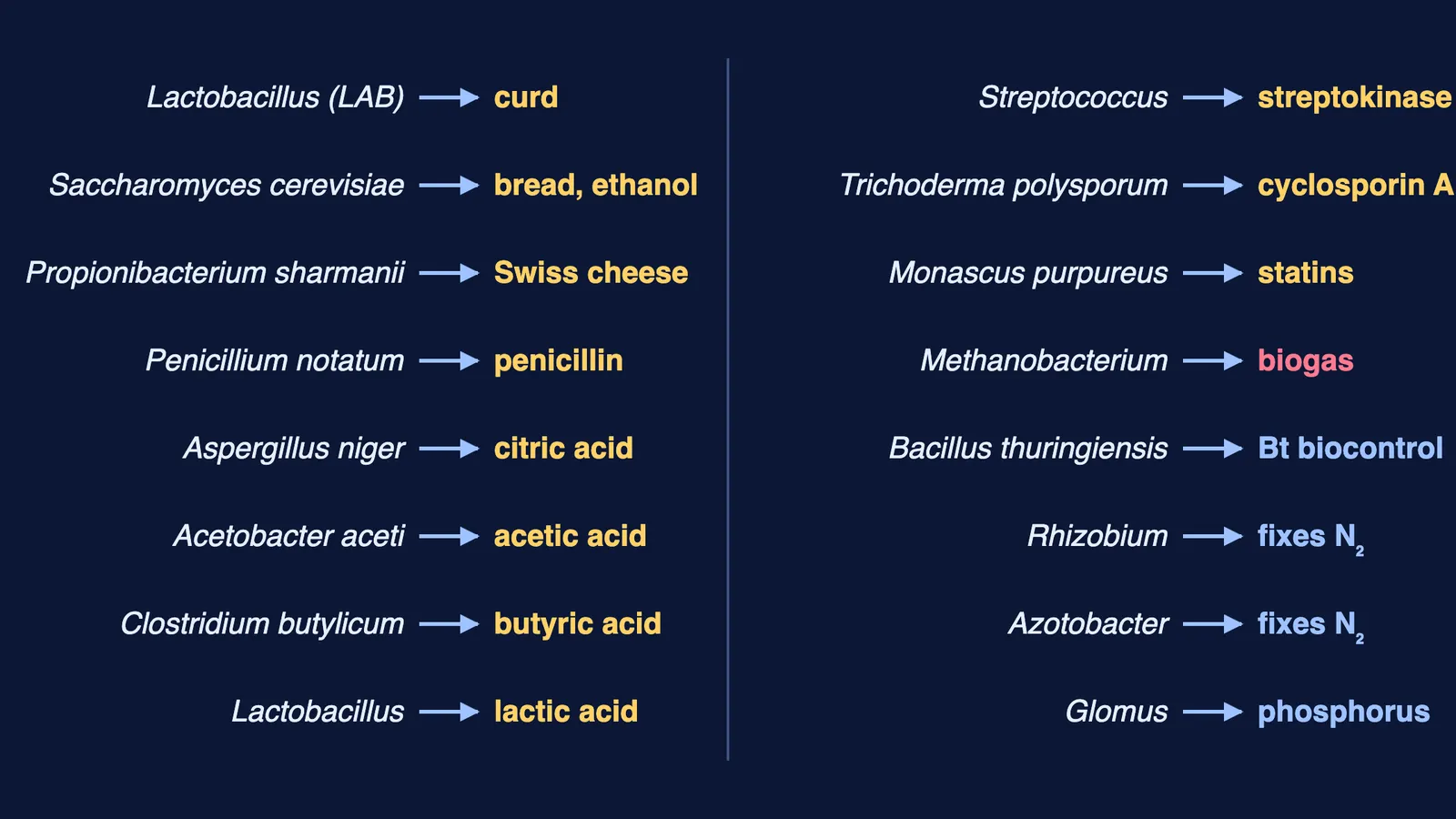
Every pairing below follows NCERT Chapter 8. Learn each name with its product.
Household products (8.1):
Lactobacillus and other lactic acid bacteria (LAB) turn milk into curd. Their acid clots milk protein, and curd gains vitamin B12.
Baker's yeast, Saccharomyces cerevisiae, ferments bread dough.
Propionibacterium sharmanii gives off plenty of CO2, which leaves the large holes in Swiss cheese.
Industrial products (8.2):
Penicillin: Alexander Fleming named it after the mould Penicillium notatum; Ernest Chain and Howard Florey later established its value, and all three shared the 1945 Nobel Prize.
Acids: citric acid from Aspergillus niger (a fungus), acetic acid from Acetobacter aceti, butyric acid from Clostridium butylicum and lactic acid from Lactobacillus (all bacteria).
Ethanol: Saccharomyces cerevisiae again, here called brewer's yeast.
Streptokinase, a clot buster, comes from Streptococcus and is modified by genetic engineering.
Cyclosporin A, an immunosuppressant used after organ transplants, comes from the fungus Trichoderma polysporum.
Statins, which lower blood cholesterol, come from Monascus purpureus, which NCERT calls a yeast.
For how antibiotics act on bacteria, see our explainer on bactericidal and bacteriostatic antibiotics.
How does sewage treatment work, step by step?
NCERT section 8.3 has two stages (steps 2 and 3 are secondary); draw them as a flow chart:
Primary treatment is physical. Debris is filtered out, grit settles, and the solids form primary sludge; the primary effluent moves on.
Secondary (biological) treatment runs in aeration tanks. With stirring and pumped air, aerobic microbes grow as flocs (bacteria meshed with fungal threads) and consume most of the organic matter.
Once the BOD has dropped enough, the flocs settle in a settling tank as activated sludge. A little returns to the aeration tank as inoculum; most goes to anaerobic sludge digesters, where bacteria release methane, hydrogen sulphide and CO2 (biogas).
BOD (biochemical oxygen demand) is the oxygen bacteria would use to oxidise all the organic matter in one litre of water, so a higher BOD means a more polluting sample (NCERT Chapter 8).
Where do biogas, biocontrol and biofertilisers fit?
Biogas (8.4): methanogens such as Methanobacterium grow without oxygen on cellulose-rich material and release mostly methane, with CO2 and H2. They live in anaerobic sludge and the cattle rumen, so dung (gobar) feeds biogas plants. India's biogas technology was developed mainly by IARI and KVIC.
Biocontrol (8.5):
Bacillus thuringiensis (Bt) spores are sprayed on crops; the toxin released in a caterpillar's gut kills it. Its toxin genes make Bt-cotton pest resistant.
Trichoderma fungi, common around roots, act against several plant pathogens.
Baculoviruses attack insects and other arthropods; most used in biocontrol belong to the genus Nucleopolyhedrovirus (NPV) and are species-specific and narrow-spectrum.
Biofertilisers (8.6):
Rhizobium fixes nitrogen in the root nodules of legumes (symbiotic).
Azotobacter and Azospirillum fix nitrogen while free-living in soil.
Cyanobacteria such as Anabaena, Nostoc and Oscillatoria fix nitrogen, notably in paddy fields; our post on heterocysts in Nostoc and Anabaena shows how.
Mycorrhiza, formed by many Glomus species, absorbs phosphorus from soil for the plant.
What are the common traps in this chapter?
Swapping kingdoms: Aspergillus niger is a fungus; Acetobacter aceti and Clostridium butylicum are bacteria.
Primary treatment uses no microbial digestion; the microbes work in secondary treatment.
Activated sludge is the floc sediment in the settling tank.
Rhizobium is symbiotic; Azotobacter and Azospirillum are free-living.
Mycorrhiza supplies phosphorus, not nitrogen.
How should you revise it in one week?
Day 1: read 8.1 and 8.2. Write a two-column organism-product list; cover one column and recall the other.
Day 2: read 8.3 and 8.4. Draw the sewage plant from filter to digester.
Day 3: read 8.5 and 8.6. Sort every organism under the six section headings.
Day 4: redraw both from memory and reread only the gaps.
Day 5: solve previous-year NEET questions on the chapter; see our guide to using previous year questions.
Days 6 and 7: mixed practice with the neighbouring chapters.
If one idea keeps slipping, the Fermi Concept Library covers every concept in biology, each with its own lesson and its place in the map. If you are unsure where to begin, Fermi's AI tutor can work out what you already know and build a plan for the session.
Start tonight with the two-column list.