On this page
Your NCERT textbook gives heterocysts one sentence. Here is what they are, why Nostoc and Anabaena make them, and where gelatinous sheaths and algal blooms fit in.
What are heterocysts in Nostoc and Anabaena?
Cyanobacteria, also called blue-green algae, are bacteria that photosynthesise using chlorophyll a, as green plants do. That is how the NCERT Class 11 chapter on biological classification describes them. The same chapter says cyanobacteria can be unicellular, colonial or filamentous. It also says some of them fix atmospheric nitrogen in specialised cells called heterocysts, giving Nostoc and Anabaena as examples.
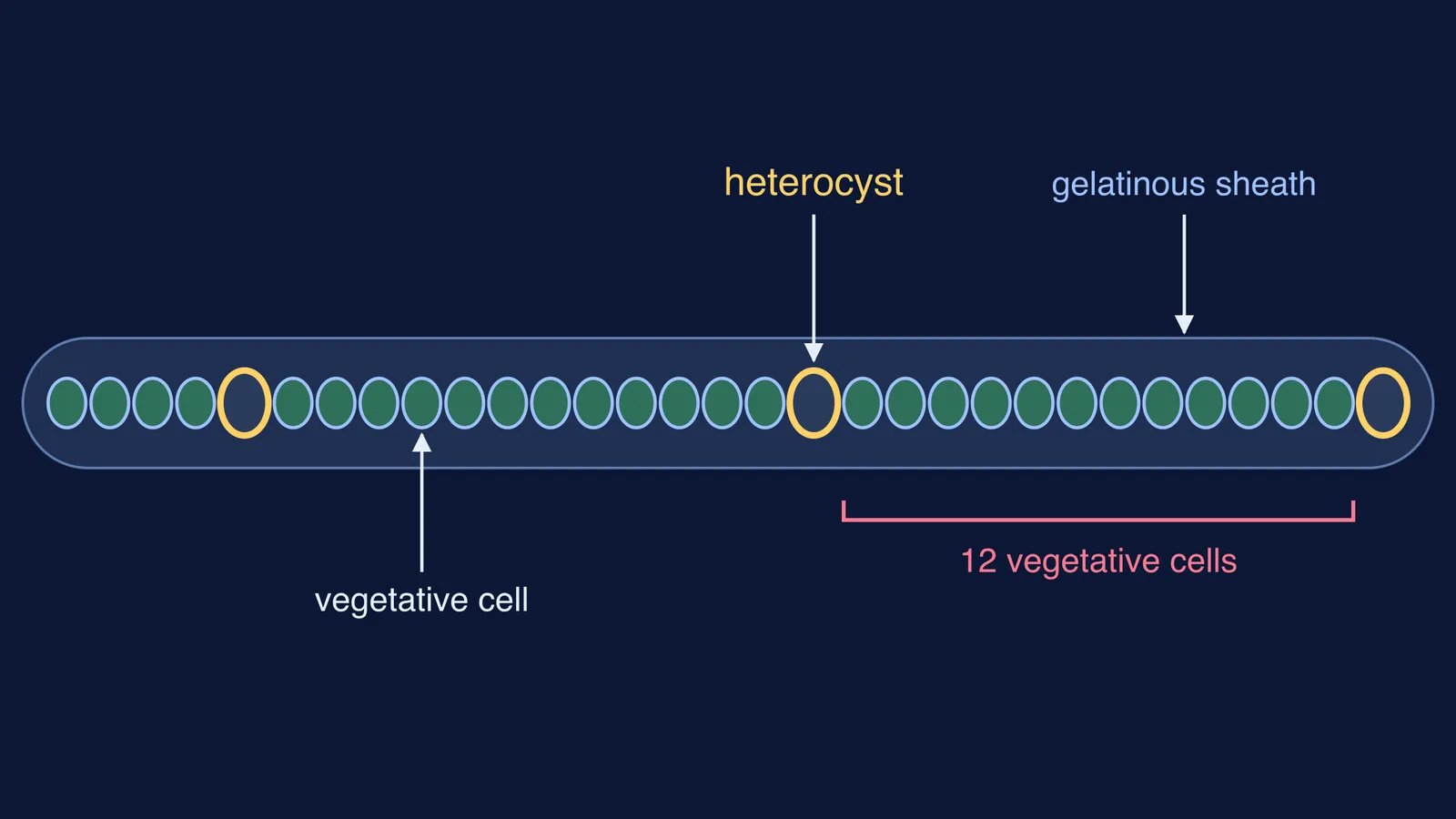
Most cells in a filament are ordinary photosynthetic cells, called vegetative cells. A heterocyst is a vegetative cell that has changed into a nitrogen-fixing specialist. In the lab strain Anabaena (Nostoc) sp. PCC 7120, single heterocysts are separated by about 10 to 20 vegetative cells along each filament (Kumar, Mella-Herrera and Golden, 2010).
For where cyanobacteria sit in Kingdom Monera, see our guide to how monerans get their food.
Why does nitrogen fixation need a separate cell?
Nitrogen fixation is sensitive to oxygen, and a heterocyst's structure and metabolism both work to protect it (Kumar and colleagues, 2010). That creates a clash. Photosynthesis in vegetative cells splits water and releases oxygen, which is exactly what nitrogen fixation must avoid.
The heterocyst's role is to keep a microoxic (very low-oxygen) space for nitrogenase, the enzyme that fixes nitrogen, and it does not split water during photosynthesis (Magnuson, 2019).
The two cell types then trade. Heterocysts and vegetative cells need each other for the filament to grow, exchanging nutrients: vegetative cells fix carbon and heterocysts fix nitrogen (Wang and colleagues, 2019).
To follow fixed nitrogen onward, try our interactive walk through the nitrogen cycle.
How many heterocysts does a filament have?
In Anabaena sp. PCC 7120, 5 to 10% of cells become heterocysts (Wang and colleagues, 2019). The same study found that switching off one gene, patD, raised the share of heterocysts, while overexpressing it lowered the share. Filaments without patD, and so with too many heterocysts, competed less well when combined nitrogen was scarce.
Here is a worked check that ties the two published numbers together:
Take the spacing from Kumar, Mella-Herrera and Golden (2010): one heterocyst, then 10 to 20 vegetative cells, then the next heterocyst.
One repeating unit is therefore 11 to 21 cells, with one heterocyst in each.
The heterocyst share is 1 divided by 21, about 4.8%, at the widest spacing, and 1 divided by 11, about 9.1%, at the closest.
That range, roughly 5 to 9%, closely matches the 5 to 10% that Wang and colleagues reported, so the two figures are consistent.
For a filament of 100 cells, expect roughly 5 to 10 heterocysts.
The diagram at the top of this page uses 12 vegetative cells between heterocysts, which works out to 1 in 13 cells, about 7.7%.
Why do cyanobacteria form gelatinous sheaths and blooms?
The NCERT chapter notes that cyanobacterial colonies are generally surrounded by a gelatinous sheath and often form blooms in polluted water bodies (NCERT Class 11, Chapter 2). Its figure of Nostoc shows a filament inside a mucilaginous sheath, with heterocysts along its length.
A bloom is excessive growth of cyanobacteria. The US Environmental Protection Agency says blooms can contribute to oxygen depletion in water, and some cyanobacteria produce toxins called cyanotoxins, of which microcystins are the most common.
The same organisms help farmers too. The NCERT Class 12 chapter on microbes in human welfare lists Anabaena, Nostoc and Oscillatoria as nitrogen-fixing cyanobacteria. It also says cyanobacteria serve as an important biofertiliser in paddy fields. For a related partnership, see our post on lichen symbiosis and pollution.
How do you write a full-marks answer on heterocysts?
Use this checklist for a three-mark answer:
Define it: a specialised cell in filamentous cyanobacteria that fixes atmospheric nitrogen.
Name two examples: Nostoc and Anabaena.
Give the reason: nitrogen fixation is sensitive to oxygen, so it happens in a cell that keeps oxygen low and does not split water.
Add the trade: vegetative cells fix carbon, heterocysts fix nitrogen, and they exchange nutrients.
Draw it: a filament in a gelatinous sheath, with one larger heterocyst between vegetative cells, all labelled.
Watch for three common slips:
Filing cyanobacteria under plants or protists. NCERT places them with the eubacteria in Kingdom Monera.
Writing that every cell in the filament fixes nitrogen. Only the heterocysts do.
Confusing heterocysts with root nodules. NCERT Class 12 describes the nodules on legume roots as a separate partnership with Rhizobium.
If the oxygen problem still feels abstract, the Fermi Concept Library gives every biology concept its own lesson and shows where it sits in the map. When you are ready to practise, the Fermi Problem Library has worked problems with a step-by-step solver that explains the reasoning rather than printing an answer.