

On this page
Lichens are among the most reliable biological indicators of air quality. Unlike weather stations that measure chemical concentrations at a single moment, lichens show the cumulative impact of air pollution over years.
Their sensitivity is especially useful for tracking sulphur dioxide (SO₂), a major byproduct of industrial processes and vehicle exhausts. To understand why lichens are so vulnerable to polluted air, we first have to look at how they are built.
What is the lichen symbiosis?
A lichen is not a single organism. It is a mutualistic partnership between two distinct life forms: a fungus (the mycobiont) and an alga or cyanobacterium (the photobiont).
The fungus forms the physical structure of the lichen, providing a protected environment and absorbing water and minerals from the surroundings. The alga, containing chlorophyll, performs photosynthesis to produce food (carbohydrates) for both partners. This symbiotic relationship allows lichens to survive in harsh environments where neither partner could live alone.
Understanding biological relationships like symbiosis and ecological succession requires a strong grasp of foundational science. You can explore these mechanisms in detail in the Fermi Concept Library, which covers every concept in physics, chemistry, biology, mathematics and computing.
Why are lichens used as pollution indicators?
Lichens are highly sensitive to air pollution, particularly sulphur dioxide, for three main structural reasons:
No protective cuticle: Vascular plants have a waxy cuticle and stomata (pores) that regulate what enters and leaves their leaves. Lichens lack these barriers. They absorb water, gases and nutrients directly through their entire surface.
No excretory system: Lichens cannot excrete the toxic substances they absorb. Heavy metals and gases simply accumulate in their tissues over time.
Chlorophyll degradation: When a lichen absorbs sulphur dioxide, the gas dissolves in the organism's internal moisture to form acidic sulfite and bisulfite ions. These ions attack the alga's chlorophyll, stripping away its central magnesium atom. Without intact chlorophyll, the alga cannot photosynthesise, and the lichen starves.
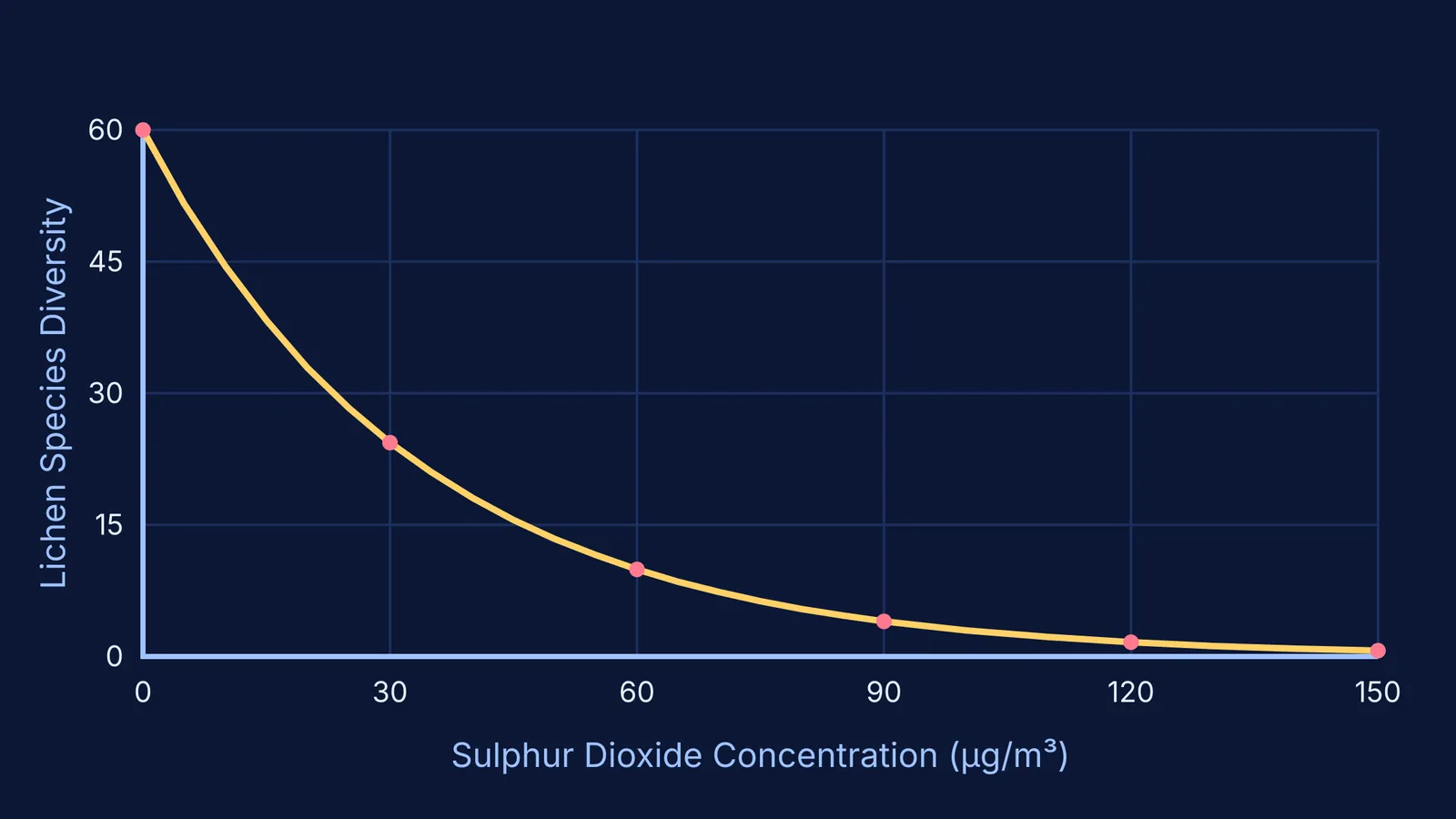
Because of this direct absorption mechanism, the presence and diversity of lichens in an area accurately reflect the cleanliness of the air, making them effective monitors for atmospheric sulphur dioxide (Świeboda & Kalemba, 1978). As SO₂ concentrations increase, lichen species diversity drops sharply.
How do lichens colonise bare rock?
Lichens are pioneer species. In primary succession—the process of life taking hold in a lifeless environment like a new lava flow or a retreating glacier—lichens are the first organisms to colonise bare rock.
They achieve this through biological and chemical weathering. Crustose lichens adhere tightly to the stone. Their fungal threads (hyphae) grow into microscopic cracks. When it rains, the lichen absorbs water and expands dramatically, exerting physical pressure that pries mineral grains apart.
Simultaneously, the lichen acts as a microscopic chemical factory. It secretes organic acids, such as oxalic acid, which dissolve the rock's minerals to extract essential nutrients like calcium and magnesium. (If you are studying the chemical makeup of living tissues, you might also find our guide to the acid-soluble pool vs acid-insoluble fraction helpful.)
Over decades, the combination of crushed rock and the decaying organic matter of dead lichens forms a thin layer of humus. This primitive soil traps moisture, allowing mosses and ferns to take root. Eventually, these pave the way for grasses, shrubs, and higher plants.
How are lichens tested in biology exams?
In board exams and competitive tests like NEET-UG, lichens frequently appear in questions bridging ecology, environmental issues, and biological classification. Examiners often test your understanding of the mycobiont-photobiont relationship and the specific mechanism of SO₂ toxicity.
For rigorous practice on these topics, including tricky statement-based questions, the Fermi Problem Library provides worked problems with a step-by-step solver that explains the reasoning rather than printing an answer. You can also review how to handle complex exam formats in our breakdown of assertion-reason traps on DNA and gene expression.
By understanding how lichens break down rocks and respond to the air around them, you move beyond memorising ecological facts to seeing how biological structures determine an organism's survival.


