

On this page
Assertion-Reason (A-R) questions are a frequently challenging part of biology exams. Unlike standard multiple-choice questions, they do not just ask you to recall facts. They test whether you can recognize the exact causal relationship between two biological statements. In molecular genetics, the complex mechanisms of gene expression make these traps especially effective.
What makes the central dogma and replication so tricky?
Research published in *CBE—Life Sciences Education* (Williams and Barney, 2008) highlights that Assertion-Reason questions require higher-order thinking and are often more difficult than standard multiple-choice questions, as they force students to explicitly identify causality. When you study the central dogma, it is easy to assume that the arrows between DNA, RNA, and proteins represent physical transformations. However, DNA is not converted into RNA; it acts strictly as a template.
Example Trap: Replication
Assertion: DNA replication is semi-conservative.
Reason: RNA polymerase unwinds the helix to create a new mRNA strand.
The assertion is biologically true, but the reason describes transcription, not replication (which uses DNA helicase and DNA polymerase). This is a classic bait-and-switch where the test writer gives a true statement in the reason that has absolutely nothing to do with the assertion.
How do you solve assertion-reason traps on the genetic code?
The genetic code has very specific vocabulary, and examiners know exactly which terms students confuse. The most frequent trap involves mixing up the terms "degenerate" and "unambiguous."
A codon is considered unambiguous because one specific codon will only ever code for one amino acid. However, the code is degenerate because that same amino acid might also be coded by other distinct codons.
Example Trap: Genetic Code
Assertion: The genetic code is unambiguous.
Reason: Some amino acids are coded by more than one codon.
Both statements are factual. However, the reason provided is actually the definition of *degeneracy*, not unambiguity. Therefore, both are true, but the reason is not the correct explanation for the assertion. You can verify these definitions and practice tracing these pathways in Fermi's concept library.
What are the most common traps on the lac operon?
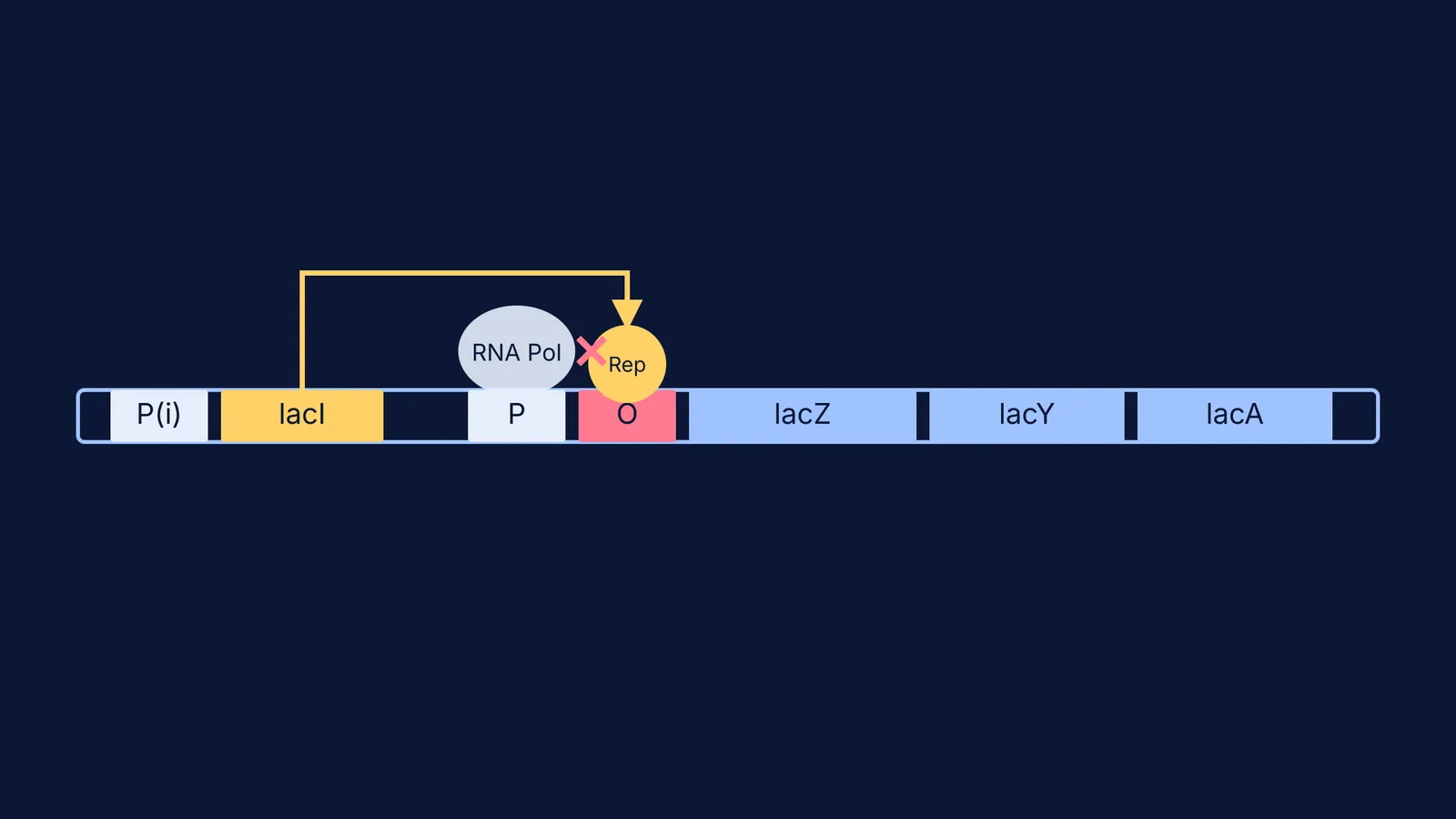
The *lac* operon is a canonical model for gene regulation, but its dynamic nature causes persistent confusion. The Lac Operon Concept Inventory (LOCI)—a validated 12-item multiple-choice assessment tool developed by Stefanski et al.—reveals common errors students make regarding gene regulation, such as misunderstanding basal expression.
Many students think that when the operon is repressed, expression drops to absolute zero. This is biologically impossible because a tiny amount of the permease enzyme must always be present to let lactose into the cell in the first place.
Example Trap: Basal Expression
Assertion: A very low level of expression of the lac operon must be present in the cell at all times.
Reason: Lactose cannot enter the cell unless a small amount of permease is already present in the membrane.
Both are true, and the reason is the exact correct explanation. If you assume "repressed" means "zero," you will incorrectly mark the assertion as false.
How can you test statements systematically?
To beat A-R traps reliably, do not read the statements together on your first pass. Human brains naturally want to find patterns, and reading them as a single thought will make you unconsciously invent a link that does not exist. Instead, treat them as two entirely separate true-or-false questions first.
Hide the Reason: Cover the second statement with your hand. Is the Assertion true or false entirely on its own? Read every word carefully to ensure no definitive words (like "always" or "never") make a generally true statement false.
Hide the Assertion: Now cover the first statement. Is the Reason biologically factual, ignoring the context of the Assertion? Test writers love to use accurately detailed descriptions of the wrong biological process.
Insert "Because": Only if both statements evaluate as true, read them together with the word "because" in the middle. If the combined sentence makes logical sense and explains *why* the first event happened, then it is the correct explanation. If the Reason just adds a related but non-causal fact, mark it as "not the correct explanation."
By breaking down the physical mechanics step-by-step, rather than just memorizing textbook diagrams, you remove the guesswork from your studying and build real confidence in your molecular genetics knowledge.


