

On this page
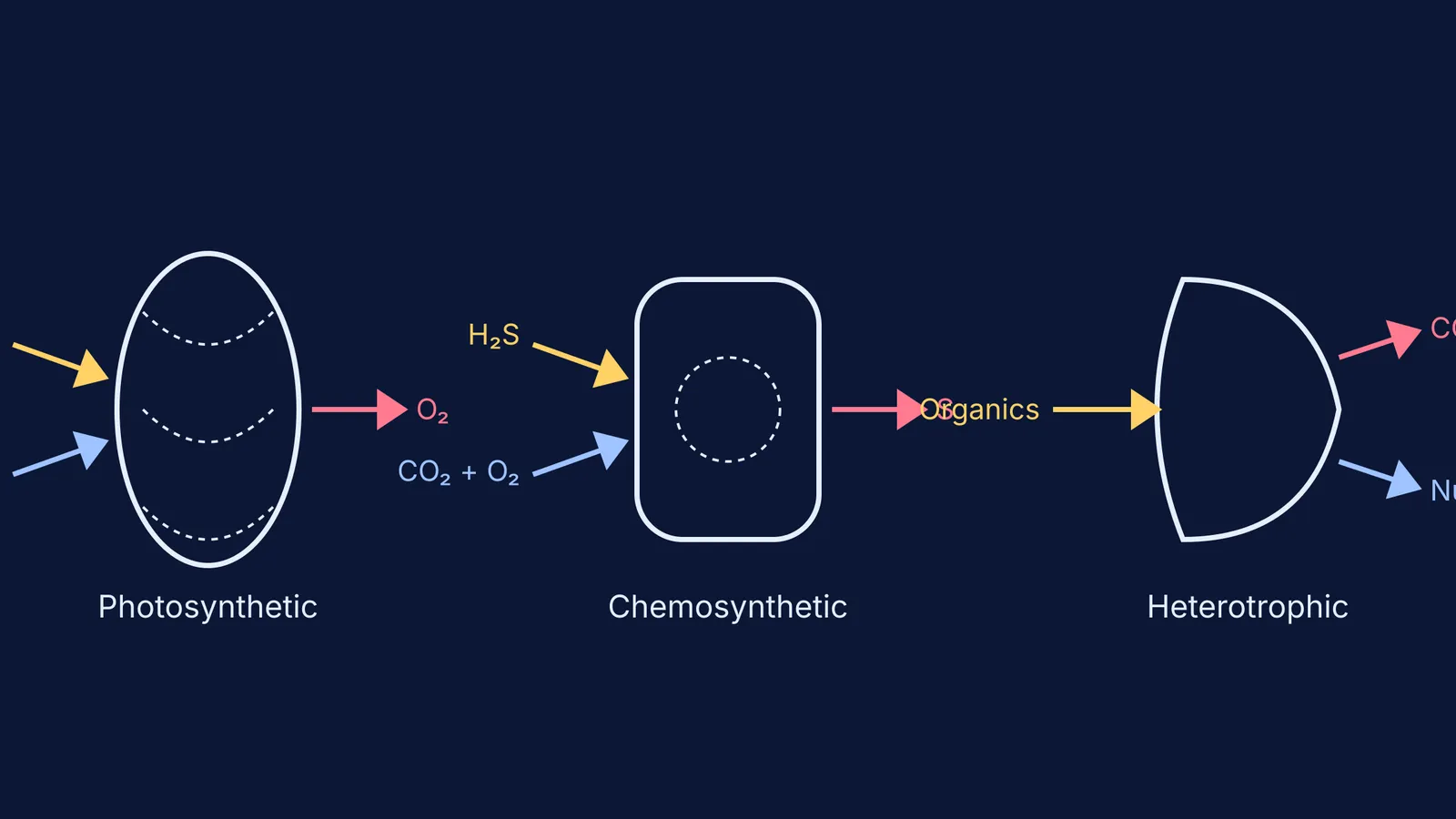
Kingdom Monera contains the most metabolically diverse organisms on Earth. While plants rely on the Sun and animals rely on their food, bacteria have evolved three distinct ways to get the carbon and energy they need to survive and reproduce. Understanding these three pathways—photosynthetic, chemosynthetic, and heterotrophic—is essential for mastering the fundamentals of biological classification and ecosystem dynamics.
What are photosynthetic bacteria?
Photoautotrophs use sunlight as their energy source and carbon dioxide as their carbon source to build organic molecules. The most famous and ecologically significant examples are cyanobacteria, often called blue-green algae. Cyanobacteria are the only prokaryotes capable of oxygenic photosynthesis, using water as an electron donor to release free oxygen into the environment. The fossil record, including ancient stromatolites, indicates they have been doing this for roughly 3.5 billion years (Wikipedia).
These bacteria use light-harvesting pigments like chlorophyll-a and phycobilins (which give them their distinct colour) to capture solar energy. Beyond just fixing carbon, many cyanobacteria also possess specialized, thick-walled cells called heterocysts. These cells allow them to fix atmospheric nitrogen into ammonia, providing a critical nutrient for themselves and their surroundings in harsh, nitrogen-poor environments. While they are central to Kingdom Monera, biological classification can sometimes be tricky—just look at the misfits like viruses, viroids and lichens.
How do chemosynthetic bacteria survive without light?
Chemoautotrophs also build their own organic food from carbon dioxide, but they manage to do it in pitch darkness. Instead of harvesting light, they extract their energy by oxidizing inorganic chemical compounds. This process is known as chemosynthesis, and it powers some of the most extreme ecosystems on the planet.
At deep-sea hydrothermal vents, chemosynthetic bacteria use hydrogen sulfide from superheated mineral fluids that can reach 400 °C (WHOI). These microscopic organisms form the absolute base of a unique, sunless ecosystem. Some live as endosymbionts inside giant tubeworms, which have no mouths or digestive tracts and can grow up to 6 feet tall purely on the food their internal bacteria produce (WHOI). Other chemoautotrophs do not live in the ocean depths but right under our feet; for example, nitrifying bacteria in the soil oxidize ammonia to nitrite to get their energy, driving the nitrogen cycle that all terrestrial plants depend on.
Why are heterotrophic bacteria important?
Most bacteria on Earth are heterotrophs, meaning they cannot fix their own carbon from carbon dioxide. They must consume pre-formed organic compounds to satisfy both their carbon and their energy requirements. A major and ecologically vital group within these are the saprotrophs, commonly known as decomposers.
Heterotrophic decomposers secrete extracellular enzymes directly onto dead organic matter to break down complex structural molecules—like proteins, lipids, and tough plant cellulose—into simpler molecules they can easily absorb (Wikipedia). By digesting this detritus, they recycle essential nutrients such as nitrogen and phosphorus back into the soil and water. Without these bacteria constantly breaking down waste and dead organisms, the ecosystem's nutrient loops would stall, and primary producers would quickly run out of raw materials. This organic breakdown is functionally distinct from respiration as an amphibolic pathway in higher organisms, but it serves the exact same ultimate goal of extracting usable energy from chemical bonds.
How to learn bacterial nutrition effectively?
Reading about deep-sea vents, nitrogen fixation, and cellular metabolism is only the first step in mastering biology. To make these complex ideas stick for a competitive exam, you need to actively apply them to new scenarios and solve related problems.
If you are struggling to remember which bacteria oxidizes what, or how energy flows through different ecosystems, the Fermi Concept Library holds interactive lessons mapping out every biological concept. When you bring your questions to Fermi, the AI tutor does not just hand you a static table to memorise. It works out what you already know, builds a plan for the session, and teaches through it—drawing the figure and checking your understanding as it goes. If you keep getting stuck on nutrition numericals, genetics puzzles, or classification rules, you can also practice with the Fermi Problem Library, a step-by-step solver that explains the reasoning rather than printing an answer.


