On this page
If you are revising antibiotics from NCERT, every drug needs two labels: what it does to bacteria (kills them or stops them growing) and how many kinds of bacteria it reaches (its spectrum). This guide sorts penicillin, ofloxacin, erythromycin and chloramphenicol using the NCERT text's own wording, then shows where real science is messier.
Check one thing first. NCERT's list of rationalised content for Class XII (May 2022) dropped Unit 16, "Chemistry in Everyday Life", as a full chapter. Confirm on your exam's current official syllabus whether it is assessed; it still matters for older previous-year papers.
What is the difference between bactericidal and bacteriostatic antibiotics?
NCERT says antibiotics "have either cidal (killing) effect or a static (inhibitory) effect on microbes" (NCERT Class 12 Chemistry Part II, Unit 16, archived scan).
Bactericidal antibiotics kill bacteria. NCERT's examples are penicillin, aminoglycosides and ofloxacin.
Bacteriostatic antibiotics inhibit bacteria, stopping their growth. NCERT's examples are erythromycin, tetracycline and chloramphenicol.
The same chapter defines an antibiotic as a substance produced wholly or partly by chemical synthesis which, in low concentrations, inhibits the growth of or destroys microorganisms by intervening in their metabolic processes.
Which antibiotics are broad spectrum, according to NCERT?
NCERT defines an antibiotic's spectrum of action as the range of bacteria or other microorganisms it affects. Three terms follow, all from the same page of the NCERT chapter:
Broad spectrum: kills or inhibits a wide range of Gram-positive and Gram-negative bacteria.
Narrow spectrum: effective mainly against Gram-positive or Gram-negative bacteria.
Limited spectrum: effective against a single organism or disease.
NCERT names penicillin G as narrow spectrum. Ampicillin and amoxycillin, synthetic modifications of penicillin, are broad spectrum. Chloramphenicol, isolated in 1947, is broad spectrum; NCERT notes it is absorbed rapidly from the gut, so it can be given orally for typhoid, dysentery, acute fever, some urinary infections, meningitis and pneumonia. Vancomycin and ofloxacin are the other broad-spectrum examples it gives.
How do you classify penicillin, ofloxacin, erythromycin and chloramphenicol?
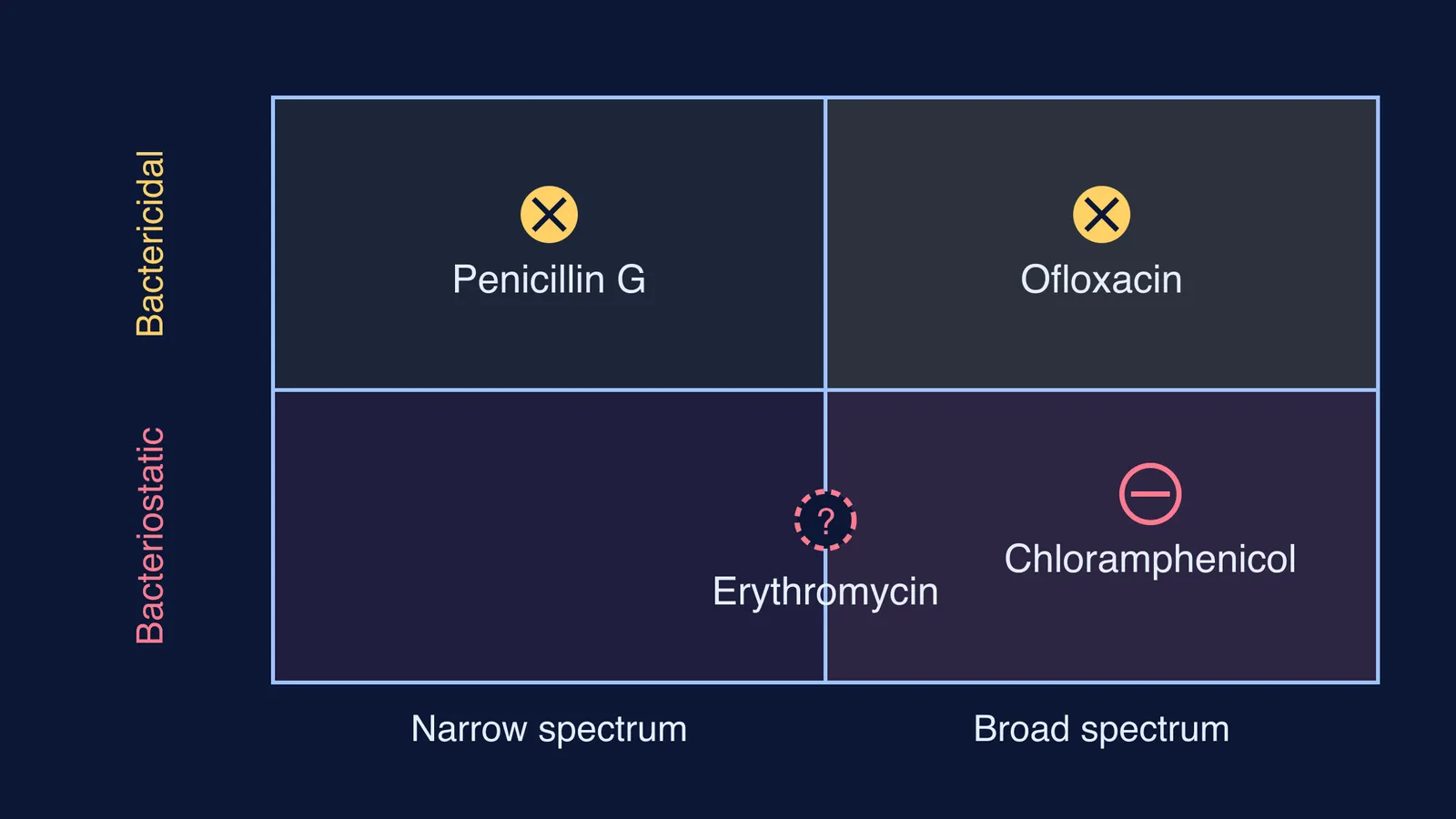
Ask two questions of every drug: does it kill or stop growth, and is its spectrum narrow or broad? Here is the worked answer, the NCERT way:
Penicillin (G): bactericidal, narrow spectrum.
Ofloxacin: bactericidal, broad spectrum.
Chloramphenicol: bacteriostatic, broad spectrum.
Erythromycin: bacteriostatic; NCERT gives it no spectrum label.
The traps come in pairs. Ofloxacin and chloramphenicol share a spectrum but differ in action; penicillin and ofloxacin share an action but differ in spectrum. So of these four, only ofloxacin is both bactericidal and broad spectrum. Also watch penicillin G (narrow) versus its modification ampicillin (broad). For erythromycin, do not invent a spectrum label in a written answer.
Is a bactericidal antibiotic always better than a bacteriostatic one?
No, and the textbook boxes are tidier than real bacteria. In a 1979 study in Antimicrobial Agents and Chemotherapy, James Rahal Jr. and Michael Simberkoff found that chloramphenicol was bactericidal at clinically achievable concentrations against Haemophilus influenzae, Streptococcus pneumoniae and Neisseria meningitidis, but bacteriostatic against Enterobacteriaceae and Staphylococcus aureus (Rahal and Simberkoff, 1979). Whether a drug acts as "static" or "cidal" can depend on the organism and the dose, not just the drug.
A 2018 systematic review in Clinical Infectious Diseases found 56 randomised controlled trials, published since 1985, comparing the two kinds of drug: 49 found no significant difference in efficacy, 6 found the bacteriostatic drug better, and only 1 found the bactericidal drug better, which the authors said was explainable by underdosing of the bacteriostatic drug (Wald-Dickler, Holtom and Spellberg, 2018). For your exam, write the NCERT classification. For understanding, remember that the labels describe how a drug behaves against particular bacteria in laboratory tests.
This is a chemistry topic, not medical advice. The World Health Organization says misuse and overuse of antimicrobials are driving drug-resistant infections, and that bacterial antimicrobial resistance was estimated to be associated with more than 4.7 million deaths worldwide in 2021. Questions about taking antibiotics are for a doctor, not a revision guide.
A 15-minute revision plan for this topic
Write both lists from memory using "POA kills, ETC stops", then check them against the lists above.
Draw the grid from the top of this page: action down the side, spectrum along the bottom. Place penicillin G, ofloxacin and chloramphenicol, park erythromycin on the line, and add ampicillin, amoxycillin and vancomycin to the broad column with their action left blank.
Say aloud, in one sentence each, what Gram-positive and Gram-negative mean. If you cannot, that is a concept gap rather than a memory gap: the Fermi Concept Library covers every concept in physics, chemistry, biology, mathematics and computing, each with its own lesson and its place in the map.
Solve five mixed questions that test both labels at once. The Fermi Problem Library has worked problems with a step-by-step solver that explains the reasoning rather than printing an answer, so you can see why each wrong option fails.
Get the two questions right for every drug, and this topic becomes a quick, reliable win in revision.