On this page
If you have walked past a paddy field in the monsoon, you have walked past a methane factory. The gas is made in the mud under the standing water, by microbes that live where oxygen cannot reach.
What happens to soil when a paddy is flooded?
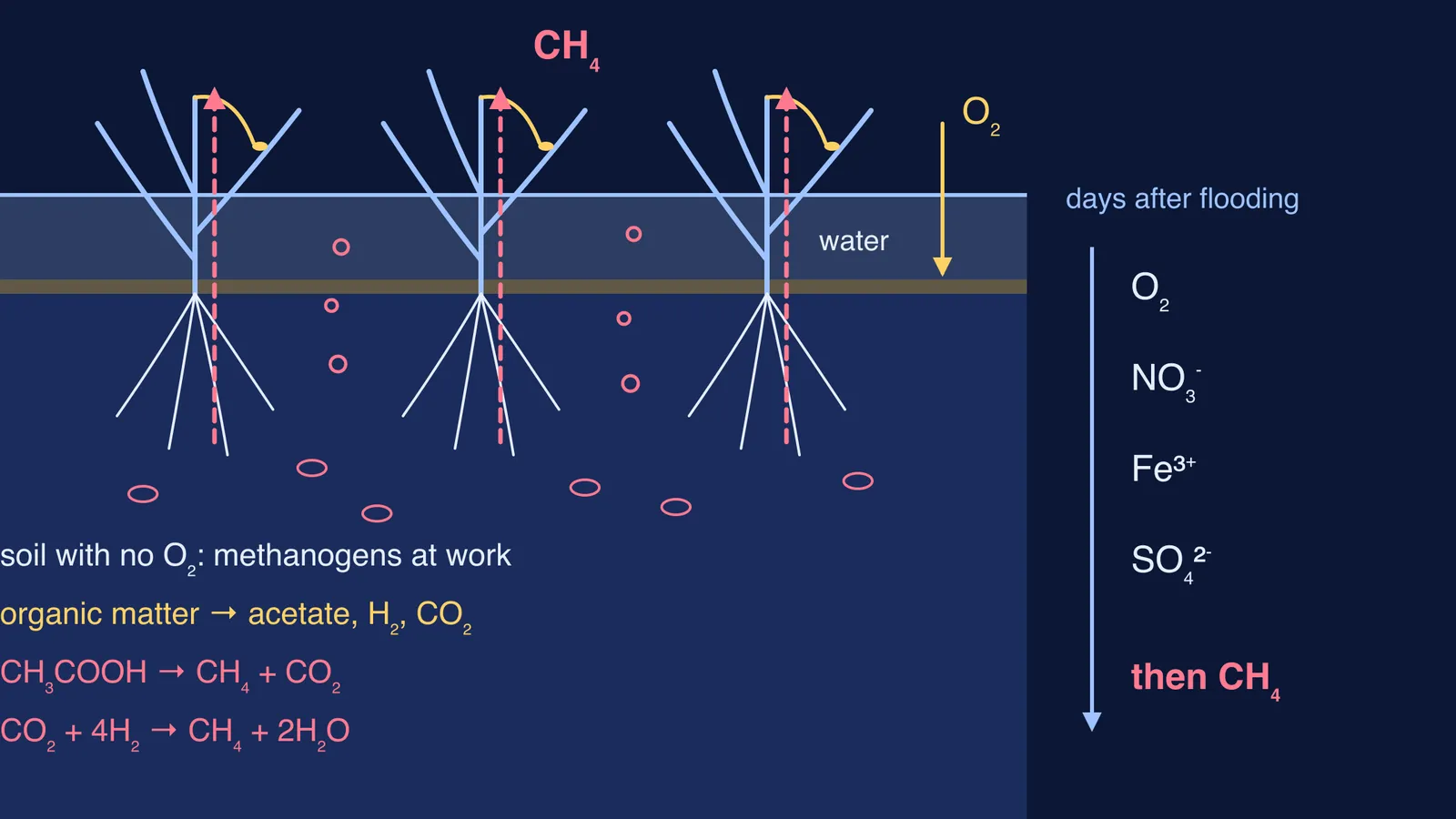
Soil is normally full of tiny air pockets. Flood it, and water fills them. Oxygen moves through water slowly, so soil microbes soon use up what is left. Only a thin top layer, touching the water, keeps some oxygen. (Rice itself copes with this, as we explain in why rice is grown in flooded fields.)
Below that layer, microbes still need to break down dead roots, straw and other organic matter, so they switch to other substances that can accept electrons. A review by microbiologist Ralf Conrad explains that oxidation of organic matter uses up the available oxidants in sequence: the most common are oxygen, nitrate, ferric iron and sulfate. Once those run out, the review explains, organic matter can only break down into a mix of carbon dioxide and methane.
Which microbes make methane in rice fields?
Methane is the end of a food chain of microbes. In Conrad's words, "hydrolytic and fermenting bacteria degrade complex organic matter to H2, CO2 and simple organic compounds", which are fermented further to acetate, hydrogen and carbon dioxide. These are the food of methanogenic archaea, which turn them into methane and carbon dioxide.
There are two main routes:
From acetate: CH3COOH → CH4 + CO2
From hydrogen: CO2 + 4H2 → CH4 + 2H2O
The same review notes that, when organic matter breaks down fully, more than two-thirds of the methane comes from acetate and less than one-third from hydrogen and carbon dioxide.
The second route is the link to your respiration chapter. In aerobic respiration, oxygen accepts the electrons at the end of the chain. In anaerobic respiration, something else does. Here, carbon dioxide takes the electrons from hydrogen and becomes methane. Similar microbes run village biogas plants, which we cover in biogas plants and methanogens.
How does methane get out of the field?
Rice plants have air channels called aerenchyma that carry oxygen down to their roots. The same pipes work in reverse: a 2019 paper in F1000Research, citing earlier experiments, notes that rice absorbs methane from its roots and emits it through aerenchyma. Some methane also bubbles up through the water.
Not all of it escapes. Near the roots and at the soil surface, where a little oxygen leaks in, bacteria called methanotrophs oxidise methane back to carbon dioxide. The same paper says researchers have not yet agreed how much methanotrophs and rice roots cut emissions.
How much methane do rice fields release?
The Global Methane Budget, an international assessment by Saunois and colleagues, estimates that rice paddies emitted 32 (range 25 to 37) million tonnes of methane a year in 2010 to 2019. That is about 9% of all human-caused methane, according to the same report.
Using the IPCC's Sixth Assessment values, methane from non-fossil sources has a 100-year global warming potential of 27: one tonne warms like 27 tonnes of carbon dioxide over a century. So 32 million tonnes × 27 ≈ 864 million tonnes of carbon dioxide equivalent a year. To see how gases trap heat, try our greenhouse effect predictions.
Can farmers grow rice with less methane?
Yes, mainly by not keeping the field flooded all season. The Global Methane Budget explains that periodic drainage lets existing soil methane oxidise and also stops further methane production, and that upland rice, which is not usually flooded, is not a significant source. The same report notes that adding organic material to flooded paddies raises emissions.
One method is alternate wetting and drying, where the field is allowed to dry out a little between irrigations; another is draining it in mid-season. A 2025 synthesis of 11 meta-analyses by Kazunori Minamikawa found that, compared with continuous flooding, water management of this kind cut methane by 31 to 62%. There is a trade-off: nitrous oxide, another greenhouse gas, rose by 37 to 445%, and yield changed by between −5.4% and +11%, with a mean of +1.3%.
Practice: follow one carbon atom from straw to sky
A carbon atom sits in rice straw left in the field after harvest.
The field is flooded; the soil runs out of oxygen.
Fermenting bacteria break the straw's cellulose into sugars, then into acetate.
A methanogen splits the acetate: one carbon becomes CO2, the other becomes CH4.
The CH4 diffuses into a root and rises through the aerenchyma.
Either a methanotroph near the root oxidises it back to CO2, or it leaves the plant and enters the air.
Now test yourself: what would change at step 2 if the farmer drained the field for a week? Which steps would stop, and which microbes would win?
If the order of electron acceptors is hard to picture, the Fermi Simulation Lab has interactive simulations for ideas that are easier to see than to read, and the Fermi Concept Library has a lesson for every concept in biology and chemistry.