

On this page
In rural belts across India, cattle dung is far more than agricultural waste. For decades, farming households have fed it into masonry digesters to produce clean, soot-free cooking fuel and nutrient-rich biofertiliser. Known colloquially as gobar gas, this renewable fuel is generated by specialized microorganisms functioning in the strict absence of oxygen.
Understanding how a biogas plant operates connects core concepts in microbiology, thermodynamics, and organic chemistry. Whether revising the NCERT Class 12 Biology curriculum or studying anaerobic ecosystems, the process centres on one microbial group: the methanogens.
Where do methanogens come from?
Methanogens are strictly anaerobic prokaryotes belonging to the domain Archaea. Unlike ordinary soil bacteria, they cannot tolerate dissolved oxygen. In nature, they inhabit waterlogged wetlands, the anaerobic sludge digesters in municipal sewage treatment, and the digestive systems of ruminant animals.
Inside cows and buffaloes, the primary stomach chamber—the rumen—acts as an anaerobic fermentation chamber. Cattle graze on fodder rich in cellulose that vertebrate enzymes cannot digest alone. A symbiotic consortium dominated by methanogens like *Methanobacterium* breaks down this cellulose into fermentable carbohydrates and volatile fatty acids. Because cattle continuously excrete these microbes, fresh dung (*gobar*) provides a natural inoculum for biogas digesters.
A genomic study by Torres Tejerizo et al. (2017) analysed *Methanobacterium congolense* strain Buetzberg, isolated from a mesophilic biogas digester. The authors sequenced its 2,451,457 base-pair circular chromosome and identified 474 genetic determinants dedicated to cell wall biogenesis and stress resistance, which allow *Methanobacterium* to thrive under fluctuating digester conditions.
When studying how cellular processes connect to environmental systems, the Fermi Concept Library covers every concept in physics, chemistry, biology, mathematics and computing, each with its own lesson and its place in the map.
What does a typical biogas plant look like?
In India, rural biogas technology was standardized through designs by the Indian Agricultural Research Institute (IARI) and the Khadi and Village Industries Commission (KVIC), as detailed in the NCERT textbook.
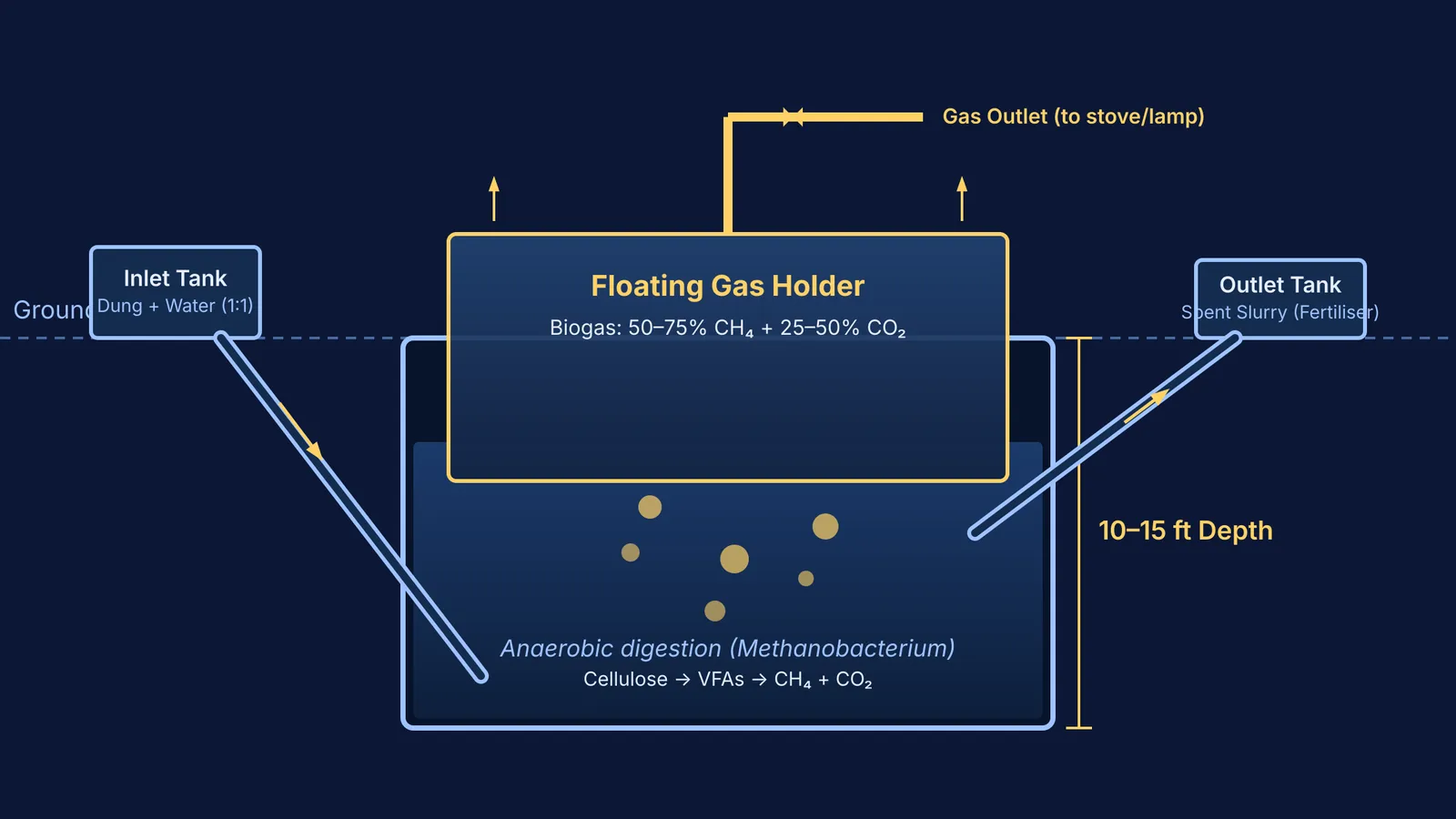
A standard KVIC-style floating-drum biogas plant features several core components:
Digester tank: A cylindrical concrete well 10 to 15 feet deep, built underground to conserve heat and sustain anaerobic conditions.
Inlet chamber: A mixing tank where dung and water are mixed 1:1 by volume into an 8% to 10% total solids slurry.
Inlet pipe: A sloped pipe carrying fresh slurry down to the base of the digester tank.
Floating gas holder: An inverted steel drum that rises over the slurry as gas accumulates, providing a direct visual measure of gas volume.
Gas delivery pipe: An outlet pipe with a shut-off valve atop the dome to direct fuel to household stoves and lamps.
Outlet tank: An overflow chamber collecting displaced spent slurry, which is dried and used as nitrogen-rich biofertiliser.
To support domestic installations, the Ministry of New and Renewable Energy (MNRE) notified the National Bioenergy Programme with a Phase-I budget of ₹858 crore from FY 2021-22 to 2025-26, providing Central Financial Assistance for rural family biogas units.
What is the gas mix produced during anaerobic digestion?
Biogas is a composite gas mixture generated through progressive microbial fermentation. In a review of anaerobic systems, Peter Weiland (2010) identified the typical composition of raw biogas:
Methane (CH4): 50% to 75% by volume, providing the combustible fuel value (about 20 to 25 MJ per normal cubic metre).
Carbon dioxide (CO2): 25% to 50% by volume, acting as an incombustible ballast gas.
Water vapour: Saturated at digester operating temperatures, typically 1% to 5% by volume.
Trace gases: Nitrogen (N2), hydrogen (H2), and hydrogen sulphide (H2S), typically totaling 1% to 2%.
Because raw biogas contains gases of differing molecular weights, you can explore how individual fractions determine gas density in our guide to calculating the average molar mass of a gas mixture. For students solving stoichiometry and gas yield problems, the Fermi Problem Library provides worked problems with a step-by-step solver that explains the reasoning rather than printing an answer.
How can you track the biochemical stages of a biogas digester?
As reviewed by Peter Weiland (2010), anaerobic digestion in biogas plants operates as a four-stage biochemical sequence:
Hydrolysis: Hydrolytic bacteria break complex polymers (cellulose, starch) into soluble monomers like glucose and amino acids.
Acidogenesis: Acid-forming bacteria ferment monomers into volatile fatty acids (acetic, propionic, butyric acids), CO2, and H2.
Acetogenesis: Acetogenic bacteria convert longer fatty acids into acetic acid, CO2, and H2.
Methanogenesis: Methanogens produce methane by reducing CO2 with H2 (hydrogenotrophic *Methanobacterium*) or by cleaving acetate (acetoclastic methanogenesis).
These stages mirror the organic degradation seen in amphibolic pathways in cellular respiration, where carbon compounds are systematically dismantled.
Operational digester parameters:
Slurry ratio: Mix 1 part cattle dung with 1 part water to achieve an optimal total solids concentration below 10%, ensuring smooth flow through inlet and outlet pipes.
pH control: As documented by Weiland (2010), methanogens require an operating pH between 6.5 and 7.5; if volatile fatty acids accumulate faster than methanogens consume them, the pH drops and inhibits methanogenesis.
Gas holder movement: Verify that the floating drum elevates as gas generates, checking valves and seals if it remains stationary.
If you want to explore how pressure, volume, and temperature interact inside gas systems, the Fermi Simulation Lab provides interactive simulations for ideas that are easier to see than to read.


