

On this page
You can memorise the greenhouse effect as a sentence, or turn it into predictions and test each one. Here are five predictions for a free simulation and one calculation to check its answers.
How does the greenhouse effect work?
On average, 340 watts per square metre of sunlight arrives at the top of the atmosphere, according to NASA's Earth energy budget explainer. About 29% of it is reflected straight back to space by clouds, particles and bright surfaces, and Earth returns the rest as heat.
The same NASA page notes that most of the Sun's energy is visible and near-infrared light, while Earth's surface, about 15 °C on average, radiates most strongly in the thermal infrared, around 12.5 micrometres. The textbook Introduction to climate dynamics and climate modelling by Goosse and colleagues explains that the atmosphere is almost opaque across most of the infrared because of minor gases such as water vapour, carbon dioxide, methane and ozone, while nitrogen and oxygen play nearly no part.
These molecules re-radiate the heat in all directions, so some comes back down. NASA calls this supplemental heating of the surface by the atmosphere the natural greenhouse effect, and says it keeps the surface more than 30 degrees warmer than it would be without an atmosphere.
What can you change in a greenhouse effect simulation?
The PhET Greenhouse Effect simulation runs in a browser and has three screens: Waves, Photons and Layer Model. You press Start Sunlight, then set Greenhouse Gas Concentration from None to Lots or pick a time period from Ice Age to 2020. You can add a cloud, a surface thermometer and a flux meter. The Layer Model screen adds absorbing layers, surface albedo and infrared absorbance.
Five predictions to test before you press play
Write a prediction and a one-line reason, run it, then explain any surprise. Committing first gives you something to check the simulation against; see our look at what PhET research says interactive simulations are good for.
Light in, infrared out. On the Photons screen, predict what sunlight and infrared photons do with no gas, then with Lots. Expect sunlight to reach the ground while infrared photons get absorbed and re-sent in random directions.
More gas, warmer, then steady. With the thermometer on, let the reading settle at None, then switch to Lots and predict whether it rises forever. NASA explains why it settles: the heat a surface radiates grows with the fourth power of its temperature, so a warmer surface sheds heat faster until balance returns.
History in order. Before clicking, rank Ice Age, 1750, 1950 and 2020 by steady temperature.
A cloud cools. The simulation's text says the cloud reflects some sunlight back into space, so predict a lower steady temperature. Real clouds also absorb infrared: NASA notes that high, thin cirrus enhance greenhouse warming, low stratocumulus cool, and globally cooling predominates.
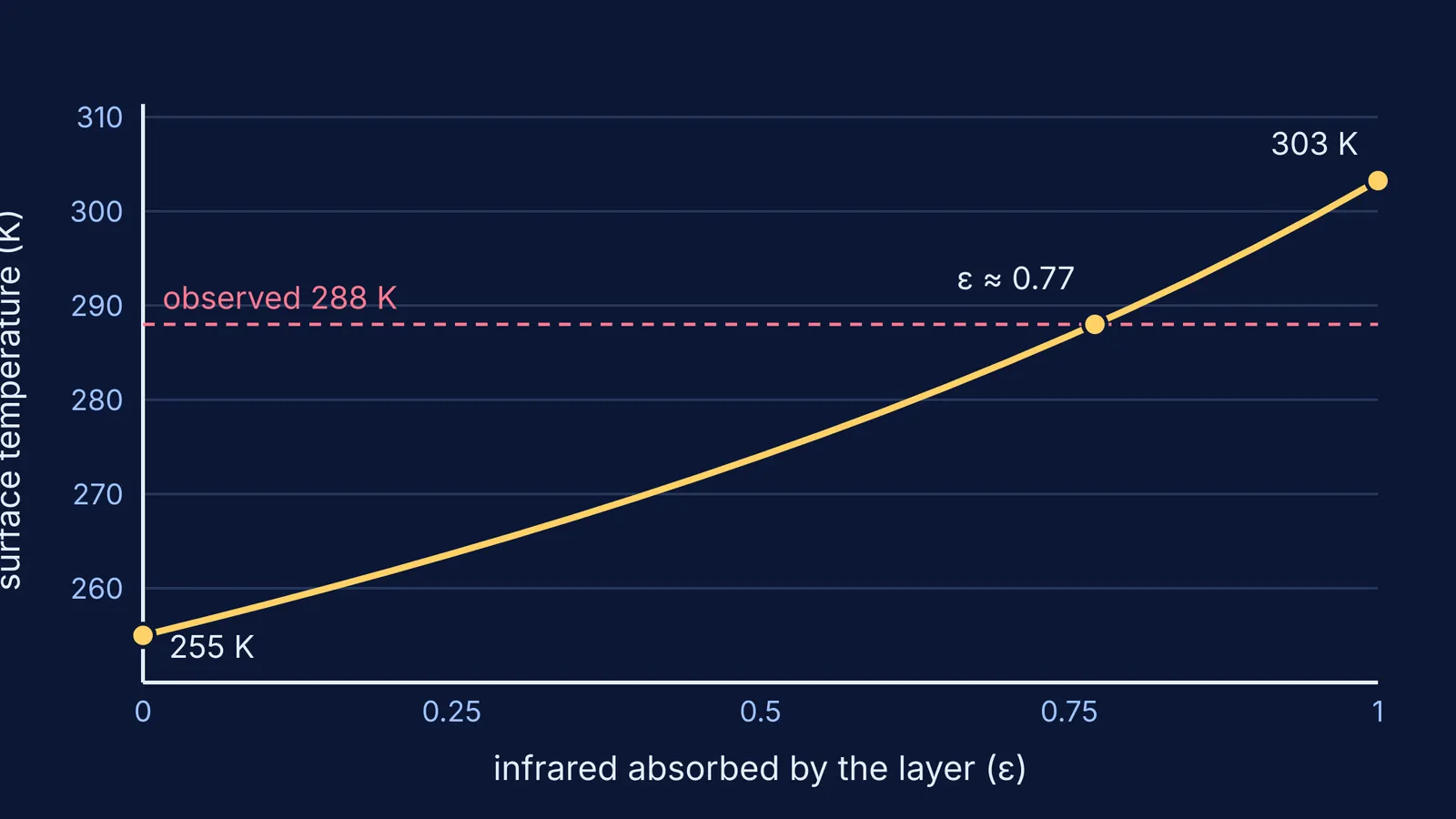
Equal steps, equal warming? On the Layer Model screen, raise infrared absorbance in equal steps. Predict whether each step adds the same warming.
Can you check the simulation with a calculation?
Yes, with Stefan's law: a black body radiates σT⁴ per square metre, where σ = 5.670 × 10⁻⁸ W m⁻² K⁻⁴ according to NIST. Refresher: black-body radiation with Stefan's law and Wien's law.
No greenhouse effect. Using NASA's figures, absorbed sunlight is 340 × (1 − 0.29) ≈ 241 W/m². Setting σT⁴ = 241 gives T⁴ ≈ 4.26 × 10⁹ K⁴, so T ≈ 255 K, about −18 °C. The Goosse textbook gets the same 255 K.
Add one layer. The textbook models the atmosphere as one layer, clear to sunlight, absorbing a fraction ε of the ground's infrared: Ts = (2/(2 − ε))^¼ × Te. With ε = 1 the surface reaches 303 K, which the authors note is warmer than the observed 288 K because of crude approximations in the model.
Tune ε to match Earth. Solve for 288 K: (288/255)⁴ ≈ 1.63, so ε ≈ 0.77. That is only what this crude model needs; the textbook's typical atmospheric value, 0.97, gives 301 K.
Answer prediction 5. From ε = 0 to 0.5 the surface warms by about 19 K; from 0.5 to 1 by about 29 K. Equal steps do not give equal warming.
A cloud in numbers. If reflection rose from 29% to 35%, absorbed sunlight falls to 221 W/m², Te to about 250 K, and the surface (ε = 0.77) to about 282 K: 6 K cooler. This illustration ignores the infrared real clouds trap.
One layer ignores oceans, convection, weather and the fact that each gas absorbs only some wavelengths. Real climate models add those pieces, a story that starts with Syukuro Manabe and the first computer climate models.
What should you do after the simulation?
Write one paragraph using three phrases: sunlight in, infrared out, new steady state. If you cannot do it without looking, rerun predictions 1 and 2. If a step in the calculation loses you, the Fermi Concept Library has a lesson for every concept in physics and chemistry. For more ideas that are easier to see than to read, try the interactive simulations in the Fermi Simulation Lab.


