

On this page
If you have ever seen a rice paddy, you might assume the plant is entirely aquatic, naturally requiring a constant supply of standing water to survive. However, rice is actually a "facultative hydrophyte"—meaning it is highly adaptable and can grow perfectly well in dry, aerated soil, much like other common cereals. The real reason farmers expend so much effort to submerge their fields is not that the rice plant intrinsically demands a flooded environment, but because the weeds that compete with it simply cannot survive such conditions.
Why is rice grown in flooded fields?
Weeds are the single greatest threat to a rice crop's overall success. In dry-seeded fields where standing water is absent, intense weed competition for nutrients, sunlight, and space can cause severe yield losses of up to 80% (10.24198/kultivasi.v25i2.69943).
Flooding creates an effective anaerobic (oxygen-poor) barrier in the top layer of the soil. Most weed seeds require a steady supply of oxygen to germinate and grow, and they will quickly suffocate under just a few centimetres of water. Because this method of cultural control is so consistently effective and avoids the heavy reliance on synthetic herbicides, more than 90% of the world's rice is produced in Asia, where flooded transplanting is the major system used to control weeds (10.1017/s0043174500055697).
How does rice survive underwater?
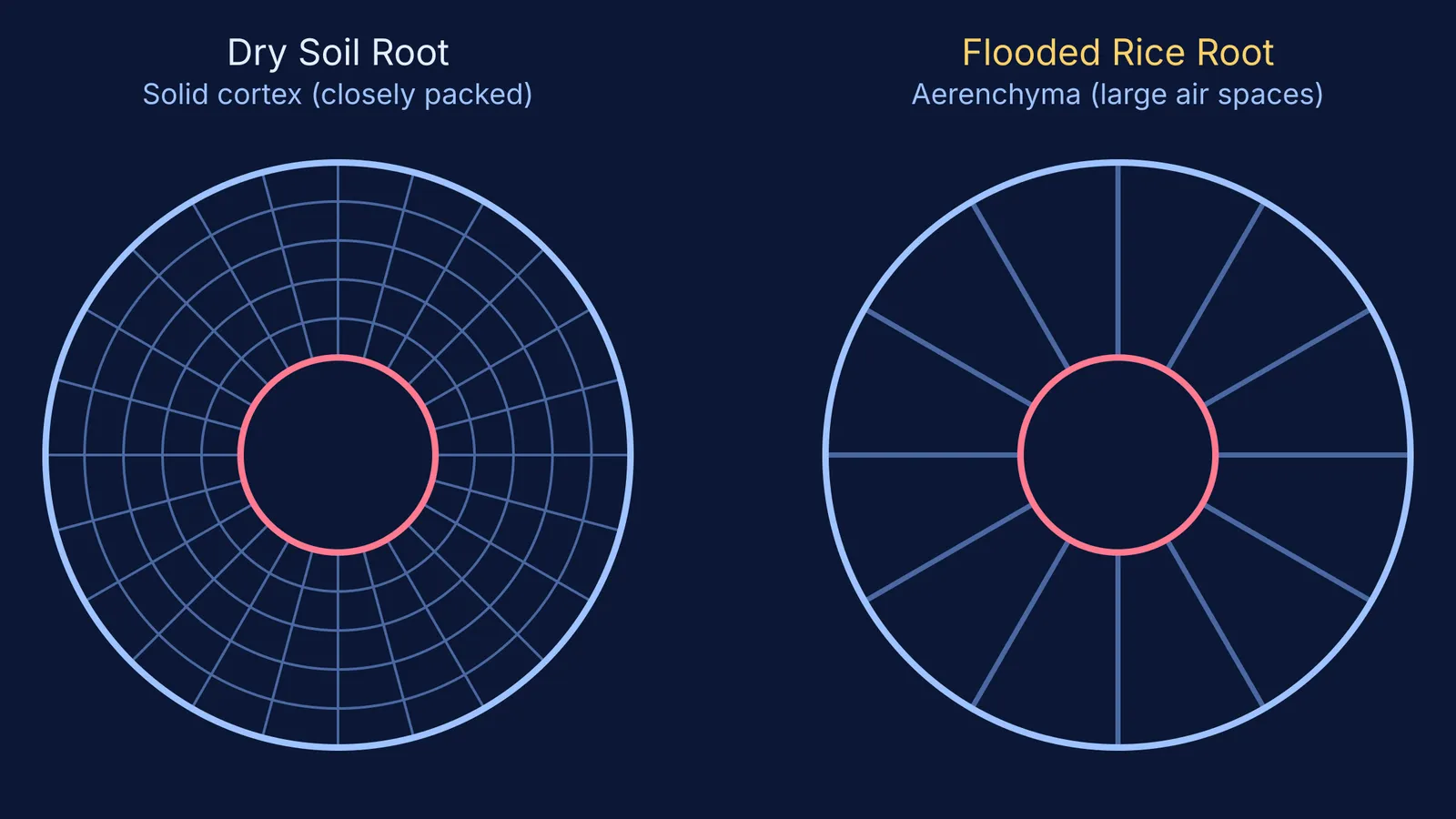
Most traditional crops, such as wheat or maize, die rapidly in waterlogged soil because their root systems cannot get enough oxygen to perform cellular respiration. Rice solves this critical problem with a specialised anatomical adaptation called aerenchyma.
Aerenchyma is a spongy tissue filled with continuous gas channels that act as an internal snorkel for the plant. This tissue forms in two main ways: *schizogeny* (where root cells separate from each other to create spaces) and *lysigeny* (where certain cells deliberately die and collapse to open up large cavities). The cellular geometry before this happens matters too; roots with cells arranged in a cubic pattern can naturally hold more air than those packed tightly in a hexagonal pattern.
Under flooded conditions, the aerenchyma expands dramatically and the root's fractional porosity—its overall gas-filled volume—can reach up to 45% (10.1111/j.1469-8137.1987.tb00153.x). Oxygen produced by the leaves during photosynthesis, or absorbed directly from the air, travels down these hollow tubes straight to the root tips, allowing the plant to maintain aerobic respiration even in deeply waterlogged soils.
Integrating plant anatomy into your exam prep
Questions on plant adaptations and root anatomy frequently appear in competitive school biology exams. You are often asked to compare the distinct root structures of mesophytes (standard land plants), xerophytes (desert plants adapted to drought), and hydrophytes (water plants adapted to flooding).
Here is a quick checklist for mastering plant adaptations:
Identify the stressor: Is the plant facing severe drought, excess standing water, or extremely low light?
Observe the anatomical change: Look for thicker waxy cuticles and sunken stomata in xerophytes, or expansive aerenchyma networks in hydrophytes.
Connect to function: Explicitly explain how the physical change solves the environmental problem (for example, how continuous air channels deliver necessary oxygen for root respiration).
Understanding how tissues change in response to environmental stress helps you memorise plant morphology intuitively, without relying on rote learning. When you study anatomy, focus on the causal link between the habitat and the physical structure. For instance, knowing that a submerged root must avoid suffocating makes the presence of large air lacunae perfectly logical. If you struggle to recall how plant structures adapt and develop over their life cycle, reviewing related topics like meristems and their locations or phototropism and other tropic movements can reinforce the fundamental rules of plant survival.
When you need to visualise how different cells respond to water uptake and environmental stress, the Fermi Simulation Lab offers interactive simulations for ideas that are easier to see than to read. If you have a specific question about aerenchyma formation or any other structural adaptations, the Fermi Concept Library contains a lesson on every concept in biology, along with its place in the map.


