On this page
These eight NEET-style questions are new, not taken from NCERT, exemplar or past papers. They climb from one-line work and power to a two-dimensional collision, and each answer names the trap behind the most tempting wrong option. Take g = 10 m/s².
What does NEET test in work, energy and power?
The NMC syllabus for NEET (UG)-2026 lists Unit 4, Work, Energy and Power, as work by constant and variable forces, kinetic and potential energy, the work-energy theorem, power, spring potential energy, conservation of mechanical energy, conservative and non-conservative forces, motion in a vertical circle, and elastic and inelastic collisions in one and two dimensions. The textbook is Chapter 5 of NCERT Class 11 Physics Part I. New to the chapter? Start with our guide on how to prepare work, energy and power for NEET.
How should you attempt these NEET questions?
As in NEET-UG 2026, according to the NTA Information Bulletin, each question has four options and one correct answer, with +4 for a right answer and −1 for a wrong one.
Give yourself 12 minutes for all eight.
Before you calculate, decide: force times distance, energy bookkeeping, or momentum.
Mark an option before reading the solution.
Read every trap, even when you were right.
If one kind of mistake keeps returning, the Fermi Problem Library has worked problems with a step-by-step solver that explains the reasoning rather than printing an answer.
Easy: work, kinetic energy and power
Q1 (easy). A box is dragged 4 m along a level floor by a rope that pulls with a tension of 20 N at 60° above the horizontal. The work done by the tension is
(A) 0 J (B) 40 J (C) 69.3 J (D) 80 J
Answer: (B). W = Fd cos θ = 20 × 4 × cos 60° = 40 J.
Trap: (C) uses sin 60°. Only the component along the displacement does work.
Q2 (easy). A 1500 kg car brakes from 72 km/h to rest on a level road. The work done on the car by the braking force is
(A) +3.0 × 10⁵ J (B) −3.0 × 10⁵ J (C) −3.9 × 10⁶ J (D) −1.5 × 10⁴ J
Answer: (B). 72 km/h = 20 m/s. By the work-energy theorem, W = 0 − ½ × 1500 × 20² = −3.0 × 10⁵ J.
Trap: (C) puts 72 straight into ½mv² without converting to m/s.
Q3 (easy). A 60 kg student runs up stairs that rise 6 m in 12 s. Her average power against gravity is
(A) 50 W (B) 300 W (C) 30 W (D) 3600 W
Answer: (B). P = mgh/t = 60 × 10 × 6 / 12 = 300 W.
Trap: (D) is the work done, 3600 J, not the rate of doing it.
Medium: springs, potential energy and loops
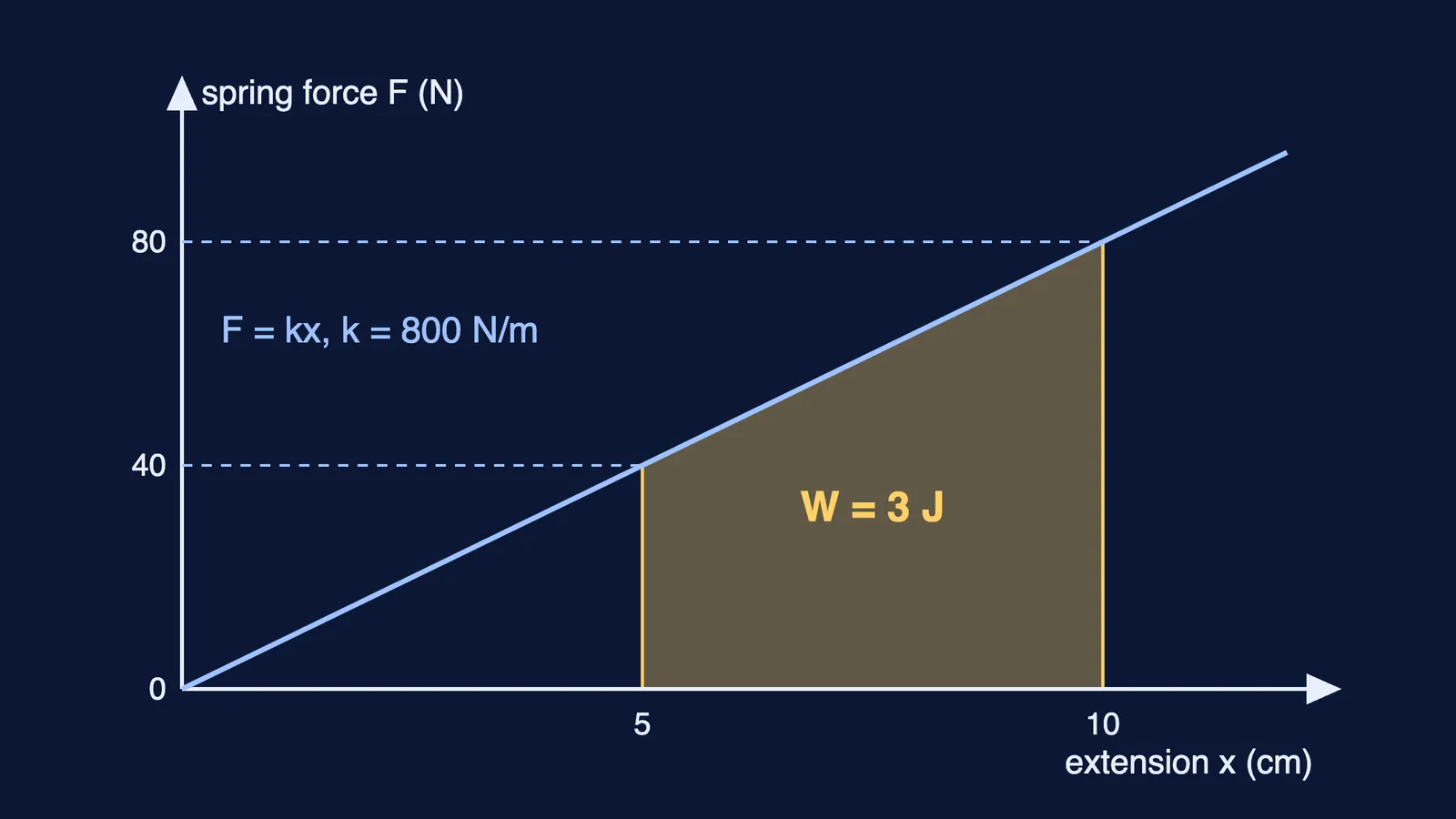
Q4 (medium). A spring of stiffness 800 N/m is already stretched by 5 cm. How much more work is needed to stretch it to 10 cm?
(A) 1 J (B) 2 J (C) 3 J (D) 4 J
Answer: (C). W = ½k(x₂² − x₁²) = ½ × 800 × (0.01 − 0.0025) = 3 J, the shaded area under the F-x line.
Trap: (A) uses ½k(Δx)², as if the spring started unstretched.
Q5 (medium). A particle moves along the x-axis with potential energy U(x) = (4x² − 8x) J, with x in metres. The force on it at x = 3 m is
(A) 16 N along +x (B) 16 N along −x (C) 12 N along −x (D) 24 N along −x
Answer: (B). F = −dU/dx = −(8x − 8) = −16 N at x = 3 m, so 16 N towards −x, towards the equilibrium point x = 1 m.
Trap: (A) drops the minus sign in F = −dU/dx.
Q6 (medium). A toy car is released from rest on a smooth track and runs into a vertical loop of radius 4 m. The least release height, above the bottom of the loop, for the car to go round without leaving the track is
(A) 8 m (B) 10 m (C) 12 m (D) 20 m
Answer: (B). At the top the track force can fall to zero, so v² ≥ gR. Energy from release to the top: mg(h − 2R) = ½mgR, so h = 2.5R = 10 m.
Trap: (A) only gets the car to the top at zero speed; it would leave the track before that.
Hard: collisions in two steps and two dimensions
Q7 (hard). A ball moving at 6 m/s hits an identical ball at rest. The collision is elastic, and the first ball moves off at 60° to its original direction. The speed of the second ball is
(A) 3 m/s (B) 3√2 m/s (C) 3√3 m/s (D) 6 m/s
Answer: (C). Equal masses, elastic, one at rest: the balls separate at 90°. So the second moves at 30° to the original line, giving speeds 6 cos 60° = 3 m/s and 6 cos 30° = 3√3 m/s.
Trap: (A) is the first ball's speed; check which angle belongs to which ball.
Q8 (hard). A 25 g bullet is fired horizontally into a 2.475 kg wooden block hanging from a long string, and stays inside it. The block swings up through a height of 20 cm. The bullet's speed was
(A) 2 m/s (B) 20 m/s (C) 200 m/s (D) 400 m/s
Answer: (C). The swing conserves energy: V = √(2gh) = 2 m/s for block plus bullet. The impact conserves momentum only: 0.025u = 2.5 × 2, so u = 200 m/s.
Trap: (B) conserves energy through the impact, ignoring what is lost as the bullet embeds.
Which topics should you revisit after a miss?
Missed Q1 or Q2: work as Fd cos θ, unit conversion, and the sign of work.
Missed Q3: power as work per unit time.
Missed Q4 or Q5: spring energy and F = −dU/dx, NCERT sections 5.7 to 5.9.
Missed Q6: energy conservation with the condition at the top of a loop.
Missed Q7 or Q8: when momentum is conserved and when kinetic energy is.
For the slips that cost marks most often, read three work-energy mistakes and how to avoid them, and for school-exam revision, our Work, Energy and Power Class 11 notes.