On this page
These eight NEET-UG Biology questions on Plant Physiology are original, not copied or reworded from NCERT, exemplar or past papers. They move from recall to reasoning and end with two calculations.
Which Plant Physiology topics does this NEET set cover?
The updated NEET (UG)-2026 syllabus from the National Medical Commission puts Plant Physiology in Biology Unit 4 with three topics: photosynthesis, respiration, and plant growth and development. Each maps to one chapter of NCERT Class 11 Biology (Reprint 2026-27): Chapter 11, Photosynthesis in Higher Plants, Chapter 12, Respiration in Plants, and Chapter 13, Plant Growth and Development. Every fact below is checked against them.
Not finished the chapters? Start with our guide on how to prepare Plant Physiology for NEET, then come back.
How should you use this practice set?
Allow about a minute per question, two for Q7 and Q8.
Write a one-line reason before you check, not just a letter.
Read the trap line even when you were right.
Redo every question that caught you after three days.
Easy: do you know where each process happens?
Q1 (easy). A leaf receives only light of wavelength 710 nm. Which statement about its light reaction is correct?
(A) Only PS I works; only ATP is made (B) Only PS II works; only NADPH is made (C) PS II and PS I work in series; ATP and NADPH are made (D) Only PS I works; ATP and NADPH are made
Answer: (A). NCERT Chapter 11 says cyclic photophosphorylation occurs when only light beyond 680 nm is available. Only PS I (P700) works, and the electron returns to PS I instead of reducing NADP+. Trap: (C) is the normal non-cyclic Z scheme, which needs PS II.
Q2 (easy). A sugarcane farmer wants longer stems, where the crop stores its sugar. Which spray does NCERT describe for this?
(A) NAA (B) Gibberellins (C) Ethephon (D) Abscisic acid
Answer: (B). Chapter 13 says spraying sugarcane with gibberellins lengthens the stem and can raise yield by as much as 20 tonnes per acre. Trap: (A) tempts because auxins promote elongation, but NCERT credits gibberellins here.
Q3 (easy). Yeast in a sealed jar of sugar solution has no oxygen. Per glucose, what is the net ATP gain and how far is glucose broken down?
(A) 38 ATP; fully to CO2 and water (B) 2 ATP; only partly, to ethanol and CO2 (C) 2 ATP; fully to CO2 and water (D) 36 ATP; only partly, to ethanol and CO2
Answer: (B). In alcoholic fermentation, pyruvic acid from glycolysis becomes CO2 and ethanol, and NCERT Chapter 12 gives a net gain of only 2 ATP per glucose. Trap: (C) has the right ATP but complete breakdown needs aerobic respiration.
Medium: can you apply the rules?
Q4 (medium). Which statements about a maize (C4) leaf are correct?
(i) Oxaloacetic acid is formed in the mesophyll cells.
(ii) Mesophyll cells carry out the Calvin cycle using RuBisCO.
(iii) The Calvin cycle runs only in the bundle sheath cells.
(iv) Bundle sheath cells fix CO2 with PEPcase.
(A) (i) and (iii) only (B) (i), (ii) and (iii) only (C) (ii) and (iv) only (D) (iii) and (iv) only
Answer: (A). NCERT Chapter 11 says mesophyll cells of C4 plants have PEPcase but lack RuBisCO, so OAA forms there; bundle sheath cells have RuBisCO but lack PEPcase, so the Calvin cycle runs only there. Trap: (B) assumes mesophyll cells run the Calvin cycle, as in C3 plants.
Q5 (medium). Germinating seeds take up 50 mL of O2 and give out 35 mL of CO2 in the same time. What is the respiratory quotient, and what is the most likely substrate?
(A) 1.0; carbohydrate (B) 0.7; fat (C) 0.9; protein (D) 1.43; fat
Answer: (B). RQ is the volume of CO2 evolved divided by the volume of O2 consumed, so RQ = 35/50 = 0.7. Chapter 12 gives 0.7 for the fat tripalmitin, against 1 for carbohydrates and about 0.9 for proteins. Trap: (D) divides O2 by CO2; the ratio is the other way up.
Q6 (medium). A chloroplast fixes 30 molecules of CO2 through the Calvin cycle. How many ATP and NADPH molecules are used?
(A) 60 ATP and 60 NADPH (B) 90 ATP and 60 NADPH (C) 60 ATP and 90 NADPH (D) 90 ATP and 90 NADPH
Answer: (B). Chapter 11 gives 3 ATP and 2 NADPH per CO2 fixed: 2 ATP for reduction plus 1 ATP to regenerate RuBP. So 30 x 3 = 90 ATP and 30 x 2 = 60 NADPH, enough for 5 glucose. Trap: (A) forgets the ATP spent on regeneration.
Hard: can you finish the calculation?
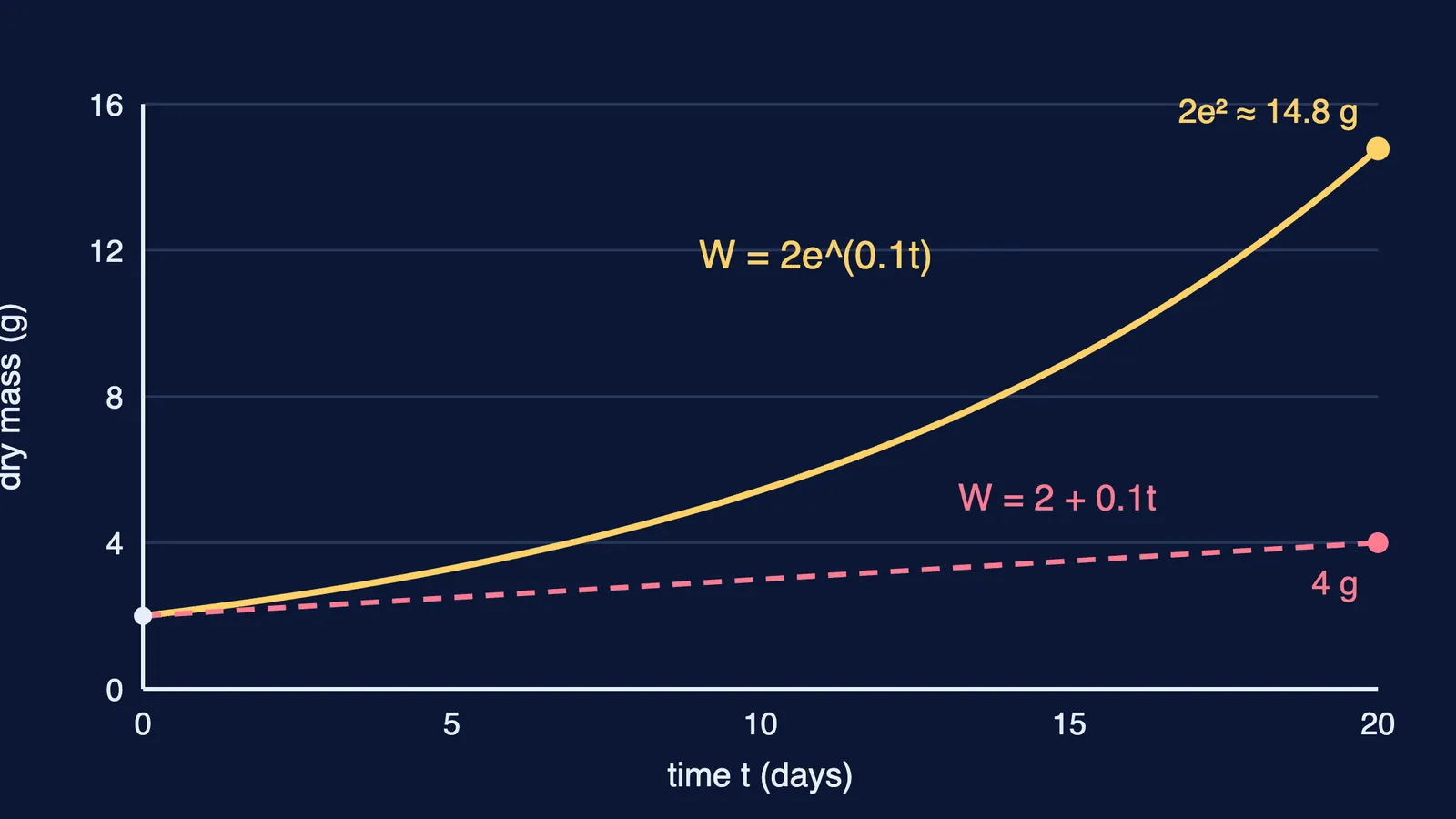
Q7 (hard). A seedling's dry mass follows geometric growth, W1 = W0 e^(rt). It starts at 2 g with a relative growth rate of 0.1 per day. What is its dry mass after 20 days?
(A) 4 g (B) 2e^0.1 g, about 2.2 g (C) 2e^2 g, about 14.8 g (D) e^2 g, about 7.4 g
Answer: (C). In the Chapter 13 equation, rt = 0.1 x 20 = 2, so W1 = 2e^2, about 14.8 g. Trap: (A) uses the arithmetic equation Lt = L0 + rt, meant for constant-rate growth such as an elongating root.
Q8 (hard). Using NCERT's counting (1 NADH gives 3 ATP, 1 FADH2 gives 2 ATP), how many ATP come from the complete aerobic oxidation of one molecule of pyruvic acid in the mitochondrion?
(A) 12 (B) 15 (C) 16 (D) 19
Answer: (B). NCERT's matrix equation for one pyruvic acid gives 4 NADH (one from pyruvate to acetyl CoA, three in the Krebs cycle), 1 FADH2 and 1 ATP. That is 12 + 2 + 1 = 15 ATP. Check: 2 x 15 = 30, plus glycolysis's 2 ATP and 2 NADH (8), gives NCERT's 38 per glucose. Trap: (D) halves 38, wrongly sharing glycolysis's ATP between the pyruvates.
What should you do after this set?
For counting errors, redo Q6 and Q8 and check the ATP count in our Respiration in Plants Class 11 notes. If Q7 caught you, our Plant Growth and Development Class 11 guide compares arithmetic and geometric growth.
For more practice after that, the Fermi Problem Library has worked problems with a step-by-step solver that explains the reasoning rather than printing an answer.