On this page
Respiration in Plants is biology as bookkeeping: follow one glucose, count its carbons, carriers and ATP, then explain why the count is only theoretical.
What does CBSE examine from Respiration in Plants in 2026-27?
In the CBSE Biology curriculum for 2026-27, Respiration in Plants is Chapter 12 in Unit IV, Plant Physiology, which carries 12 of the 70 theory marks. Those 12 marks are shared with Photosynthesis in Higher Plants and Plant Growth and Development; CBSE gives no separate figure for this chapter.
The topic line covers gas exchange, glycolysis, fermentation, the TCA cycle and ETS, ATP numbers, amphibolic pathways and respiratory quotient. The only Class XI topic marked for formative assessment alone is Digestion and Absorption, so all of this chapter counts in the theory paper. In practicals, experiment 9, the rate of respiration in flower buds or leaf tissue and germinating seeds, is in the list for the one minor experiment, worth 4 marks.
Study Chapter 12 of the NCERT Class 11 Biology textbook (Reprint 2026-27), sections 12.1 to 12.7. NCERT's list of rationalised content for Class XI drops no topic from this chapter, so the whole of it is examinable.
How does glucose break down, step by step?
NCERT Chapter 12 follows this order.
Gas exchange: with no special organs, plants use stomata and lenticels; each part meets its own needs, and living cells sit close to air.
Glycolysis (EMP pathway), in the cytoplasm: glucose becomes two pyruvic acid molecules through ten enzyme steps. ATP is used twice (glucose to glucose-6-phosphate, fructose-6-phosphate to fructose 1,6-bisphosphate) and made at BPGA to PGA and PEP to pyruvate. One NADH + H+ forms when PGAL becomes BPGA.
Fermentation, without oxygen: yeast turns pyruvic acid into CO2 and ethanol (pyruvic acid decarboxylase, alcohol dehydrogenase); some bacteria and oxygen-short muscle make lactic acid (lactate dehydrogenase). NADH is reoxidised to NAD+. Less than 7% of glucose's energy is released.
Link reaction, in the matrix: pyruvate dehydrogenase converts each pyruvate to acetyl CoA, releasing CO2 and NADH.
TCA (Krebs') cycle, in the matrix: acetyl CoA joins oxaloacetic acid to form citric acid; two decarboxylations follow. Per turn: 3 NADH, 1 FADH2 and 1 GTP (which makes ATP).
ETS, on the inner membrane: complexes I to IV pass electrons to O2, the final hydrogen acceptor, forming water. ATP synthase (complex V) makes ATP as 4 H+ pass through F0 per ATP.
For mitochondria, see our guide to Cell: The Unit of Life for Class 11.
How do you count 38 ATP from one glucose?
NCERT takes 3 ATP per NADH and 2 ATP per FADH2. Per glucose:
Glycolysis: 4 ATP made, 2 used, net 2; plus 2 NADH = 6. Stage total 8.
Link reaction: 2 NADH = 6.
TCA cycle, two turns: 2 ATP; 6 NADH = 18; 2 FADH2 = 4. Stage total 24.
Sum: 8 + 6 + 24 = 38 ATP.
Fermentation stops after glycolysis, so its net gain is 2 ATP. The 38 rests on NCERT's assumptions, such as glycolytic NADH entering mitochondria and no intermediate being drawn off; real cells break them, so it is theoretical.
What is the respiratory quotient, and how do you calculate it?
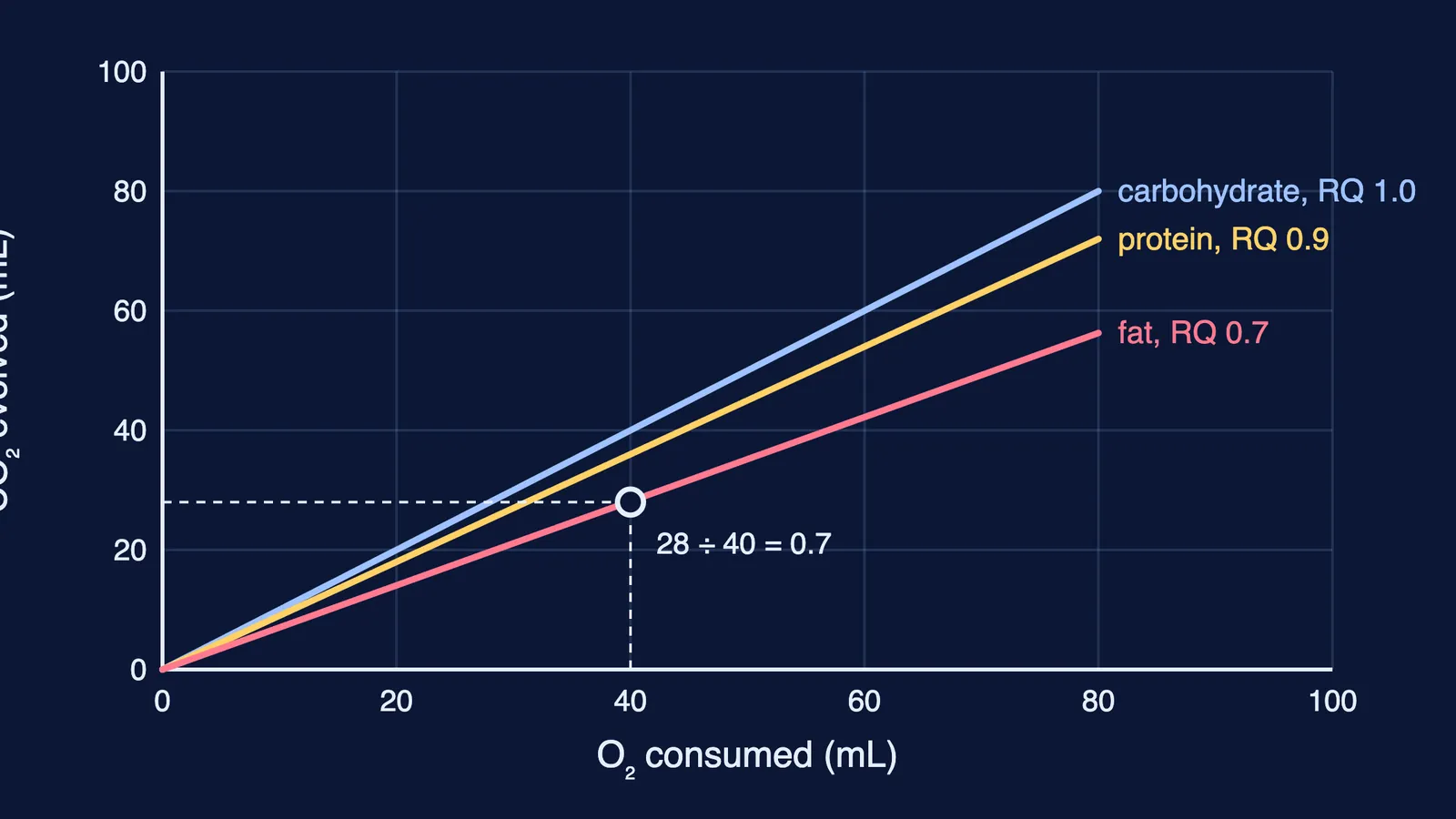
RQ is the volume of CO2 evolved divided by the volume of O2 consumed. Per NCERT section 12.7, it is 1 for carbohydrates, about 0.7 for fats (tripalmitin: 102 CO2 ÷ 145 O2) and about 0.9 for proteins.
Worked example. Germinating seeds in a respirometer take up 40 mL of O2 and give out 28 mL of CO2. RQ = 28 ÷ 40 = 0.7, which fits a fat-rich store. Living tissues usually respire mixed substrates.
Respiration is also amphibolic: glycerol enters as PGAL, fatty acids as acetyl CoA and amino acids at pyruvate, acetyl CoA or the Krebs' cycle; the same intermediates are withdrawn to build those molecules.
What board-style questions should you practise?
Our own questions; mark labels are our suggestion, not CBSE's.
(1 mark) Which enzyme reduces pyruvic acid to lactic acid in muscle short of oxygen?
(1 mark) According to NCERT, how many protons pass through F0 for each ATP that ATP synthase makes?
(2 marks) A tissue releases 45 mL of CO2 while taking up 50 mL of O2. Find its RQ and the likely substrate.
(2 marks) Using NCERT's values, how many ATP come from oxidising 5 NADH and 4 FADH2?
(3 marks) For three glucose molecules, give the theoretical ATP from aerobic respiration, the net ATP from fermentation, and the CO2 released aerobically.
(5 marks) Account for the three CO2 released when one pyruvate is fully oxidised: name the step and site of each, and count the NADH and FADH2 formed.
Answers: (1) Lactate dehydrogenase. (2) Four. (3) 0.9, protein. (4) 23. (5) 114, 6 and 18. (6) One at pyruvate dehydrogenase, two at the TCA decarboxylations, all in the matrix; 4 NADH, 1 FADH2. Numerical answers were checked by hand and in Python.
Preparing for NEET too? See our Plant Physiology for NEET guide.
Still unsure where each ATP comes from? Fermi's AI tutor works out what you already know and builds a plan for the session.