On this page
These eight original NEET-style MCQs on Physics and Measurement go from easy to hard, each with one correct option, a worked solution and the most tempting wrong option explained.
The NMC syllabus for NEET (UG)-2026 lists Physics Unit 1 as units, SI units, least count, significant figures, errors in measurement and dimensional analysis; vernier calipers and the screw gauge sit in Unit 20, Experimental Skills. The NCERT chapter is Class 11 Physics Chapter 1, Units and Measurement.
How should you use this practice set?
Cover the answers and allow about a minute per question.
Write one line of working, so you can tell a concept error from a slip.
Mark each answer right, wrong or guessed; a lucky guess counts as wrong, and each trap note tells you what went wrong.
The NTA information bulletin for NEET (UG)-2026 gives +4 for a correct answer and -1 for a wrong one. If the basics feel shaky, start with our guide on how to prepare Physics and Measurement for NEET.
Easy: can you apply the basic rules quickly?
Q1 (easy). Samples of 23.4 g, 0.517 g and 1.06 g go into one beaker. With correct significant figures, what is the total mass?
(A) 24.977 g (B) 24.98 g (C) 25.0 g (D) 25 g
Answer: (C). The raw sum is 24.977 g. In addition, the result keeps as many decimal places as the least precise number, and 23.4 g has one decimal place, so the total is 25.0 g.
Trap: (D) drops the trailing zero, which is significant here.
Q2 (easy). A gas at pressure P fills a volume V, and t is a time. Which quantity has the same dimensions as PV/t?
(A) Energy (B) Power (C) Force (D) Momentum
Answer: (B). Pressure × volume = [M L⁻¹ T⁻²][L³] = [M L² T⁻²], which is energy. Dividing by time gives [M L² T⁻³], the dimensions of power.
Trap: (A) is PV alone; the division by t is easy to forget.
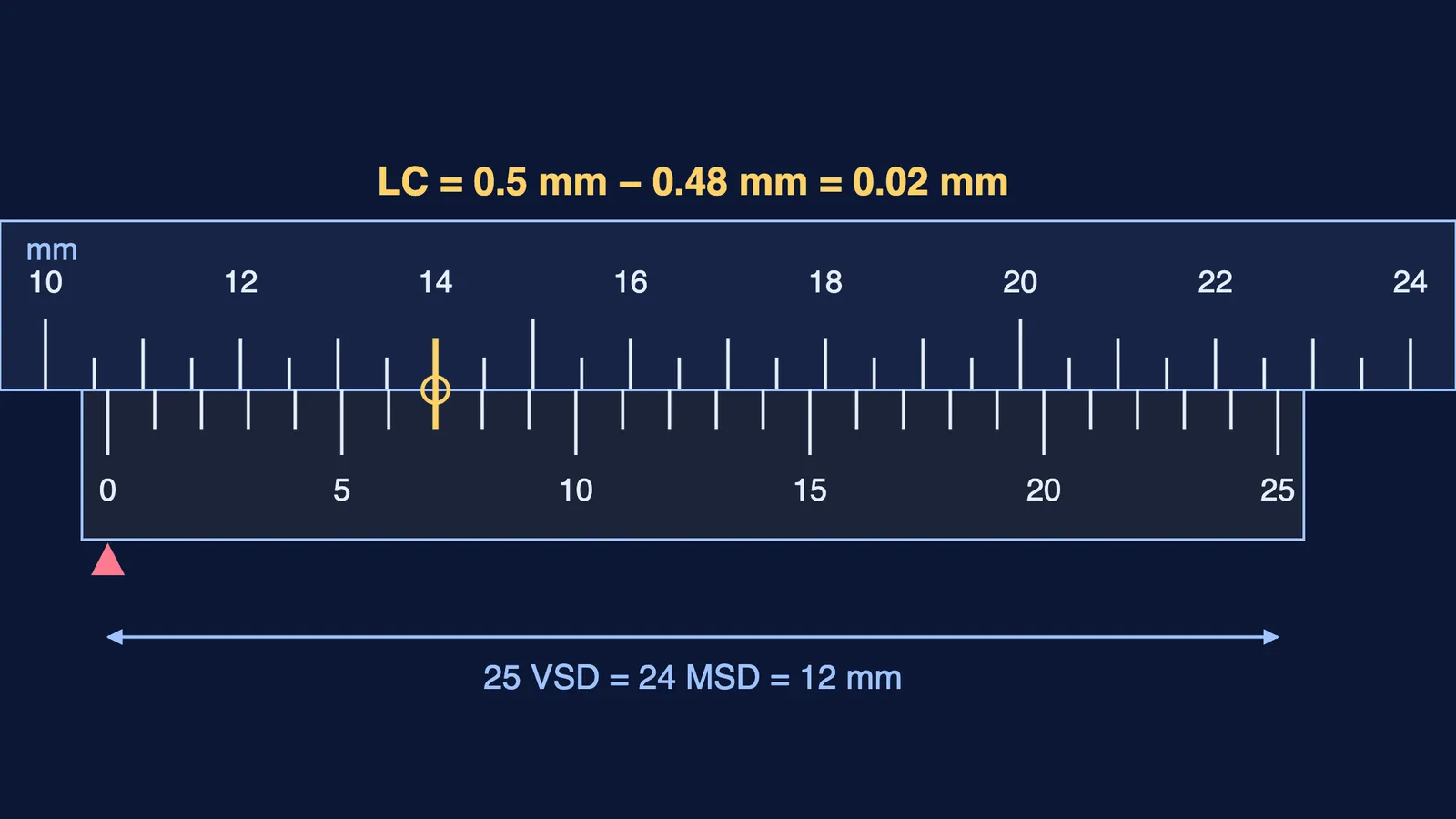
Q3 (easy). On a vernier caliper, one main-scale division is 0.5 mm, and 25 vernier divisions exactly cover 24 main-scale divisions. What is the least count?
(A) 0.0208 mm (B) 0.02 mm (C) 0.48 mm (D) 0.01 mm
Answer: (B). One vernier division = 24 × 0.5/25 = 0.48 mm. Least count = 1 MSD - 1 VSD = 0.5 - 0.48 = 0.02 mm.
Trap: (A) divides 0.5 mm by 24 instead of 25.
Medium: where do instruments and errors catch people out?
Q4 (medium). A screw gauge has a pitch of 0.5 mm and 50 divisions on its circular scale. It has a zero error of +0.03 mm. Measuring a wire, the main scale shows 3.5 mm and the 27th circular division is on the reference line. What is the corrected diameter?
(A) 3.74 mm (B) 3.77 mm (C) 3.80 mm (D) 3.497 mm
Answer: (A). Least count = 0.5/50 = 0.01 mm. Observed reading = 3.5 + 27 × 0.01 = 3.77 mm. Corrected reading = observed - zero error = 3.77 - 0.03 = 3.74 mm.
Trap: (C) adds the zero error. A positive zero error means the gauge reads high, so subtract it.
Q5 (medium). A student finds g from a pendulum using g = 4π²L/T². The length is 80.0 cm with an error of 0.1 cm, and 40 oscillations take 72.0 s with an error of 0.2 s. What is the maximum percentage error in g, roughly?
(A) 0.40% (B) 0.68% (C) 0.26% (D) 0.81%
Answer: (B). Percentage error in L = 0.1/80.0 × 100 = 0.125%. Percentage error in T = 0.2/72.0 × 100 ≈ 0.278% (the same for one period or forty). Since T is squared, its share doubles: 0.125 + 2 × 0.278 ≈ 0.68%.
Trap: (A) forgets the square on T. The constant 4π² adds no error.
Q6 (medium). The force on a particle at distance x from a point is F = αx + β/(x² + γ). What are the dimensions of β?
(A) [M L T⁻²] (B) [M L³ T⁻²] (C) [L²] (D) [M T⁻²]
Answer: (B). Only like quantities add, so γ has the dimensions of x², [L²]. Then β/[L²] must be a force, [M L T⁻²], which makes β = [M L³ T⁻²].
Trap: (A) gives β the dimensions of the whole term. (C) is γ and (D) is α.
Hard: can you build and convert dimensions?
Q7 (hard). A slightly stretched viscous drop relaxes back to a sphere in a time τ that depends only on its radius r, the liquid's viscosity η and its surface tension S. Which relation follows from dimensions?
(A) τ ∝ ηr/S (B) τ ∝ S/(ηr) (C) τ ∝ ηr²/S (D) τ ∝ ηS/r
Answer: (A). Write τ = k rᵃ ηᵇ Sᶜ, with η = [M L⁻¹ T⁻¹] and S = [M T⁻²]. Matching powers: M gives b + c = 0; L gives a - b = 0; T gives -b - 2c = 1. So b = 1, c = -1, a = 1, giving τ ∝ ηr/S.
Trap: (B) is the relation upside down, with the dimensions of frequency.
Q8 (hard). In a new system of units, the base quantities are momentum p, velocity v and time T. What are the dimensions of pressure in this system?
(A) [p v⁻¹ T⁻²] (B) [p T⁻¹] (C) [p v⁻² T⁻³] (D) [p v⁻² T⁻²]
Answer: (C). Mass = p/v and length = vT. Pressure is force per area: force = p/T, area = (vT)² = v²T², so pressure = p/(T · v²T²) = [p v⁻² T⁻³].
Trap: (A) divides force by length only once, which gives surface tension. (B) is force itself.
What should you do after checking your answers?
Sort your misses into wrong rule, wrong reading and wrong dimensions. Fix rules with a one-page rule sheet, readings with hand-worked diagrams, and dimensions with a table of dimensional formulae. For the rules in detail, see our guide to scientific notation and significant figures, and for the full chapter, our Units and Measurements Class 11 notes.
For more practice, the Fermi Problem Library has worked problems with a step-by-step solver that explains the reasoning rather than printing an answer.
Try the set again in a week, without notes, in eight minutes.