On this page
JEE Main p-block questions ask you to apply one cause, such as size, the n = 2 shell or the four-orbital limit, to a case you have not seen. These 8 original questions run easy to hard; two need a number as the answer.
They stay inside Unit 10, p-Block Elements (Group 13 to Group 18), of the NTA Syllabus for JEE (Main) 2027: electronic configuration, trends across periods and down groups, and the unique behaviour of the first element in each group. The current NCERT books have no p-block chapter, so every fact here comes from NCERT Class 11 Chemistry Unit 3, Classification of Elements (Reprint 2026-27), with PCl5 from Unit 4.
How should you use this p-block practice set?
Cover the solutions; allow about two minutes per question.
Before reading the options, write the cause you expect to use.
In the numerical questions, write every sign before you add.
Read the trap line even when you are right.
For the trends and a 10-day plan, see our guide on how to prepare p-Block Elements for JEE Main.
Easy: can you place an element and spot an impossible species?
Q1 (easy). Element X has atomic number 49. Which formula fits its normal oxide?
(A) X2O (B) X2O3 (C) XO2 (D) X2O5
Answer: (B). Z = 49 is [Kr] 4d10 5s2 5p1. The filled 4d subshell is not in the valence shell, so X has three outer electrons: group 13, oxide X2O3. NCERT's Table 3.9 lists In2O3 for this element, indium. Trap: (A) counts only the single 5p electron and forgets the 5s pair.
Q2 (easy). Which of these species cannot exist?
(A) [AlF6]3− (B) NF5 (C) PCl5 (D) [BF4]−
Answer: (B). NCERT explains that the first member of each p-block group has only four valence orbitals (2s and 2p), so its maximum covalency is 4. Nitrogen cannot hold five bond pairs; phosphorus can (PCl5 is trigonal bipyramidal). Trap: (D) looks wrong because boron has three valence electrons, but NCERT names BF4− as boron's limit and [AlF6]3− as aluminium's.
Medium: can you rank and count from the trends?
Q3 (medium). Which order of first ionization enthalpy is correct?
(A) N > O > B > Be (B) O > N > Be > B (C) N > O > Be > B (D) O > N > B > Be
Answer: (C). Ionization enthalpy rises across period 2 with two breaks NCERT explains. Boron loses a 2p electron, more shielded than beryllium's 2s electron, so B < Be. Oxygen's fourth 2p electron shares an orbital, and the extra repulsion makes it easier to remove, so O < N. Trap: (A) misses the Be, B break; (B) misses the N, O one.
Q4 (medium). Arrange the isoelectronic species P3−, S2−, Cl− and Ca2+ in decreasing order of radius.
(A) Ca2+ > P3− > S2− > Cl− (B) Cl− > S2− > P3− > Ca2+ (C) P3− > S2− > Cl− > Ca2+ (D) P3− > Cl− > S2− > Ca2+
Answer: (C). All four carry 18 electrons, and NCERT's rule is that greater nuclear charge means smaller radius. Nuclear charges are 15, 16, 17 and 20, so P3− is largest and Ca2+ smallest. Trap: (A) assumes the heaviest atom gives the largest ion, but Ca2+ has lost its whole fourth shell.
Q5 (medium, numerical value). Find the sum of the oxidation states of O in OF2, N in N2O3, Se in SeO3 and Sb in Sb2O5.
Answer: 16. Fluorine is −1, so O in OF2 is +2, an example NCERT works through. Then N: 2x = 6, x = +3; Se: x = +6; Sb: 2x = 10, x = +5. Sum: 2 + 3 + 6 + 5 = 16. Trap: writing −2 for oxygen out of habit gives 12.
Hard: can you handle the first-member exceptions?
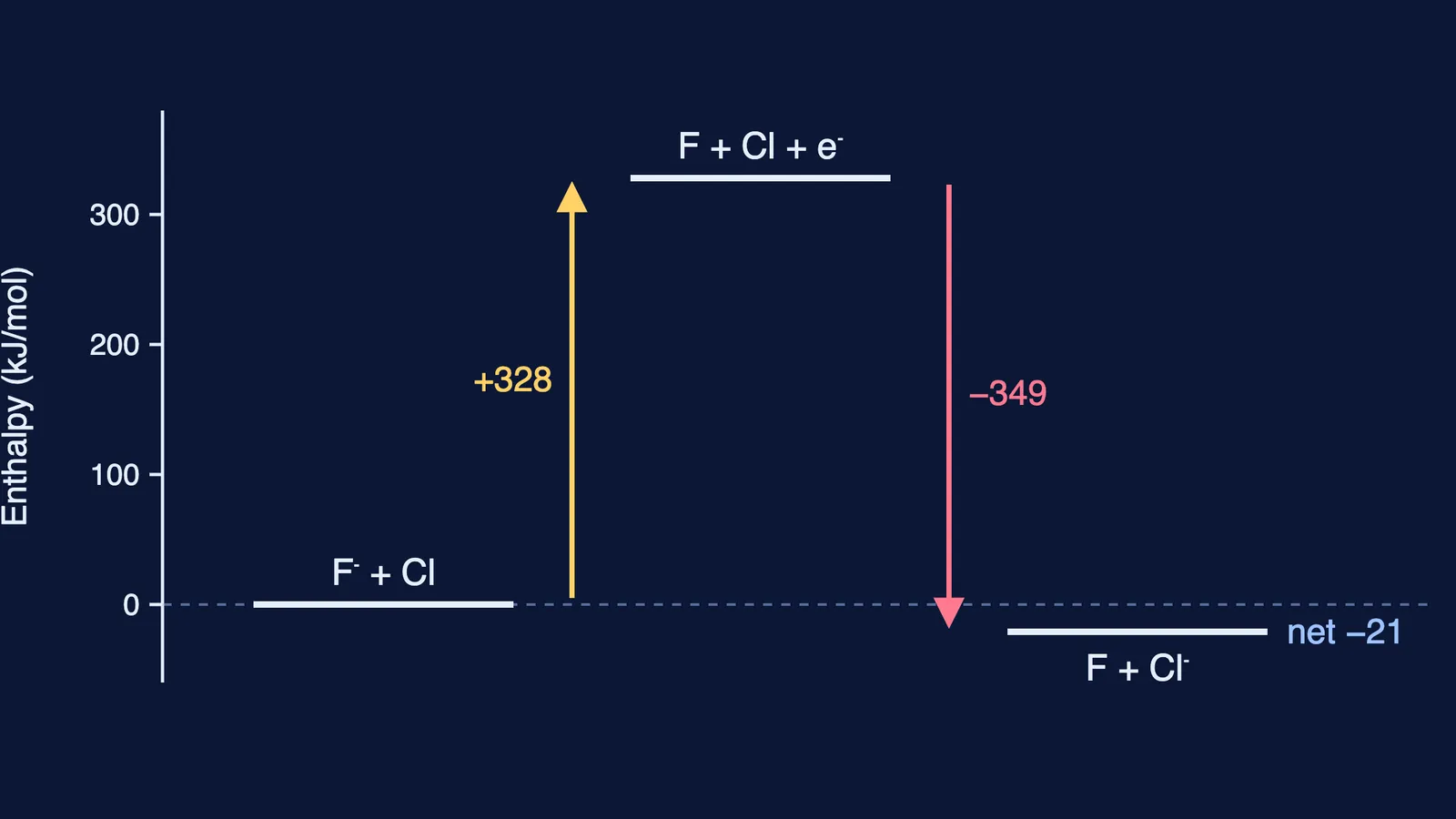
Electron gain enthalpies from NCERT's Table 3.7: F −328, Cl −349 kJ/mol.
Q6 (hard, numerical value). For the gas-phase reaction F−(g) + Cl(g) → F(g) + Cl−(g), how much energy, in kJ, is released when 3.0 mol of F− react?
Answer: 63. Taking the electron from F− costs +328 kJ/mol; chlorine gaining it gives −349 kJ/mol. Net ΔH = 328 − 349 = −21 kJ/mol, so 3.0 mol release 63 kJ. Trap: assuming the most electronegative element also has the most negative electron gain enthalpy flips the sign. NCERT explains why chlorine wins: an electron added to fluorine's compact n = 2 shell meets more repulsion.
Q7 (hard). How many of these statements are correct?
Nitrogen's maximum covalency is 4.
Oxygen is in the +2 state in OF2.
First members form pπ–pπ multiple bonds less readily than heavier members.
Boron forms [BF6]3−.
Gallium forms the oxide Ga2O3, as aluminium forms Al2O3.
The radius of F− (136 pm) is more than twice that of the F atom (64 pm).
(A) 2 (B) 3 (C) 4 (D) 5
Answer: (C). Statements 1, 2, 5 and 6 are true; 136/64 = 2.125, and NCERT gives both radii. NCERT says the first member forms pπ–pπ multiple bonds more readily, not less, and boron stops at BF4−. Trap: (B) rejects statement 6 by eye; work out the ratio.
Q8 (hard). In N2O5 (O2N–O–NO2), nitrogen is in the +5 oxidation state. Which statement is correct?
(A) Its covalency is 5, matching the oxidation state (B) Its covalency is 4 (C) It uses a 3d orbital to form five bonds (D) Its oxidation state is +4
Answer: (B). Each nitrogen forms one N=O bond, one coordinate bond to O and one bond to the bridging O: four shared pairs, NCERT's limit for a first-row element. Oxidation state and covalency are different counts, as NCERT's Problem 3.9 shows for aluminium (+3, covalency 6). Trap: (A) treats the oxidation state as a bond count; (C) gives nitrogen d orbitals it lacks.
What should you revise after this set?
Q1 or Q4 point to configuration and size; Q3, Q6 or Q7 to the data and its exceptions; Q2 or Q8 to the four-orbital limit. Our chemical bonding guide for JEE Main covers the shapes behind PCl5 and N2O5, and the p-Block NEET practice set has 8 different questions on the same unit.
If the method, not the fact, failed you, the Fermi Problem Library has worked problems with a step-by-step solver that explains the reasoning rather than printing an answer.