

On this page
Most board chemistry numericals that start in grams and end in grams are the same problem with different compounds. Once you see the chain, you can write every one of them in the same three lines, and an examiner can follow each mark.
What is mass to mass stoichiometry?
NCERT's Class 11 chemistry textbook defines stoichiometry as the quantitative study of the reactants required or the products formed in a reaction (NCERT, Some Basic Concepts of Chemistry). The same chapter says the coefficients of a balanced equation give the molar ratios of the substances taking part. A mass to mass problem gives you the mass of one substance and asks for the mass of another.
The catch is that a balanced equation never compares grams. It compares moles, so grams have to pass through moles on the way in and on the way out. One mole contains 6.02214076 × 10²³ particles, a value that is now fixed exactly (NIST CODATA value of the Avogadro constant).
What are the three steps, every time?
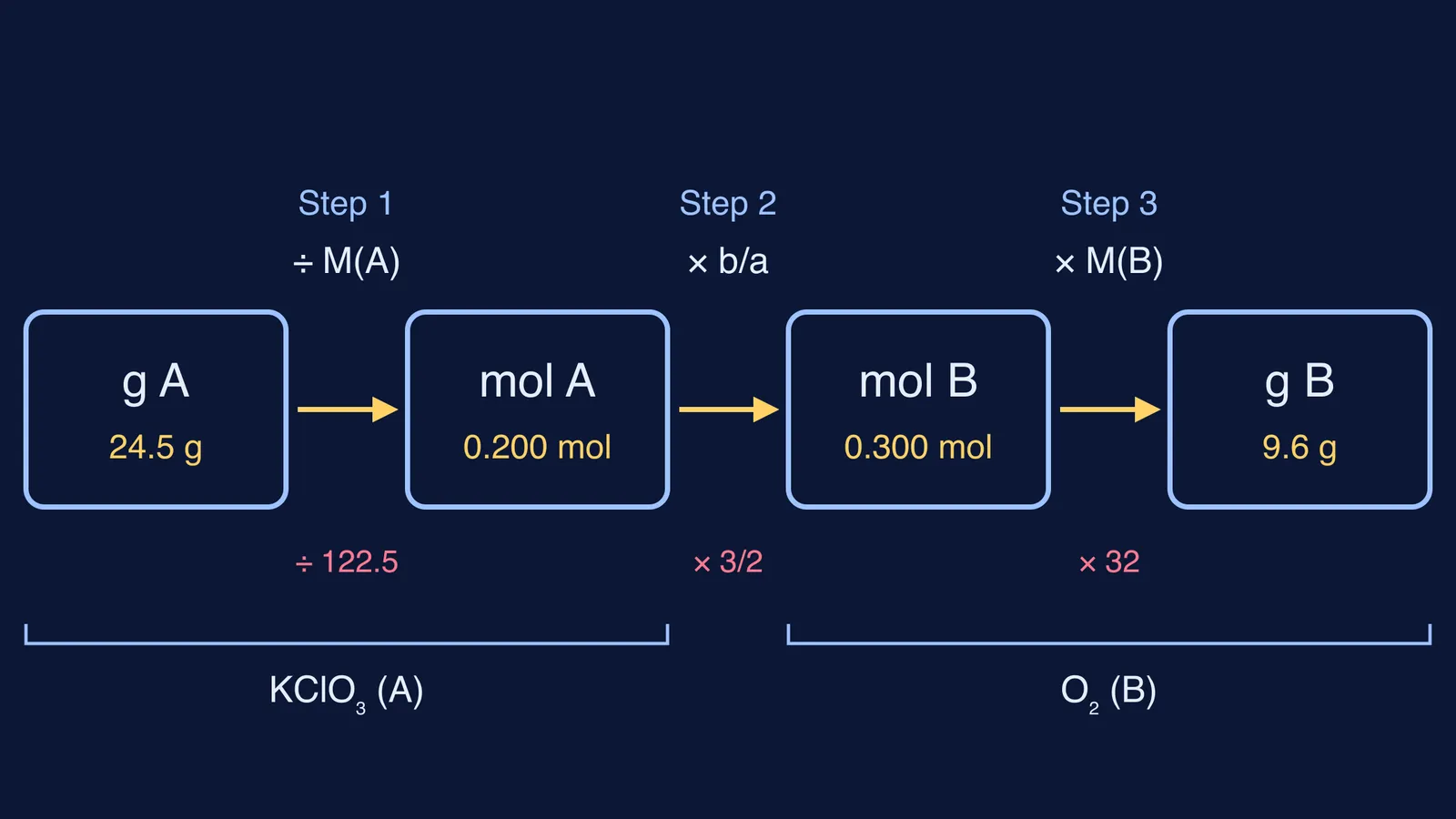
For a balanced equation aA → bB, where A is the substance you are given and B is the one asked for:
Grams to moles: moles of A = mass of A ÷ molar mass of A.
Mole ratio: moles of B = moles of A × (b ÷ a), using the coefficients from the balanced equation.
Moles to grams: mass of B = moles of B × molar mass of B.
Write the balanced equation first, then each step on its own line with units. That is the whole layout.
How does this look on a real numerical?
Example 1: NCERT Problem 1.3. How much water forms when 16 g of methane burns? NCERT's solution uses CH₄ + 2O₂ → CO₂ + 2H₂O and arrives at 36 g of water (NCERT Class 11 Chemistry, Unit 1). In three lines:
n(CH₄) = 16 g ÷ 16 g/mol = 1 mol
n(H₂O) = 1 mol CH₄ × (2 mol H₂O ÷ 1 mol CH₄) = 2 mol
m(H₂O) = 2 mol × 18 g/mol = 36 g
Example 2: a ratio that is not 1. What mass of oxygen comes from heating 24.5 g of potassium chlorate? The balanced equation is 2KClO₃ → 2KCl + 3O₂. With rounded atomic masses K = 39, Cl = 35.5 and O = 16 (close to the standard values in the CIAAW atomic weights table), M(KClO₃) = 122.5 g/mol and M(O₂) = 32 g/mol.
n(KClO₃) = 24.5 g ÷ 122.5 g/mol = 0.200 mol
n(O₂) = 0.200 mol × (3 ÷ 2) = 0.300 mol
m(O₂) = 0.300 mol × 32 g/mol = 9.6 g
Example 3: working backwards. How much calcium carbonate must decompose to give 11 g of CO₂? The equation is CaCO₃ → CaO + CO₂, and with Ca = 40, M(CaCO₃) = 100 g/mol. The given substance is now the product, but the chain is identical; only the labels swap.
n(CO₂) = 11 g ÷ 44 g/mol = 0.25 mol
n(CaCO₃) = 0.25 mol × (1 ÷ 1) = 0.25 mol
m(CaCO₃) = 0.25 mol × 100 g/mol = 25 g
If one line keeps going wrong, the Fermi Problem Library has worked problems with a step-by-step solver that explains the reasoning rather than printing an answer, so you can compare your three lines with each step.
Where do students lose marks in stoichiometry problems?
An unbalanced equation. Every ratio after it is wrong. Balance first and count atoms on both sides.
A mass ratio instead of a mole ratio. The 2 in front of H₂O multiplies moles of water, never grams of methane.
The molar mass of the wrong species. O₂ is 32 g/mol, not 16. Write the formula beside every molar mass.
Dropping units. Units are your check that the ratio is the right way up.
Rounding too early. Carry the extra digits until line 3, then round once.
When a problem gives masses of two reactants, find the limiting reagent before line 2; our guide to limiting reagent and percentage yield problems adds that one step. If the sample is impure, scale its mass before line 1, as in stoichiometry with percentage purity.
How should you practise this before the board exam?
A one-week plan, one short session a day:
Days 1 and 2: five problems with a 1:1 ratio, all three lines written out with units.
Days 3 and 4: five problems with ratios such as 3:2 or 1:2.
Day 5: five backward problems, where the product mass is given.
Day 6: a timed mixed set from all three types.
Day 7: for every wrong answer, name the line it broke on and the mistake from the list above.
If line 1 trips you because the mole itself still feels shaky, the Fermi Concept Library covers every concept in chemistry with its own lesson, and our list of mole concept errors that cost marks covers the usual slips.


